24-Hour Custody Limit Runs From Actual Detention, Not Formal Arrest: Supreme Court Clarifies
 Copy Link
 Share
 Save
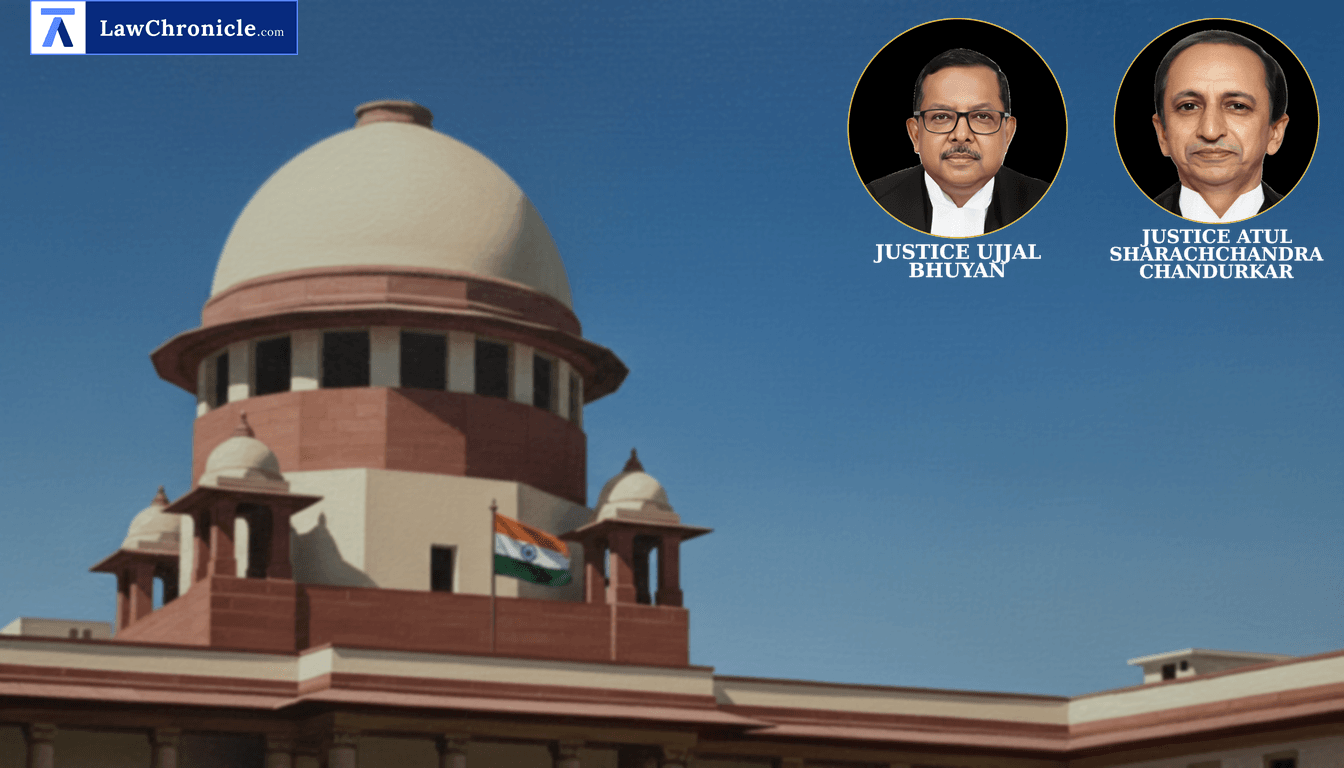
Drawing a firm line against executive overreach and arbitrary delays in recording formal arrests, the Supreme Court has ruled that the mandatory 24-hour limit to produce an arrestee before a magistrate under Article 22(2) of the Constitution of India, 1950 commences from the exact time of physical detention rather than the official time of arrest recorded on paper. A Bench of Justice Ujjal Bhuyan and Justice Atul S. Chandurkar delivered this landmark decision while allowing criminal appeals against a High Court order that had denied bail in an Narcotic Drugs And Psychotropic Substances Act, 1985 case.
Key Takeaways
Constitutional Timeline Triggers at Detention: The 24-hour countdown mandated under Article 22(2) begins the moment an individual's liberty is curtailed, rendering any formal post-facto arrest time irrelevant.
Rejection of 'Buffer Zones': The Court held that law enforcement agencies cannot create unconstitutional 'buffer zones' or 'investigative holds' under the guise of procedural formalities like search and seizure.
Mandatory Release for Over-custody: Failure to produce a detainee before a magistrate within 24 hours of actual physical restraint automatically invalidates the arrest and entitles the detainee to immediate release.
Magisterial Duty on Remand: Magistrates are explicitly bound to verify the true date and time of physical apprehension and decline remand if the custody exceeds 24 hours or is unreasonably prolonged.
Arrest and Detention vs 24-Hour Limit
The Supreme Court dismantled the prosecution's attempt to distinguish between 'detention' and 'arrest', holding that the constitutional text under Article 22(2) does not permit any temporary disruption of liberty dehors formal arrest. The Bench observed that "Clause (2) says that every person who is arrested and detained in custody shall be produced before the nearest magistrate within a period of 24 hours of such arrest excluding the time necessary for the journey from the place of arrest to the court of the magistrate and no such person shall not be detained in custody beyond the said period without the authority of the magistrate. The key expression appearing in clause (2) of Article 22 is ‘arrested and detained in custody’. What is the meaning of this expression? Does it mean that the two crucial words appearing in this expression, ‘arrest’ and ‘detain’, should be assigned separate meanings or they mean one and the same thing. It is important to note that the expression is conjunctive and not disjunctive... Any attempt to draw an artificial distinction between ‘arrest’ and ‘detention’ would dilute or negate the fundamental protection guaranteed by the Constitution under clause (2) of Article 22."
Therefore, highlighting the essence of 24-hour Arrest Rule, the Apex Court issued the following directions:
"(i) the 24 hours timeline as mandated under clause (2) of Article 22 of the Constitution of India would commence from the date and time of detention of the person detained when his liberty stands curtailed and not from the time of his formal arrest;
(ii) in the event, such detention continues beyond 24 hours before the person is produced before a magistrate, he shall be forthwith released from custody;
(iii) while computing the 24 hours deadline, no other time period is permitted to be excluded therefrom except the time necessary for the journey from the place of arrest to the court of the magistrate;
(iv) the decisions of the Orissa High Court in Aryaman Pattnayak, Madras High Court in Kannan and Kerala High Court in Arun K. Thomas do not lay down the correct law qua interpretation of clause (2) of Article 22 of the Constitution of India;
(v) the detaining authority should keep in mind not only the 24 hours deadline mandated by clause (2) of Article 22 of the Constitution but also ensure that such detention should not extend beyond a reasonable period within the 24 hours period considering the circumstances of the case in terms of Section 58 BNSS (Section 57 CrPC);
(vi) at the time of production, the magistrate is duty bound to record the actual date and time of detention of the person produced before him when his liberty stood curtailed and examine whether the 24 hours deadline has been complied with or not from the time of such detention. If there is breach of the 24 hours deadline, the concerned person shall be released forthwith from detention;
(vii) the magistrate shall also examine at the time of production whether the detention of the person produced, though is within the time frame of 24 hours, has exceeded the period which can be construed to be reasonable in the circumstances of the case. If he is satisfied that detention in custody has been for a longer period than what is reasonable, he may decline remand;
(viii) in so far the present case is concerned, for the reasons cited in paragraphs 65, 66 and 67 above, the detention of the appellants was not only in breach of clause (2) of Article 22 of the Constitution of India but was for a period beyond what can be construed to be a reasonable period considering all the circumstances of the case which was in contravention of Section 58 BNSS (Section 57 CrPC);
(ix) consequently, we set aside the impugned judgment and order of the High Court dated 29.04.2026 and direct that the appellants shall be produced before the jurisdictional Special Court within a maximum period of 7 days from today whereafter they shall be released on bail on such terms and conditions as may be deemed appropriate."
Ratio
The constitutional guarantee under Article 22(2) of the Constitution of India, 1950 is an inviolable fundamental right. The 24-hour limit within which an arrested person must be produced before a Judicial Magistrate runs strictly from the precise moment of physical apprehension or detention when personal liberty is restricted, and not from the subsequent timestamp of a formal arrest memo. No statutory procedure, investigative requirement, or pre-arrest formality under special enactments can exclude time from this 24-hour window, save for the journey time explicitly allowed by the Constitution.
Background
The appellants were intercepted by the Customs Division search team on September 29, 2025, at 02:00 PM, while transporting contraband in a truck. A preliminary search yielded psychotropic substances, leading to the registration of an Narcotic Drugs And Psychotropic Substances Act, 1985 case. A secondary search conducted at the Customs office concluded by 05:00 PM on the same day. However, the authorities formally recorded their arrest only at 11:00 AM/11:15 AM on September 30, 2025, and produced them before a magistrate at 04:45 PM that evening.
The High Court of Tripura dismissed their regular bail applications by placing reliance on State of Punjab versus Sukhwinder Singh @ Gora ( "2026 SCC Online SC 671": 2026 CaseBase(SC) 363), observing that the mandatory provisions of Section 37 of the Narcotic Drugs And Psychotropic Substances Act, 1985 override procedural lapses. Challenging this, the appellants contended that their physical liberty was curtailed at 02:00 PM on September 29, 2025, making their production before the Magistrate at 04:45 PM on September 30, 2025, a fatal violation of Article 22(2) of the Constitution of India, 1950 and Section 58 of the Bharatiya Nagarik Suraksha Sanhita, 2023 (Section 57 of the Code Of Criminal Procedure).
In analyzing the legal position, the Supreme Court relied on foundational precedents. It recalled Justice V.R. Krishna Iyer's decision in Niranjan Singh Vs. Prabhakar Rajaram Kharote ( "1980 2 SCC 559": 1980 CaseBase(SC) 281), which condemned 'informal custody' as an unfair evasion of law. The Court reaffirmed rulings in Khatri vs State of Bihar, D.K. Basu Vs. State of West Bengal, Directorate of Enforcement Vs. Subhash Sharma ( "2025 SCC Online SC 240": 2025 CaseBase(SC) 92), and Jaskaran Jeet Singh Deol Vs. State of Punjab ( "2026 SCC OnLine SC 1939": 2026 CaseBase(SC) 7015), establishing that constitutional breaches under Article 22(2) vitiate custody and override statutory bail bars under Section 37, as held in Union of India Vs. K.A. Najeeb ( "(2021) 3 SCC 713": 2021 CaseBase(SC) 830), Satender Kumar Antil Vs. CBI, Mohd. Muslim Vs. State (NCT of Delhi), Ankur Chadha Vs. State of Madya Pradesh, Vijay Singh Vs. Union of India ( "SLP(Crl.) D. No. 43071/2024": 2024 CaseBase(MP) 8011), and Syed Iftikhar Andrabi Vs. National Investigation Agency.
The Bench further noted decisions from the High Courts, approving Ashak Hussain Allah Detha @ Siddique Vs. Assistant Collector of Customs (P.), Bombay, T. Ramadevi Vs. State of Telangana, rep. by its Principal Secretary, Hanumant Jagganath Nazirkar Vs. State of Maharashtra, and Biswajit Mandal Vs. Inspector, Narcotics Control Bureau. Conversely, the Supreme Court overruled decisions in Arun K. Thomas Vs. Narcotics Control Bureau, Kannan Vs. State of Tamil Nadu, and Aryaman Pattnayak Vs. Union of India, rejecting their rationale that investigative holds under Section 67 of the Narcotic Drugs And Psychotropic Substances Act, 1985 or Rule 3 of the Narcotic Drugs and Psychotropic Substances (Seizure, Storage, Sampling and Disposal) Rules, 2022 create an investigative 'buffer zone' that pauses the 24-hour clock. The Court also discussed Directorate of Enforcement Vs. Deepak Mahajan ( "(1994) 3 SCC 440": 1994 CaseBase(SC) 1084) regarding custody concepts, Najmunisha Vs. State of Gujarat concerning statutory powers, Sakal Papers (P) Ltd. Vs. Union of India, M. Nagraj Vs. Union of India ( "(2006) 8 SCC 212": 2006 CaseBase(SC) 359), IR Coelho Vs. State of Tamil Nadu, and Dr. Jaishri Laxmanrao Patil Vs. Chief Minister ( "(2021) 8 SCC 1": 2021 CaseBase(SC) 331) on broad constitutional interpretation, and Shafhi Mohammad Vs. State of Himachal Pradesh ( "(2018) 5 SCC 311": 2018 CaseBase(SC) 1100) and Paramvir Singh Saini Vs. Baljeet Singh regarding safeguards against custodial abuse.
Holding that an unexplained 18-hour gap between search completion and formal arrest violated reasonable detention mandates under Section 58 of the Bharatiya Nagarik Suraksha Sanhita, 2023 and Article 22(2) of the Constitution of India, 1950, the Supreme Court set aside the High Court order and granted bail to the appellants.
Case Details:
Case No.: Criminal Appeal Nos. of 2026 (Arising out of SLP (Crl.) Nos. 12451-12453 of 2026)
Neutral Citation: 2026 INSC 1195
Case Title: Sri Sujit Das and Ors. Etc. v. Union of India
Appearances:
For the Petitioner(s): Mr. Rouf Rahim, Senior Advocate
For the Respondent(s): Mr. Raghavendra P. Shankar, Additional Solicitor General of India
Source: 2026 CaseBase(SC) 9532
 Breaking News