


Absence of Premeditation in 'Free Fight' Grounds Bail for Murder Accused: Madras HC
 Copy Link
 Share
 Save
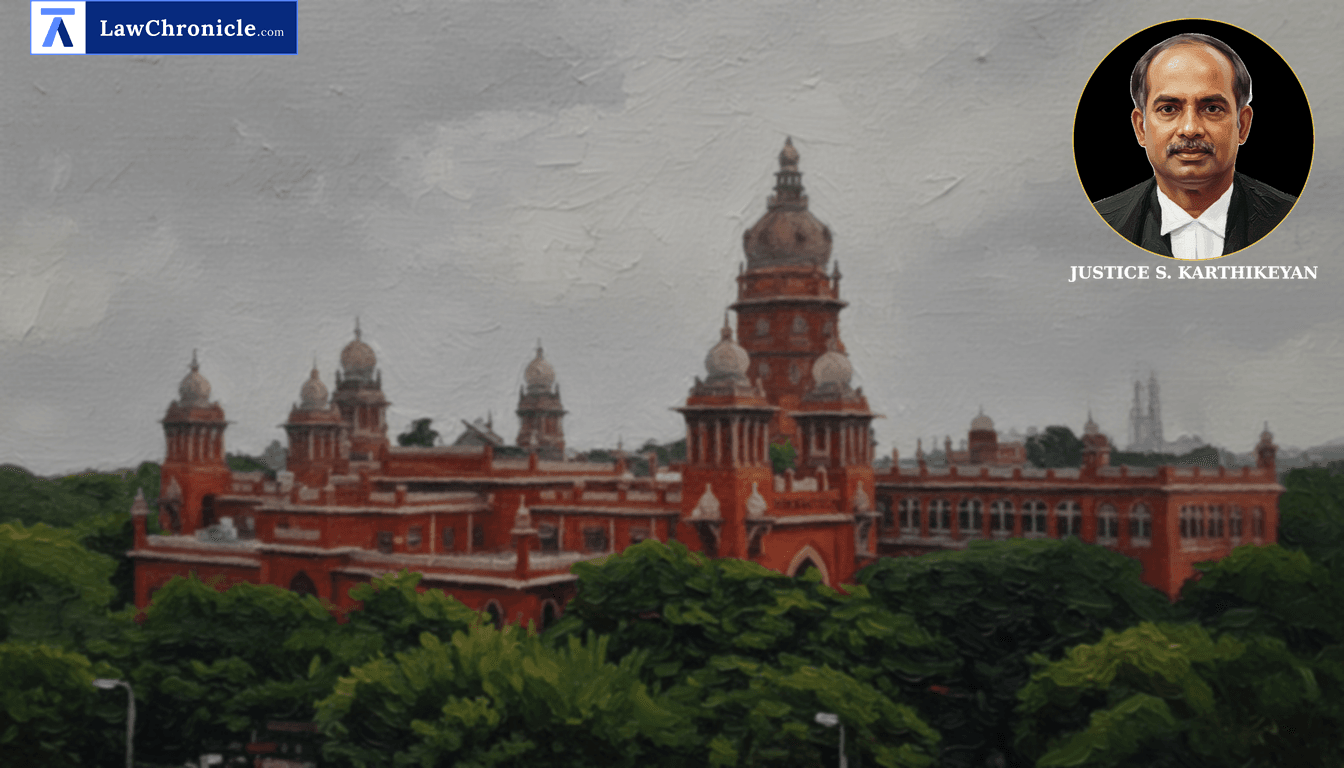
The Madras High Court has underscored the distinction between premeditated murder and fatalities resulting from spontaneous scuffles, granting bail to an accused held for seven months despite being labeled a 'history sheeter'.
In a single-judge bench proceeding, Justice S. Karthikeyan adjudicated upon a criminal appeal challenging the denial of bail by a Special Court. The appellant, accused of murder and atrocities against member of SC/ST community, sought release on the grounds that the incident was a sudden reaction in private defense without any prior malice.
Key Takeaways
Premeditation as a Bail Factor
Courts will closely examine the presence of a 'motive' or 'premeditation' in violent crimes to determine if the incident was a 'free fight' rather than a planned execution.
Trial Delay Overrides Criminal Antecedents
Even if an accused is classified as a history sheeter, a lack of progress in framing charges after seven months of custody can weigh in favor of granting liberty.
Statutory Compliance in Bail Appeals
Strict adherence to procedural requirements under the SC/ST (Prevention of Atrocities) Act, 1989 is mandatory, including victim notification and hearing of the prosecution's objections.
Court Observations and Directions
While the prosecution argued that the appellant was a habitual offender who attacked the deceased with a stone, the Madras High Court observed that the scuffle originated because the deceased had allegedly taken money from the appellant's pocket. The Bench noted that the investigation was already complete and the final report filed, yet the trial had not progressed to the stage of framing charges.
Ratio
Where an incident of homicide appears to be the result of a spontaneous scuffle or a 'free fight' without prior motive or premeditation, and where the investigation is complete but the trial is not imminent, the accused is entitled to bail under Section 439 of the Code of Criminal Procedure (now Section 483 of BNS, 2023), notwithstanding criminal antecedents, provided stringent conditions are imposed to ensure appearance and prevent tampering.
Background
The dispute arose on February 6, 2026, when the appellant allegedly attacked the deceased with a stone following a confrontation over stolen money. Consequently, an FIR was registered under Section 103(1) of the BNS, 2023 and Section 3(2)(v) of the SC/ST (Prevention of Atrocities) Act, 1989. The appellant moved the Special Court under the SC/ST (Prevention of Atrocities) Act, 1989, Dindigul, for bail, which was rejected via order dated June 2, 2026.
In the appeal before the Madras High Court, the appellant’s counsel argued that the act was committed in private defense and that continued detention served no purpose as the final report was already on file. The Government Advocate opposed the plea, highlighting that the appellant was a 'History Sheeter' with two previous cases. However, the Madras High Court, exercising its jurisdiction under Section 14-A(2) of the SC/ST (Prevention of Atrocities) Act, 1989, set aside the lower court's order and enlarged the appellant on bail, citing the lack of premeditation and the delay in framing charges.
Case Details:
Case No.: Crl. A(MD)No.1096 of 2026
Case Title: Sony @ Anadhraj Vs. The State of Tamil Nadu and others
Appearances:
For the Petitioner(s): Dr.R.Alagumani
For the Respondent(s): Mr. G.Ganesh Kumar, Government Advocate (Crl. Side)
Source: 2026 CaseBase(MAD) 23822




 Breaking News


