Absence of Recovery or Delay Can't Be Ground to Quash Corruption FIR: SC
 Copy Link
 Share
Share Save
Save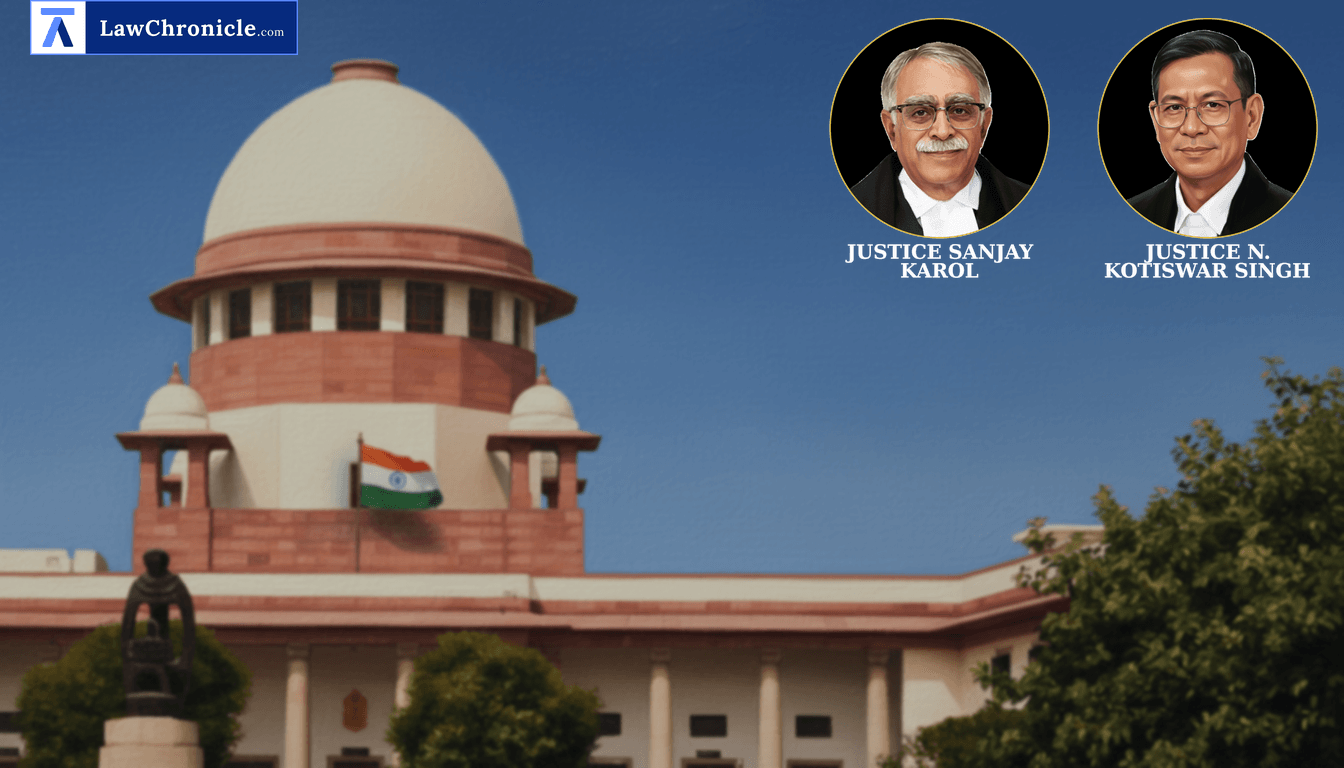
High Courts must exercise utmost caution and maintain a hands-off approach before nipping corruption investigations in the bud under the guise of exercising inherent powers. The Supreme Court has declared that absence of direct illegal gratification recovery or delay in lodging complaints cannot constitute valid grounds to quash a corruption FIR at the threshold stage.
A bench comprising Justice Sanjay Karol and Justice Nongmeikapam Kotiswar Singh set aside a common judgment of the High Court of Karnataka which had quashed multiple FIRs registered against police officials accused of corruption and extortion. The High Court had interdicted the investigation primarily citing delay in registration, lack of direct demand or recovery, and alleged departmental infighting. Reversing this approach, the apex court clarified that such factual defenses pertain strictly to the domain of trial or discharge proceedings, not Section 482 of the Code of Criminal Procedure, 1973.
High Court Cannot Conduct Mini-Trial At Investigation Stage
The Supreme Court underscored that the quashing jurisdiction under Section 482 of the Code of Criminal Procedure, 1973 is an extraordinary power to be exercised sparingly. The threshold inquiry must strictly be confined to whether the uncontradicted allegations in the FIR prima facie disclose a cognizable offence, rather than evaluating investigative material or weighing evidence.
The Court, in its reasoning, observed: "...the High Court vide the impugned orders has traversed beyond the contours of consideration of a petition under Section 482, CrPC. There were two material aspects which weighed with the High Court, the delay in lodging of the FIR and no evidence of demand/recovery of money. In our view, there cannot be any doubt that these aspects would have to be established through evidence in the criminal trial or may warrant consideration for discharge. Absence of proof as to demand of illegal gratification and recovery thereof, may become a ground for discharge and/or ultimate acquittal in the trial; however, they cannot become grounds for quashing of the FIR."
Tracing the settled precedents in State of Haryana v. Bhajan Lal and State v. K. Rangayya, the Court reiterated that actual receipt or physical exchange of a bribe is not an essential prerequisite to launch a prosecution under Section 7 of the Prevention of Corruption Act, 1988. Solicitation or an implicit direction to provide illegal gratification to subordinates squarely constitutes an attempt to obtain undue advantage. Furthermore, relying on Punit Beriwala v. State of NCT of Delhi and Ors. ( "2025 SCC OnLine SC 983": 2025 CaseBase(SC) 871), the Court held that mere delay in lodging an FIR for serious offences punishable with over three years of imprisonment cannot interdict a criminal investigation, as the plausibility of explanation for delay is a matter of trial.
Rejecting the High Court's finding that subsequent FIRs amounted to impermissible second FIRs, the Supreme Court referred to State of Rajasthan v. Surendra Singh Rathore ( "2025 SCC OnLine SC 358": 2025 CaseBase(SC) 313), noting that separate FIRs covering a wider systemic probe into departmental corruption cannot be shut down simply because earlier individual complaints existed under the Indian Penal Code, 1860. Citing State of Chhattisgarh v. Aman Kumar Singh, the bench stressed that constitutional courts owe a duty to show zero tolerance to corruption and permit investigations to reach their logical conclusion.
The Court has following directions:
"...the present appeals are allowed. The common judgment and orders dated 08.08.2021, passed by the High Court of Karnataka in Criminal Petition No. 2470/2020 connected with Criminal Petition No. 2473/2020 and Criminal Petition No. 2485/2020; Criminal Petition No. 3297/2020 connected with Criminal Petition No. 488/2021; Criminal Petition No. 2390/2020 and Criminal Petition No. 2389/2020 are hereby set aside. Needless to add, the respondents are free to exercise their remedies in accordance with law, and the same shall be decided uninfluenced of the observations made hereinabove."
Key Takeaways
• High Courts Barred From Pre-Trial Mini-Trials: Assessing evidence, trap test outcomes, or lack of direct recovery at the FIR stage exceeds Section 482 Code of Criminal Procedure, 1973 jurisdiction.
• Absence Of Physical Recovery Not Fatal To Corruption FIR: Lack of immediate recovery or direct money exchange is a ground for discharge or trial acquittal, not threshold quashing under Prevention of Corruption Act, 1988.
• Delay Is Subject To Evidence Evaluation: Procedural delay in registering complaints cannot derail investigation into serious offences carrying sentences above three years.
• Zero Tolerance Policy In Corruption Probes: Courts must maintain a hands-off approach and permit public corruption investigations to reach their logical conclusion.
Ratio
Under Section 482 of the Code of Criminal Procedure, 1973, an FIR disclosing a cognizable offence under the Prevention of Corruption Act, 1988 cannot be quashed on grounds of delay or lack of direct recovery/proof of demand, as these constitute evidentiary defences reserved exclusively for trial or discharge proceedings.
Background:
The case stems from six separate FIRs registered by the Anti-Corruption Bureau and private complainants against serving police officers, alleging offences under Sections 7(a), 13(1)(a) read with 13(2) of the Prevention of Corruption Act, 1988, as well as Section 384 read with Section 34 of the Indian Penal Code, 1860. The accused officers approached the High Court of Karnataka under Section 482 of the Code of Criminal Procedure, 1973 seeking to quash the criminal proceedings.
The High Court allowed the criminal petitions and quashed all FIRs, attributing the complaints to departmental infighting, mala fides, lack of direct demand/recovery, and unexplained delay. The State of Karnataka appealed these orders before the Supreme Court, contending that the High Court exceeded its jurisdiction by evaluating evidence prematurely. Reversing the High Court's findings, the Supreme Court allowed the State's appeals and restored the FIRs for investigation.
Case Details:
Case No.: Criminal Appeal No.(s) ____ of 2026 (Arising out of SLP (Crl.) No(s). 1522 of 2022)
NeutralCitation: 2026 INSC 766
Case Title: State of Karnataka & Anr. v. Prabhu Shankar & Anr.
Appearances:
For the Petitioner(s): Mr. Prateek Chadha, Learned AAG
Source: 2026 CaseBase(SC) 703
 Breaking News