


Absence Of Specific Allegations In Chargesheet Warrant Quashing Of FIR: SC
 Copy Link
 Share
 Save
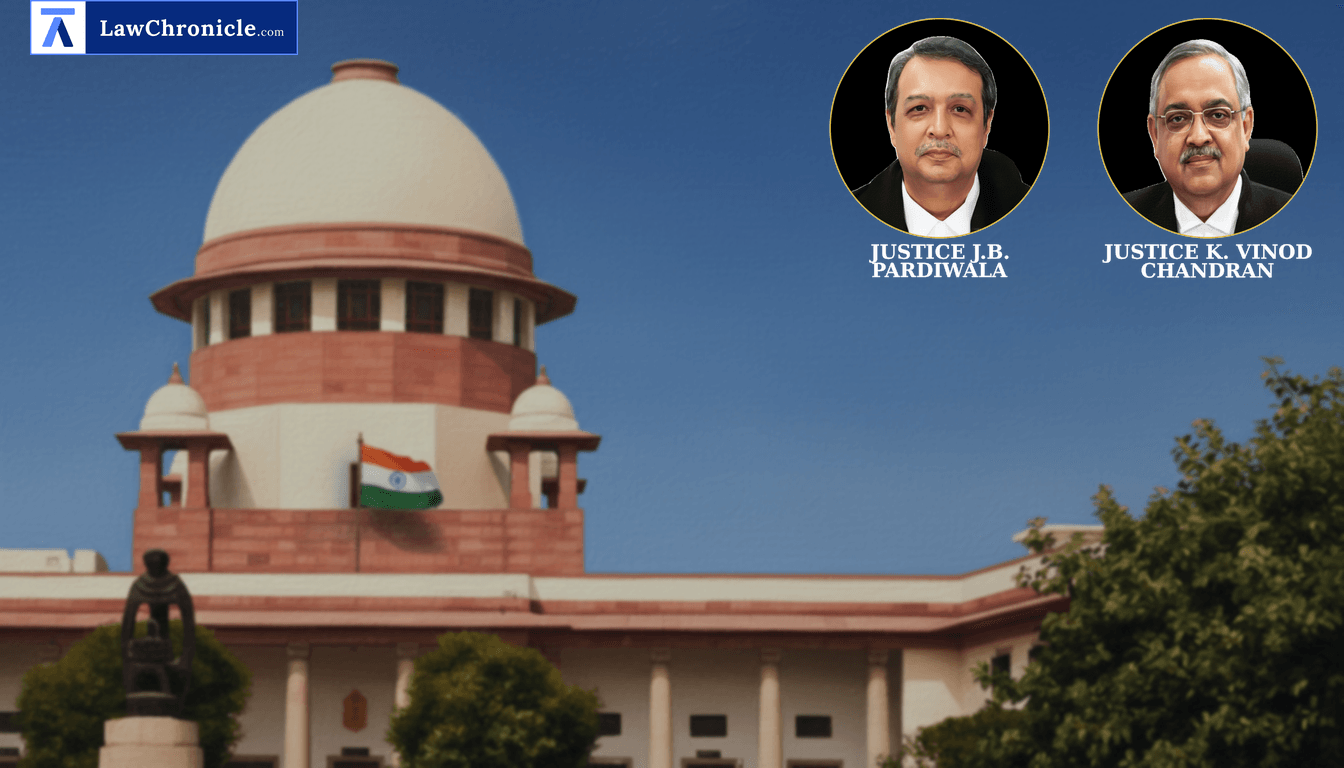
The Supreme Court has quashed criminal proceedings against a Central Government employee, highlighting that an abrupt inclusion of an accused in a chargesheet without specific allegations constitutes an unsustainable prosecution. Emphasizing the limits of criminal process, the Court held that vague assertions in an FIR cannot be permitted to drag individuals into prolonged trials.
A bench comprising Justice J.B. Pardiwala and Justice K. Vinod Chandran allowed the appeal against the High Court judgment that had refused to quash the chargesheet under Section 482 of the Code of Criminal Procedure, 1973.
Key Takeaways
Protection Against Vague Prosecution: Procedural safeguards mandate that a chargesheet must disclose specific criminal acts rather than making abrupt assertions of guilt.
Limits of Section 482 Relief: High Courts must intervene to quash proceedings when an FIR and chargesheet fail to disclose any specific prima facie case against an accused.
Delay in Filing FIR: Delayed registration of complaints by legally trained individuals without adequate explanation raises doubts on the sustainability of allegations.
The Supreme Court observed that the voluminous chargesheet produced on record failed to level any specific factual allegation against the appellant. The Court noted that the investigation primarily focused on another accused, yet abruptly concluded that a prima facie case was established against the appellant under Sections 506 and 509 read with Section 34 of the Indian Penal Code, 1860.
The Court has the following directions:
"We, hence, direct that the proceedings initiated pursuant to FIR No.78 of 2023 dated 04.05.2023 in the Howrah Police Station, leading to the Chargesheet No.191 of 2023 dated 31.10.2023, shall stand set aside. The FIR and the charge sheet shall stand quashed. There shall be no criminal proceeding continued in pursuance of the chargesheet, against the appellant herein."
The Court, in its reasoning, observed: "Having gone through the FIR and the chargesheet, we are of the opinion that there is absolutely no reason to permit the continuance of the proceedings against the appellant herein."
Ratio
Where the allegations in the FIR and the final report, even if taken at face value, do not disclose the commission of any specific offence against an accused, permitting the continuation of criminal proceedings amounts to an abuse of the process of law, warranting quashing under Section 482 of the Code of Criminal Procedure, 1973.
Background
The matter originated from an FIR registered at Howrah Police Station by a practicing advocate against her client (the third respondent), the third respondent's father, and the appellant, who is a Central Government employee. The complainant alleged fee disputes amounting to Rs. 10,00,000 with the third respondent and further claimed that the appellant telephonically intimidated her to withdraw the fee demand.
Although the alleged incident of ransacking and assault occurred on April 29, 2023, the FIR was lodged only on May 4, 2023. Following the filing of Chargesheet No. 191 of 2023, the appellant approached the High Court under Section 482 of the Code of Criminal Procedure, 1973 to quash the proceedings. The High Court rejected the application, observing that the appellant should seek remedies before the trial court since a chargesheet had already been submitted.
Reversing the High Court's stance, the Supreme Court noted that the allegations were primarily directed at the third respondent regarding unpaid professional fees and that the chargesheet contained no specific material substantiating the involvement of the appellant. Consequently, the Supreme Court allowed the appeal and set aside the proceedings against the appellant.
Case Details:
Case No.: Criminal Appeal No.3892 of 2026
Neutral Citation: 2026 INSC 877
Case Title: Kanad Saha v. The State of West Bengal and Ors.
Appearances:
For the Petitioner(s): Sri S.B. Upadhyay, Senior Counsel
For the Respondent(s): Respondent No. 2 (In-person)
Source: 2026 CaseBase(SC) 917
Similar Articles



 Breaking News


