Admission of Signature on Blank Cheque Sufficient to Trigger Legal Presumption: Himachal Pradesh HC
 Copy Link
 Share
Share Save
Save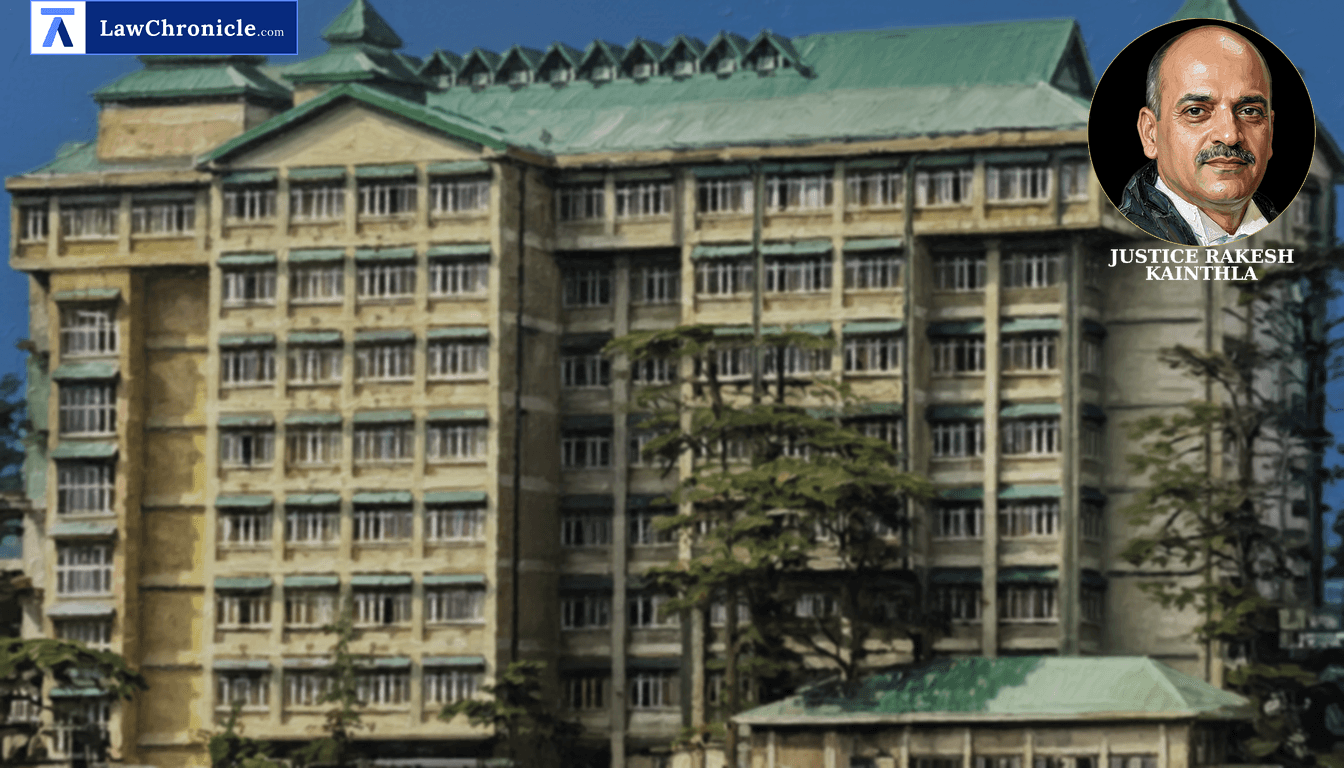
The High Court of Himachal Pradesh has reinforced the stringent legal framework governing cheque dishonour, ruling that a drawer's admission of their signature on a blank cheque is sufficient to trigger a statutory presumption of liability that the accused must affirmatively rebut. The Court dismissed a revision petition challenging concurrent convictions, emphasizing that the penal provisions of the Negotiable Instruments Act, 1881 are designed to infuse credibility into commercial transactions and deter the callous issuance of negotiable instruments.
A Single Judge Bench of Hon’ble Mr. Justice Rakesh Kainthla presided over the revision petition. The Court was tasked with determining the legality and propriety of a judgment passed by the Additional Sessions Judge (CBI Court), Shimla, which had upheld the conviction of the petitioner under Section 138 of the Negotiable Instruments Act, 1881. The petitioner had challenged the findings on the grounds of evidence misappreciation and the alleged premature nature of the complaint.
Key Takeaways
Presumption Triggers on Signature Admission
Once a drawer admits to signing a cheque, even if it is claimed to be a 'blank' instrument, the burden of proof immediately shifts to the accused under Section 139 of the Negotiable Instruments Act, 1881.
Limited Revisional Jurisdiction
Revisional courts cannot act as appellate courts to re-appreciate evidence unless there is a glaring perversity or jurisdictional error in the lower court's findings.
Deterrent Nature of NI Act
Section 138 is a deterrent provision intended to ensure trust in cheques; courts are encouraged to levy fines that reflect both the punitive and compensatory nature of the law.
Financial Capacity Proof Not Mandatory Initially
Complainants are not required to prove their financial capacity or provide detailed transaction records at the threshold unless a specific challenge is raised by the accused during the trial.
Legal Framework and Judicial Observations
The Court observed that the petitioner had admitted to issuing the cheque and signing it, though he claimed it was a blank cheque given for a smaller liability. Referring to the precedent in Rajesh Jain v. Ajay Singh ( "(2023) 10 SCC 148": 2023 CaseBase(SC) 1056), the Court noted that the presumptive device under Section 139 of the Negotiable Instruments Act, 1881 transfers the evidential burden to the accused to prove the absence of liability.
The Court, in its reasoning, observed: "As soon as the complainant discharges the burden to prove that the instrument was executed by the drawer, the rules of presumption under Sections 118 and 139 of the Negotiable Instruments Act, 1881 help him and shift the burden of rebutting the said presumptions upon the said drawer. Since these presumptions are rebuttable, the accused has the burden of disproving the same by leading evidence, either direct or indirect, to the effect that there did not exist any consideration or debt or that the non-existence of the said debt or consideration is so probable that a prudent man ought to suppose that no consideration or debt existed."
On the issue of the revisional scope, the Court cited Kuntegowda v. Thurubaiah ( "2026 SCC OnLine SC 1485": 2026 CaseBase(SC) 721) and Sanjabij Tari v. Kishore S. Borcar ( "2025 SCC OnLine SC 2069": 2025 CaseBase(SC) 746), affirming that the High Court should refrain from substituting its own conclusions on facts when two lower courts have reached consistent findings. The Court also rejected the argument that the complainant failed to produce account books, citing Uttam Ram v. Devinder Singh Hudan ( "(2019) 10 SCC 287": 2019 CaseBase(SC) 2895) and Ashok Singh v. State of U.P. to establish that the statutory presumption obviates the initial requirement to prove the underlying debt in a manner similar to a civil suit.
Adequacy of Sentence and Compensation
Regarding the sentencing, the Court referred to Bir Singh v. Mukesh Kumar ( "(2019) 4 SCC 197": 2019 CaseBase(SC) 1292), noting that the object of Section 138 is to promote the use of negotiable instruments in financial transactions. It further applied the principles from Kalamani Tex v. P. Balasubramanian ( "(2021) 5 SCC 283": 2021 CaseBase(SC) 788) to uphold the compensation awarded, noting that courts should uniformly levy fines to compensate for the loss of interest and legal expenses incurred by the complainant.
The Court has following directions:
"In view of the above, the present revision fails, and it is dismissed. All the pending applications, if any, also stand disposed of. A copy of the judgment, along with records of the learned Courts below, be sent back forthwith."
Ratio
In proceedings under Section 138 of the Negotiable Instruments Act, 1881, the admission of the signature on a cheque by the drawer regardless of whether the contents were filled by them triggers the statutory presumptions under Sections 118(a) and 139. The burden then lies entirely on the accused to rebut these presumptions through probable evidence. Revisional courts lack the jurisdiction to re-evaluate oral or documentary evidence to upset concurrent factual findings unless a jurisdictional error or gross miscarriage of justice is evident.
Background
The dispute arose when the complainant, Sanjay Sood, proprietor of 'Super Treads', filed a complaint alleging that the accused (petitioner) had issued a cheque for ₹1,26,600 towards the purchase and retreading of bus tyres. The cheque was returned by UCO Bank with the remark 'funds insufficient'. Despite a legal notice, the accused failed to make the payment.
The accused admitted his signatures on the cheque but contended that his liability was only ₹14,000 and that he had handed over a blank cheque which was subsequently misused. He also argued that the complaint was premature and that there was no evidence linking the complainant to the firm 'Super Treads'. Both the Trial Court and the Appellate Court rejected these contentions, convicting the accused and sentencing him to three months of simple imprisonment and a fine of ₹1,75,000. The High Court, finding no perversity in the lower courts' reasoning, upheld the conviction.
Case Details:
Case No.: Cr. Revision No. 649 of 2025
Neutral Citation: 2026:HHC:41037
Case Title: Sanjay Dhiman vs. Super Treads & anr.
Appearances:
For the Petitioner(s): Mr. Mohn Singh, Advocate
For the Respondent No.1: Mr. Bhairav Gupta, Advocate
For the Respondent No.2-State: Mr. Jitender Sharma, Additional Advocate General
Source: 2026 CaseBase(HP) 8462
 Breaking News