Advocates, Not Law Students – A line drawn by Supreme Court for BCI
 Copy Link
 Share
Share Save
Save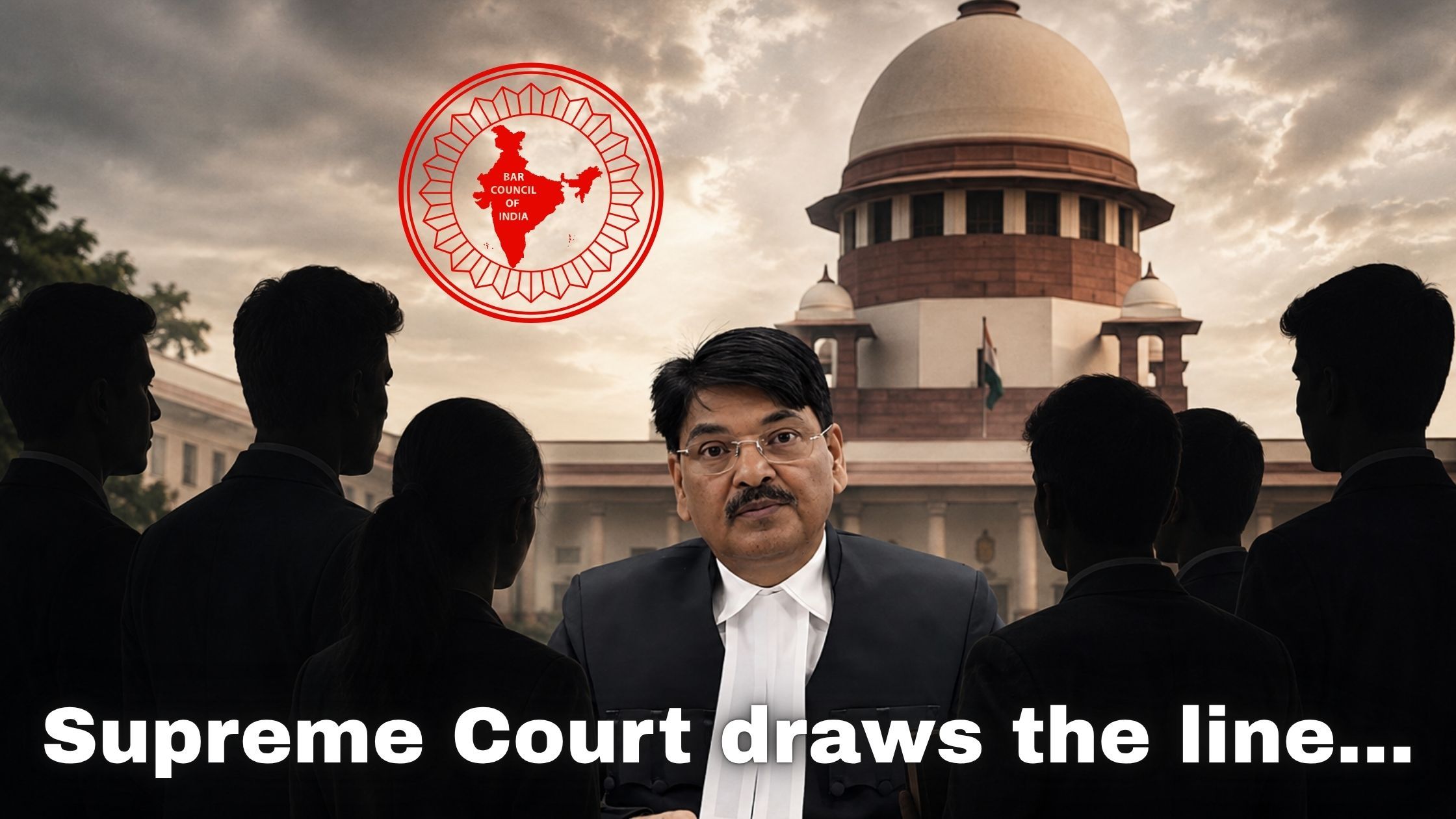
The Supreme Court on Thursday put a significant end to the controversy involving BCI Chairman and NALSAR. A three-judge Bench of Chief Justice Surya Kant, Justice Joymalya Bagchi and Justice V. Mohana held that neither the BCI nor any State Bar Council has the statutory power to take disciplinary action against law students before they are enrolled as advocates.
The Apex Court made its earlier interim protection absolute. The Bench held the communications issued by the BCI on August 13, as well as subsequent modified communications, to be “without any authority of law.” In the words of the Court, “The Advocates Act, 1961 does not confer any express or implied power upon the BCI or any State Bar Council to take any disciplinary action against the students of law.”
The Court further clarified that disciplinary authority over law students rests with their parent institution or an authority empowered under its regulations or bye-laws, rather than the statutory bodies governing advocates.
Supreme Court on BCI’s Powers
The Supreme Court drew a clear statutory line between a law student and an enrolled advocate. According to the Bench, the disciplinary jurisdiction of the Bar Councils under the Advocates Act is triggered after a law graduate is registered as an advocate. Until then, questions of student discipline fall within the domain of the educational institution.
The Court therefore declared:
“We declare all communications dt. 13 Aug or subsequent modified communication to be without any authority of law. Interim directions made absolute.”
The ruling came in Mihira Sood v. Bar Council of India (W.P.(C) No. 1040/2026), a petition filed by NALSAR alumni Mihira Sood and Abhishek Tiwari challenging the BCI Chairman's August 13 directions.
The NALSAR Controversy: Where it all Started
The Supreme Court's order brings judicial closure to a controversy that had already seen a remarkable reversal by the BCI. On August 13, the BCI had directed State Bar Councils not to enrol NALSAR's 2026 law graduates until further orders and sought a factual report concerning a student campaign over the proposed participation of CJI Surya Kant as chief guest at the university's convocation. The communication was withdrawn within hours following widespread criticism. A subsequent communication reversed the blanket restriction on enrolment, although the BCI continued to seek information concerning those allegedly involved in organizing the campaign.
The Supreme Court had, meanwhile, granted interim protection against any punitive action against NALSAR students by the BCI or State Bar Councils. That interim protection has now been made absolute.
Why today's order matters beyond NALSAR
Although the immediate controversy concerned NALSAR, the Supreme Court's declaration goes beyond the individual episode. The Court has once and for all delineated the limits of the BCI's regulatory jurisdiction over students of law. The fact that the BCI regulates the legal profession and prescribes standards relating to legal education does not, by itself, give it disciplinary jurisdiction over students who have not yet entered the profession. In other words, the BCI may regulate the profession and examine statutory requirements at the stage of enrolment, but it cannot pre-emptively punish a student for conduct while that person remains a student.
As the Court indicated during the proceedings, once a law graduate seeks enrolment, the Bar Council of India may examine whether the statutory conditions for enrolment are satisfied. But disciplinary control over the person's life as a student remains with the university or the competent institutional authority.
 Breaking News