AI Hallucinations in Law: When Courts Err
 Copy Link
 Share
Share Save
Save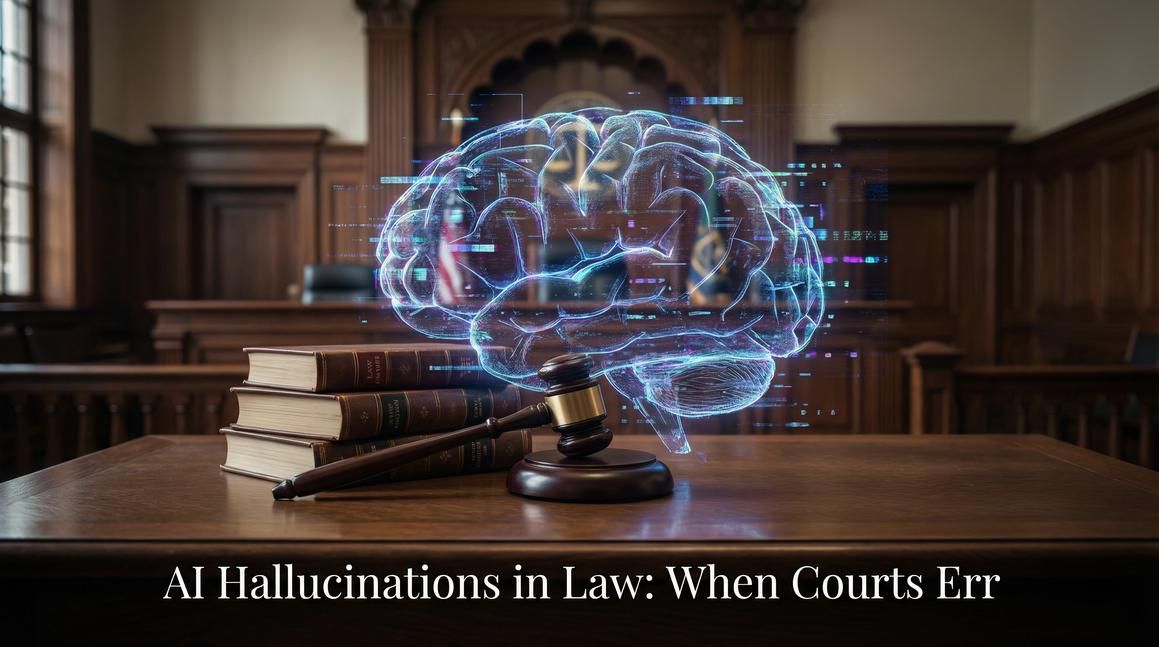
Cannot say it was the most recent, but an unmissable example of AI hallucinations being discussed in the Supreme Court last week. It is funny when Artificial Intelligence picks casual information, efficient when it does tricky tasks within seconds, but extremely risky when it comes to AI Hallucinations in Law. More particularly, when the Courts skip scrutiny of pleadings and references, it is a matter of concern, as picked by the Apex Court.
Let us scan through the disadvantages of AI in law when Courts end up erring, and the feasible ways out.
AI Hallucinations in Court
As mentioned earlier, the Supreme Court recently raised its brows on adjudication, being a byproduct of hallucination. It was an injunction suit titled Gummadi Usha Rani vs Sure Mallikarjuna Rao, decided on merits of the case. However, the Apex Court in order dated 27th February, 2026 took cognizance of the Trial Court deploying “AI generated non-existing, fake or synthetic alleged judgments”.
While details of the case are discussed below and will keep coming, it is important to understand how Artificial Intelligence can make or break the image of Legal Professionals. When an AI tool hallucinates, it aims at bringing results for the users, often non-existent or unauthenticated ones. Black letters of law, when incorrectly interpreted, weaken the advocate’s arguments, and distract the decision making for judges. There is no scope for errors in the Courts.
AI Cases in Court
Indian Legal System primarily extends the law-making powers to the Legislature. To fill in the gaps during implementation, the Supreme Court and High Courts are also empowered to make laws. That is how case laws become laws followed by the stakeholders as an authority and can be dynamic law changing as per the needs of the evolving society. Speaking of case authority, it plays a vital role in adjudication. As highlighted by the Supreme Court in the case being discussed on Artificial Intelligence hallucinations, the following cases were relied upon by the Trial Court:
- Subramani v. M. Natarajan (2013) 14 SCC 95,
- Chidambaram Pillai v. SAL Ramasamy (1071) 2 SCC 68,
- Lakshmi Devi v. K. Prabha (2006) 5 SCC 551 and
- Gajanan v. Ramdas (2015) 6 SCC 223.
As can be seen, there are case titles and even citations given to it. Hence, if these cases are found to be genuine, existing, being authoritative in law, then there is no issue. However, if these are actually an outcome of AI hallucinations, then it’s all trouble. A wrong case law means an erroneous legal text, which lays incorrect precedent and in turn, a question mark upon justice. The episode is not just technological overreach, but fiction seeping through judicial records, under the garb of precedents.
This is not the first time that AI cases in Court is a topic of discussion. Those who are involved in legal research and have tried some Artificial Intelligence tools for legal research to scrutinize are already aware of the context. Such cases are random and need to be scrutinized by the researcher for authenticity and correctness.
Institutional Accountability of Courts
The Supreme Court, having taken cognizance of the matter, seeks to examine the consequences and accountability of AI hallucinations in adjudication, acknowledging that it has a direct bearing on integrity of adjudicatory process. The Apex Court at the outset declared that Courts deciding a matter relying on allegedly non-existent and fake judgments is not a decision-making error. In plain words, the Apex Court termed it a “misconduct” for which legal consequences would follow. Now that the Court has already taken cognizance of the matter, notices have been issued to the Attorney General, Solicitor General and the Bar Council of India.
It is now all the more interesting to see how the Supreme Court deals with the matter, to assess the genuineness of alleged AI generated cases. On the other hand, if those cases are a result of AI hallucinations, then how the Apex Court delineates the use of AI in Courts, by Judges, Advocates, and Legal Researchers. Since the Court mimicked the legal consequences of misconduct, let’s await the same to assess how AI hallucinations in law will be tackled in future.
AI Hallucinations in Law: Expected Way Forward
Since the matter is already in the hands of the Supreme Court of India, some sort of clarity regarding the use of AI in Courts is expected. It can be the mandatory disclosure of AI-use in pleadings by the advocates. As reflected in a Madras High Court order, judicial training modules on AI tools seems to be just a matter of time. The Bar Council may come up with ethical guidelines on its usage to avoid AI Hallucinations in law and Courts. The most awaited aspect is how the Apex Court deals with similar instances and how the approach is streamlined for tackling AI in Courts.
 Breaking News