Inside Allahabad HC Split Verdict on 2-Year Ban on Bulldozer Justice
 Copy Link
 Share
Share Save
Save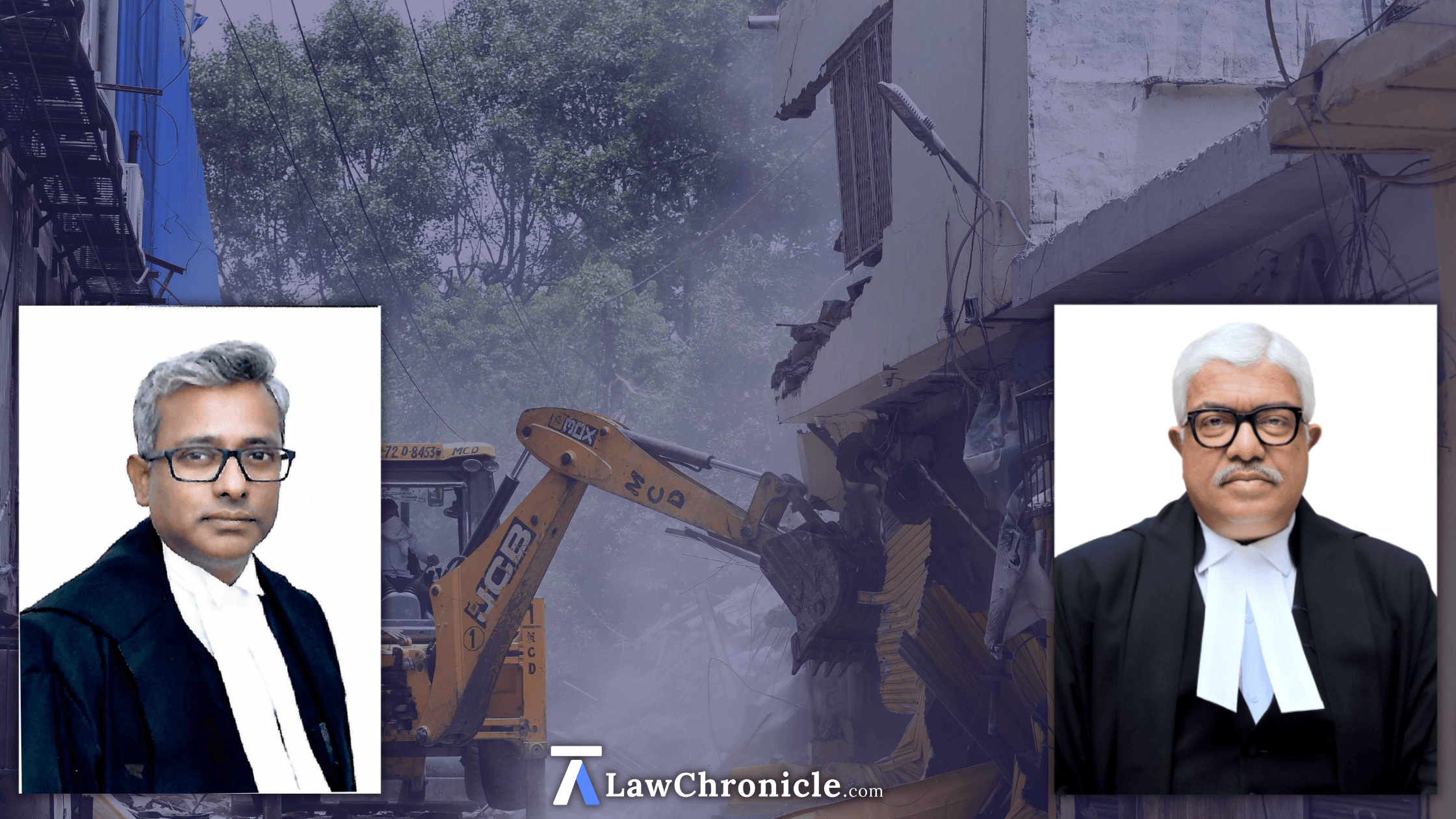
Allahabad High Court Division Bench of Justice Atul Sreedharan and Justice Siddharth Nandan has delivered a split verdict in Faimuddeen v. State of U.P. (20th July, 2026). While deciding bulldozer justice, the two judges disagreed on whether the Court can impose a two-year moratorium on demolition of the dwelling places of persons accused of crime. The matter has been referred to a third judge under Chapter VIII Rule 3 of the Allahabad High Court Rules.
Explore the opinions of the two Allahabad High Court Judges on 2-year ban on bulldozer action by the State.
Background of the Case
The petitioners: a son, father and mother, residents of District Hamirpur claimed ownership of a residential house purchased through sale deeds executed between 2001 and 2009, along with a commercial lodge named "Indian Lodge" and a saw mill.
An FIR was registered against a relative of the petitioners, under provisions of the Bharatiya Nyaya Sanhita (BNS), the Information Technology Act, the POCSO Act, and the U.P. Prohibition of Unlawful Religious Conversion Act. During the pendency of the petition, one of the resident petitioners was also made a co-accused. The petitioners alleged that immediately after the FIR, the authorities issued notices concerning their residential house, sealed the "Indian Lodge," and sealed the saw mill, and apprehended further demolition action, popularly referred to as bulldozer action.
The State disputed the petition as premature and denied that the residence and lodge had been sealed. It stated that the saw mill was sealed by the Forest Department after prohibited wood was recovered from its premises, and that its licence had lapsed. It further was submitted for the State that "Indian Lodge" was constructed on Irrigation Department land and was itself the scene of the alleged crime.
Justice Atul Sreedharan's Opinion
Writing the lead opinion, Justice Atul Sreedharan examined the Supreme Court's ruling In re: Directions in the Matter of Demolition of Structures (2024 CaseBase(SC) 957). The case is referred to as the "bulldozer case," along with Rajendra Kumar Barjatya and Another v. U.P. Avas Evam Vikas Parishad (2024 CaseBase(SC) 761) and Zulfiquar Haider and Another v. State of Uttar Pradesh (2025 CaseBase(SC) 1027). Justice Atul Sreedharan also touched upon the right to shelter and livelihood as facets of Article 21, referring to Olga Tellis v. Bombay Municipal Corporation (1985 CaseBase(SC) 275), Chameli Singh v. State of U.P. (1995 CaseBase(SC) 924), and Shiv Sagar Tiwari v. Union of India (1996 CaseBase(SC) 2010).
Justice Sreedharan held that demolishing the dwelling place of a person accused of an offence, immediately following registration of an FIR, on the pretext of violation of municipal law, amounts to a "Retributive Exercise of Executive Discretion". The Court termed it as a species of colourable exercise of executive discretion.
Justice Atul Sreedharan gave the following directions favouring 2-year ban on bulldozer justice:
- No dwelling place of an accused person may be demolished for a period of two years from the date of registration of the FIR, except where removal is required for a proven public purpose and is not restricted to the accused's structure alone.
- Where an occupant has stayed in an illegal structure for three years or more, the authority must issue one year's advance intimation before initiating proceedings under municipal law, subject to waiver in cases of "compelling urgency" of larger public need.
- Notices for construction-norm violations shall be valid only if simultaneous proceedings under the Prevention of Corruption Act, 1988, are also initiated against erring officers, to be concluded within six months.
- Demolition action must not target an individual selectively while ignoring similar violations by neighbouring structures; such selective action can be challenged as retributive exercise of executive discretion.
- Violation of the directions would attract contempt proceedings.
Applying these directions to the case, Justice Atul Sreedharan quashed the demolition proceedings against the petitioners' residence and lodge. It was held that no proceedings could be initiated for two years from the date of FIR registration. The proceedings against the saw mill under the Forest Act were left unaffected.
Justice Siddharth Nandan's Dissent
Justice Siddharth Nandan agreed with the adoption of the Supreme Court's directions in the bulldozer case and in Rajendra Kumar Barjatya (2024 CaseBase(SC) 761), and concurred with the directions on corrupt-officer accountability, non-discriminatory enforcement, and continuation of the Forest Act proceedings against the saw mill.
However, Justice Siddharth Nandan dissented from the directions imposing a fixed two-year moratorium and the one-year "notice of intent" requirement. In his opinion, no fixed time period can be judicially imposed on bulldozer action, as this would amount to keeping the U.P. Urban Planning and Development Act, 1973, in abeyance for that period. That would mean exceeding the Court's jurisdiction and encroaching upon the domain of the legislature, as per Justice Siddharth Nandan. He further observed that such a moratorium could incentivise frivolous prosecutions or FIRs to claim the two-year protection.
On the one-year notice of intent, Justice Nandan noted that the U.P. Urban Planning and Development Act, 1973, already prescribes a detailed notice and hearing procedure under Sections 27, 43, 44 and 45, and that superimposing an additional one-year "notice of intent" requirement was not warranted.
Justice Nandan further recorded that, as per the State's counter affidavits, no demolition proceedings were currently pending against the petitioners' residential house, and that the alleged crime scene, "Indian Lodge," was case property being dealt with under the Bharatiya Nagarik Suraksha Sanhita (BNSS).
Bulldozer Justice in UP: Referral to a Third Judge
In view of the disagreement between the two judges regarding 2-year ban for bulldozer action, the case has been referred to the Chief Justice for nomination to a third judge or other judges under Chapter VIII Rule 3 of the Allahabad High Court Rules. The questions framed for reference are:
- Whether, in exercise of powers under Article 226 of the Constitution of India, a direction can be issued in rem restraining the State from taking action under the U.P. Urban Planning and Development Act, 1973, for a period of two years or otherwise, subject to exceptions.
- Whether, before initiating a procedure under municipal laws, a direction can be issued requiring authorities to give a "notice of intent" one year prior to initiating such procedure for an alleged statutory violation.
 Breaking News