


Supreme Court: Anticipatory Bail Does Not Automatically End On Filing Of Chargesheet
 Copy Link
 Share
 Save

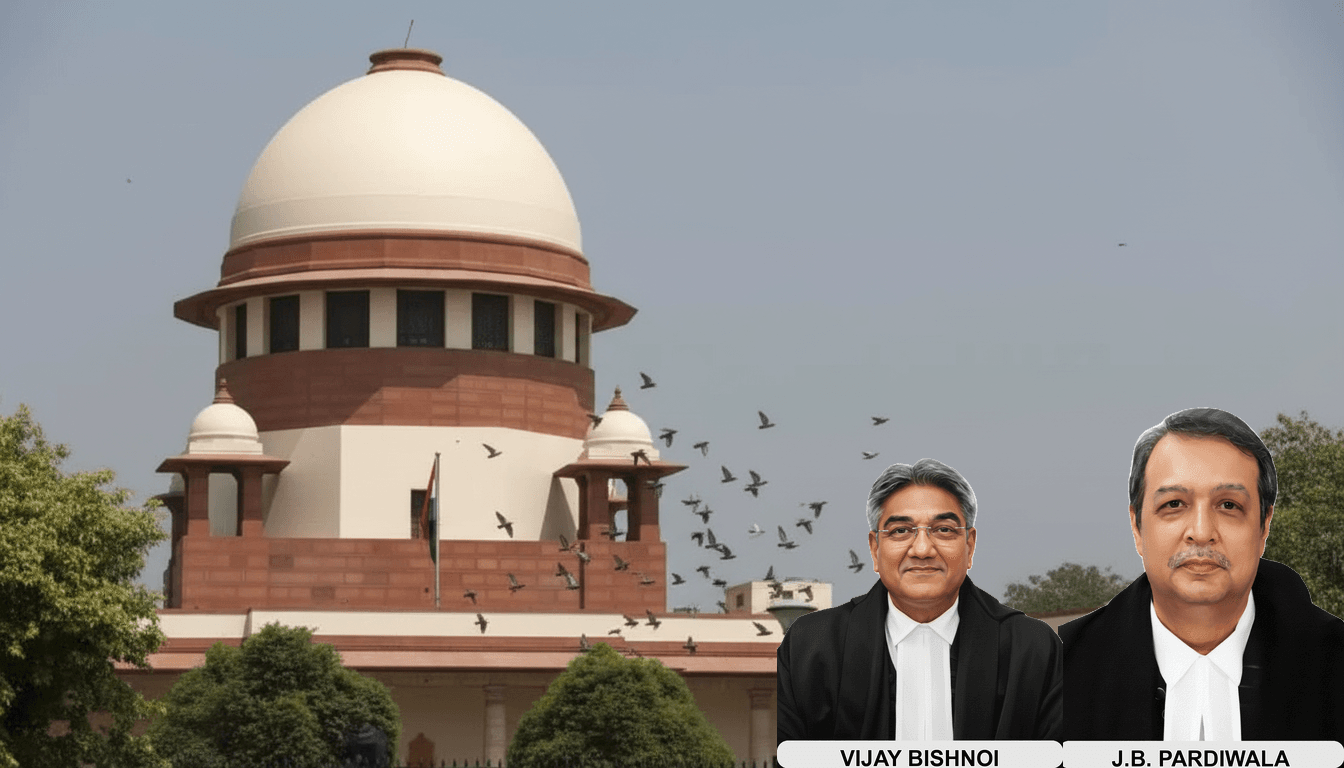
A bench of Justices J.B. Pardiwala and K.V. Viswanathan of the Supreme Court heard an appeal against an order of the High Court of Allahabad which had rejected a fresh anticipatory bail application by the appellant after earlier granting interim protection limited "till the filing of the police charge sheet". The issue concerned whether an anticipatory bail order could be curtailed to expire on the filing of the charge-sheet and whether the High Court erred in directing the accused to surrender after investigation was completed.
The Court allowed the appeal, set aside the impugned High Court order and clarified settled law on the duration of anticipatory bail. The bench held that once the High Court exercised its discretion in favour of an accused and granted anticipatory bail, there was ordinarily no good reason to restrict its operation merely until filing of the charge-sheet. The Court relied on earlier decisions including Bharat Chaudhary, Ravindra Saxena, Siddharth, and the Constitution Bench in Sushila Aggarwal to state that protection under Section 438 CrPC need not be time‑bound and, barring special reasons, could continue.
The Court, in its reasoning, observed: “91.1. Regarding Question 1, this Court holds that the protection granted to a person under Section 438 CrPC should not invariably be limited to a fixed period; it should enure in favour of the accused without any restriction on time. Normal conditions under Section 437(3) read with Section 438(2) should be imposed; if there are specific facts or features in regard to any offence, it is open for the court to impose any appropriate condition (including fixed nature of relief, or its being tied to an event), etc.
91.2. As regards the second question referred to this Court, it is held that the life or duration of an anticipatory bail order does not end normally at the time and stage when the accused is summoned by the court, or when charges are framed, but can continue till the end of the trial. Again, if there are any special or peculiar features necessitating the court to limit the tenure of anticipatory bail, it is open for it to do so.” The Court also observed that “We fail to understand what is the idea in restricting the grant of anticipatory bail upto the stage of completion of investigation and filing of the chargesheet,” and noted that “Either the Court may grant anticipatory bail or may decline. However, once having exercised its discretion in favour of the accused ... there was no good reason for the High Court to restrict it upto the stage of filing of the chargesheet.”
Background
The appeal arose from FIR No. 560/2024 registered at Akbarpur Police Station, District Kanpur Dehat (U.P.) for offences under Sections 80(2)/85 BNS and Sections 3 and 4 of the Dowry Prohibition Act, 1961, following the mysterious death of a woman at her matrimonial home about seven months after marriage. The appellant was the deceased's brother‑in‑law (devar). The mother of the deceased lodged the FIR, and the matter was characterised as one of dowry death. The appellant sought anticipatory bail before the High Court; the Allahabad High Court granted anticipatory bail but expressly limited it “till the filing of the police charge sheet.” After the charge‑sheet was filed, the protection lapsed and the appellant’s fresh anticipatory bail application was rejected, prompting the present appeal.
The Supreme Court reviewed established precedent and emphasised that filing of a charge‑sheet, taking of cognizance or framing of charges did not automatically terminate anticipatory bail unless the court recorded special reasons to impose a temporal limit. The Court set aside the High Court order and directed that in the event of arrest the appellant shall be released on anticipatory bail subject to such terms and conditions as the Investigating Officer deems fit; once released by the Investigating Officer, the appellant was to appear before the trial court and furnish a fresh bail bond. The Court further clarified the position where new, graver cognizable and non‑bailable offences are added: the accused may become disentitled to earlier protection and courts must re‑examine bail in changed circumstances, with authorities able to seek arrest or cancellation of bail under Sections 437(5) or 439(2) CrPC.
Case Details:
Case No.: Criminal Appeal No. 830 of 2026 (Arising out of SLP(Crl.) No.1536/2026)
NeutralCitation: 2026 INSC 145
Case Title: Sumit v. State of U P & Anr.
Appearances:
For the Petitioner(s): Mr. Varinder Kumar Sharma, Advocate
For the Respondent(s): Mr. Ankit Goel, Advocate
Source: 2026 CaseBase(SC) 244
Similar Articles



 Breaking News


