


Appellate Courts Cannot Ignore Additional Evidence Applications: SC
 Copy Link
 Share
 Save
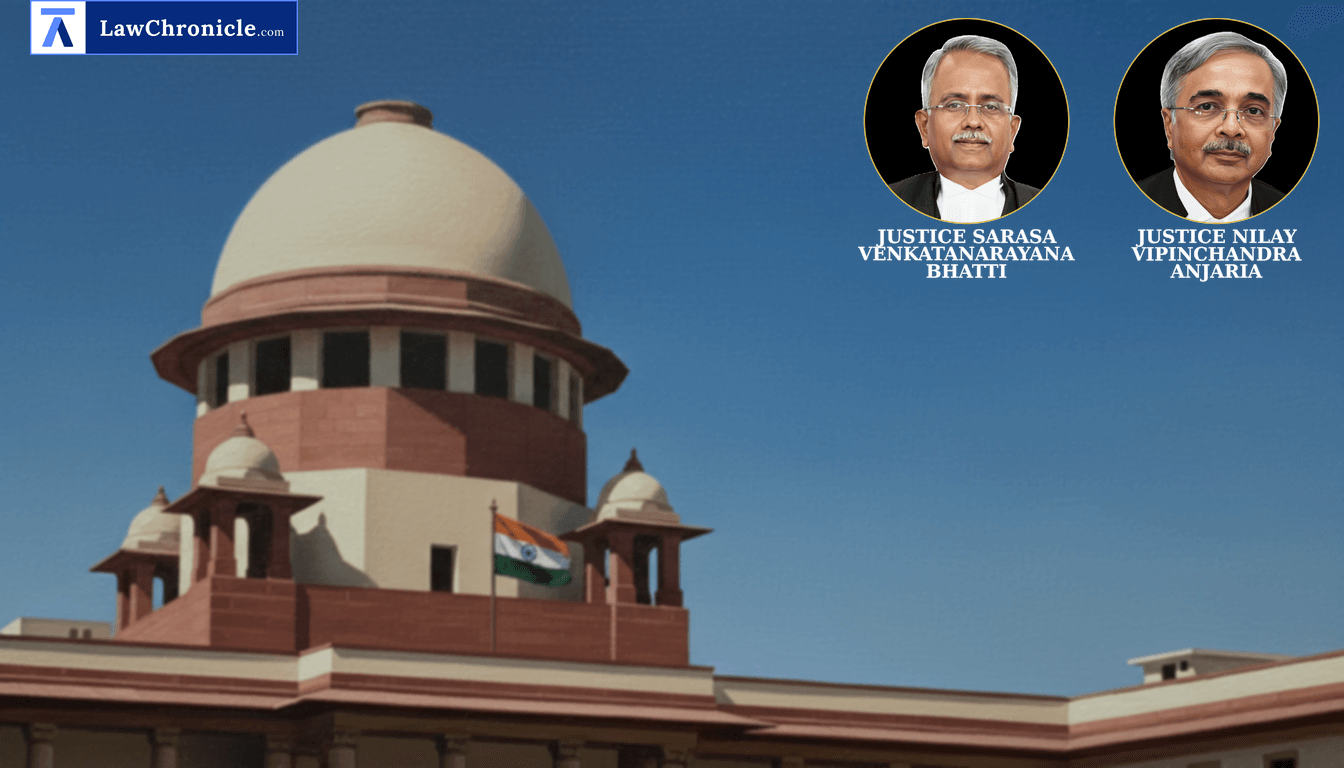
Disposing of an appeal without deciding a pending application for additional evidence constitutes a fatal jurisdictional error that invalidates the final judgment. The Supreme Court has remitted a property partition suit back to the High Court, reaffirming that appellate courts have an unyielding statutory duty to adjudicate Order XLI Rule 27 applications alongside the main appeal.
A Division Bench comprising Justice S.V.N. Bhatti and Justice N.V. Anjaria set aside a decision of the Karnataka High Court for failing to consider an application seeking to adduce additional documentary evidence filed under the Code of Civil Procedure, 1908.
Key Takeaways
Mandatory Adjudication: Appellate courts cannot bypass or leave unresolved applications seeking the production of additional evidence under Order XLI Rule 27.
Simultaneous Consideration: Applications for additional evidence must be evaluated concurrently with the main appeal on merits to test their necessity for pronouncing judgment.
Jurisdictional Error: Passing a final judgment while ignoring pending evidence applications constitutes a procedural failure and a clear miscarriage of justice.
Court's Reasoning on Order XLI Rule 27
The Supreme Court observed that the High Court had committed a direct jurisdictional error by completely ignoring the application while disposing of the appeal, directly contravening settled statutory principles. The Court emphasized that an appellate court has a duty to evaluate such applications at the final hearing stage to assess if the additional documents are required to pronounce judgment in a satisfactory manner.
The Court, in its reasoning, observed: "Dismissing an appeal without deciding a pending application for additional evidence constitutes a jurisdictional error and results in a severe miscarriage of justice... The High Court had a duty to evaluate the Application at the final hearing to determine whether the documents were necessary to pronounce Judgment in a more satisfactory manner. The failure to pass a reasoned order either allowing or rejecting this Application before sustaining the Trial Court's decree resulted in a procedural failure and a miscarriage of justice."
The Court issued the following directions:
"In view of the above, the Impugned Judgment dated 16.12.2025 is set aside. The Civil Appeals are allowed. The RFA No. 2076 of 2006 is restored together with cross objections and remanded to the High Court for fresh disposal."
Ratio
An appellate court is statutorily obligated under Order XLI Rule 27 of the Code of Civil Procedure, 1908 to pass a reasoned order either allowing or rejecting an application for additional evidence concurrently while deciding the appeal on merits; ignoring such an application invalidates the final appellate decree.
Background
The original dispute stems from a partition suit filed in 1999 (renumbered as O.S. No. 86 of 2006) before the Senior Civil Judge, Devanahalli, seeking partition and separate possession of Plaint Schedules 'A', 'B', and 'C'. The Trial Court decreed the suit in September 2006. Aggrieved by the decree, appeals and cross-objections were filed in the High Court of Karnataka, Bengaluru.
During the appellate proceedings, the appellant (Defendant No. 1) filed an application (I.A. No. 1/25) under Order XLI Rule 27 of the Code of Civil Procedure, 1908 on October 28, 2025, seeking to produce additional documentary evidence, including judgments from O.S. 369 of 1997, bank loan discharges, and surveyor sketches. Although the High Court heard arguments and reserved orders on November 4, 2025, its final judgment delivered on December 16, 2025, dismissed the cross-objections without referring to, considering, or adjudicating the pending additional evidence application.
In reaching its decision to set aside the High Court's ruling, the Supreme Court relied on established legal precedents, including Jatinder Singh and another v. Mehar Singh and others ( "(2009) 17 SCC 465": 2008 CaseBase(SC) 297), North Eastern Railway Administration, Gorakhpur v. Bhagwan Das (Dead) By LRs. ( "(2008) 8 SCC 511": 2008 CaseBase(SC) 920), Namdeo v. Tukaram S/o Marotrao Jadhav, Iqbal Ahmed (Dead) by LRs. and another v. Abdul Shukoor ( "(2025) SCC OnLine SC 1787": 2025 CaseBase(SC) 885), and G. Shashikala (dead) Thr. LRs v. G. Kalawati Bai (dead) Thr. LRs and others. These rulings unanimously hold that appellate courts must pass explicit, reasoned orders regarding Order XLI Rule 27 applications at the time of final hearing. Consequently, the Supreme Court allowed the civil appeals and remanded the matter back to the Karnataka High Court for fresh disposal.
Case Details:
Case No.: Civil Appeal Nos. of 2026 (@ Special Leave Petition (Civil) Diary Nos. 10525 of 2026)
Neutral Citation: 2026 INSC 816
Case Title: Chowdappa v. Hanumantharayappa and Others
Appearances:
For the Petitioner(s): Ms. Kiran Suri, Learned Senior Counsel
For the Respondent(s): Mrs. Prabha Swami, Learned Counsel
Source: 2026 CaseBase(SC) 762
Similar Articles
 Breaking News


