


Arbitration Clause No Shield Against Criminal Prosecution For Embezzlement: Allahabad HC
 Copy Link
 Share
 Save
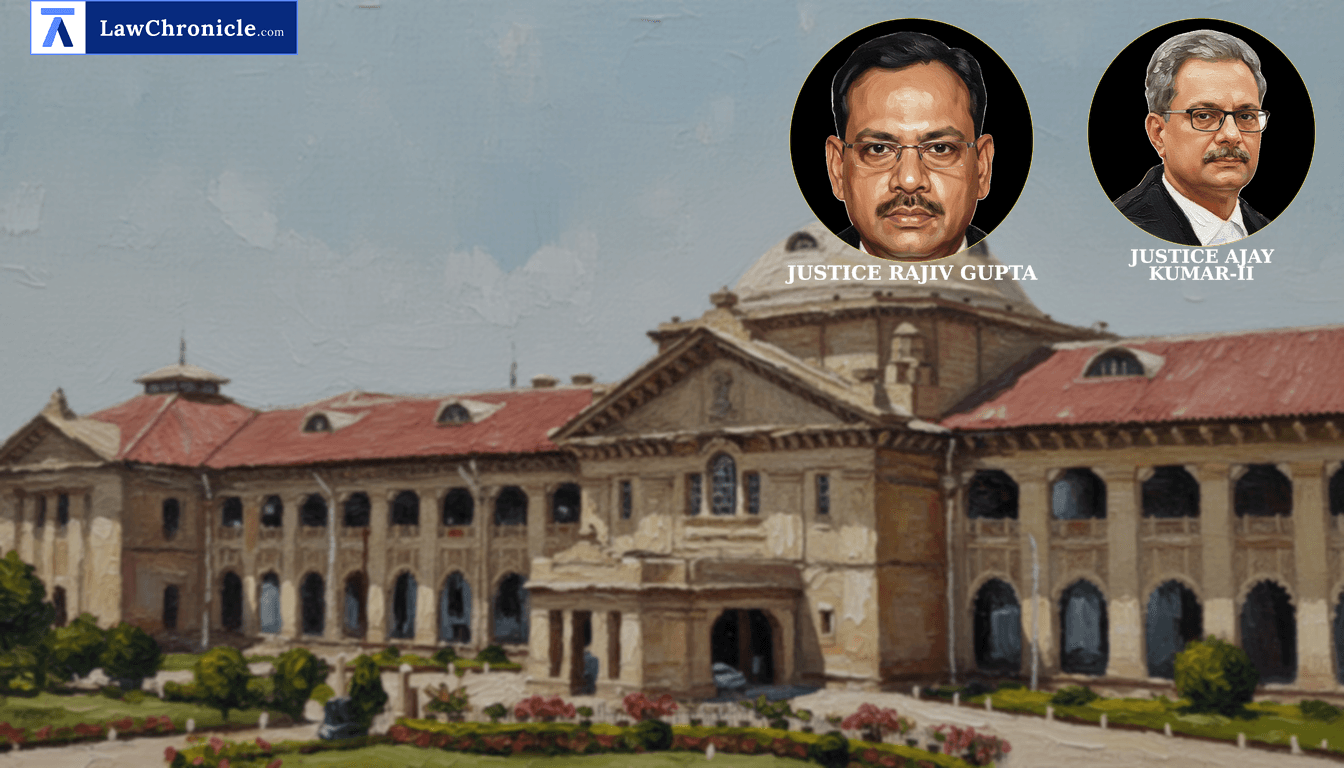
The Allahabad High Court has firmly established that the mere existence of an arbitration clause in a commercial agreement does not oust the jurisdiction of criminal courts or bar the registration of an FIR when the allegations prima facie disclose a cognizable offense such as embezzlement.
Dismissing a writ petition seeking to quash an FIR, a division bench comprising Justice Rajiv Gupta and Justice Dr. Ajay Kumar-II clarified that civil and criminal remedies are coextensive and not mutually exclusive, particularly when a fraudulent intent or 'mens rea' is evident in a commercial transaction.
The Intersection of Commercial Contracts and Criminal Law
The dispute originated from a 'Master Franchisee Service Agreement' between Hitachi Payment Services Pvt. Ltd. and the petitioners for operating ATM/CRM machines. The Company alleged that the petitioners, acting as custodians and trustees of physical cash, failed to load approximately ₹30,95,700/- into the machines, effectively misappropriating the funds for personal use. The petitioners challenged the FIR registered under Sections 316(5) and 318(4) of the Bhartiya Nyaya Sanhita, 2023, arguing that the dispute was purely contractual and should be settled via the agreed-upon arbitration mechanism.
Court Rejects Argument on Arbitral Bar to Criminal Proceedings
The Court emphasized that while an arbitrator can adjudicate civil consequences of a contract breach, they lack the jurisdiction to investigate or prosecute criminal acts. The Bench noted that the same set of facts can give rise to both civil liability and criminal prosecution if the essential ingredients of an offense are present.
Regarding the arbitration clause, the Court observed: "We are unable to appreciate the reasoning that the provision incorporated in the agreement for referring the disputes to arbitration is an effective substitute for a criminal prosecution when the disputed act is an offence. Arbitration is a remedy for affording reliefs to the party affected by breach of the agreement but the arbitrator cannot conduct a trial of any act which amounted to an offence albeit the same act may be connected with the discharge of any function under the agreement."
The Court further clarified that the pendency of civil proceedings or the availability of civil remedies provides no justification to quash criminal proceedings if a prima facie case exists. This principle was reinforced by citing Kathyayini Vs. Sidharth P.S. Reddy & Ors. ( "2025 INSC 818": 2025 CaseBase(SC) 807) and K. Jagadish Vs. Udaya Kumar G.S. and another ( "(2020) 14 SCC 552": 2020 CaseBase(SC) 1635).
Observations on Multiple FIRs and Mens Rea
The petitioners also contended that multiple FIRs were lodged for the same cause of action, citing T.T. Antony Vs. State of Kerala & Others ( "2001 (6) SCC 181": 2001 CaseBase(SC) 983) and Babubhai Vs. State of Gujarat & Others. However, the Court found that the FIRs related to different ATM locations and distinct amounts, thereby constituting different sets of facts. On the issue of intent, the Court noted that the temporary deposit of a portion of the missing amount after detection was "prima facie indicative of temporary embezzlement," satisfying the requirement of 'mens rea'.
The Court has the following directions:
"The prayer for quashing of the first information report is therefore, refused. The instant writ petition lacks merit and is accordingly dismissed."
Key Takeaways:
Arbitration is Not a Criminal Shield
Contractual clauses requiring arbitration for disputes do not prevent the police or courts from investigating criminal offenses arising from the same transaction.
Coextensive Remedies Confirmed
Victims of financial fraud in a business context are entitled to pursue civil recovery and criminal prosecution simultaneously as they differ in content and consequence.
Mens Rea in Commercial Breaches
Where a party violates the terms of a trust such as misappropriating cash meant for ATM replenishment the act transcends simple breach of contract and enters the realm of criminal breach of trust.
Distinct Offenses for Distinct Locations
Multiple FIRs lodged by the same entity against the same accused are maintainable if they pertain to different incidents, locations, or specific financial discrepancies.
Ratio Decidendi:
The mere existence of an arbitration clause in a contract, or the availability of civil remedies, does not preclude the initiation or continuation of criminal proceedings if the allegations and material on record prima facie disclose the commission of a cognizable offense. Civil and criminal jurisdictions are coextensive, and an arbitrator has no power to adjudicate upon the criminal consequences of an act.
Background:
Petitioner No. 1 and later Petitioner No. 2 (his son) entered into agreements with Hitachi Payment Services to manage ATMs in Ghazipur. As 'Master Franchise Agents', they were responsible for replenishing cash withdrawn from designated bank accounts into the ATMs. Following a switch data audit, the Company found a shortfall of over ₹43 Lakhs. While the petitioners returned about ₹12 Lakhs, they allegedly failed to return the remaining ₹30.95 Lakhs.
The Company lodged an FIR under the Bhartiya Nyaya Sanhita, 2023. The petitioners moved the High Court to quash the FIR, arguing the dispute was civil/contractual and that an arbitration clause governed all disputes. They relied on T.T. Antony Vs. State of Kerala & Others ( "2001 (6) SCC 181": 2001 CaseBase(SC) 983) and Babubhai Vs. State of Gujarat & Others regarding multiple FIRs. The State and the Complainant relied on State of Telangana vs. Habib Abdullah Jellani ( "(2017) 2 SCC 779": 2017 CaseBase(SC) 535), Neeharika Infrastructure Pvt. Ltd. vs. State of Maharashtra and Others, and Directorate of Enforcement Vs. Niraj Tyagi and others ( "(2024) 5 SCC 419": 2024 CaseBase(SC) 487) to argue that the investigation should not be thwarted at the threshold. The Court ultimately found that the ingredients of Section 316(5) of the Bhartiya Nyaya Sanhita, 2023 were prima facie met, leading to the dismissal of the petition.
Case Details:
Case No.: CRIMINAL MISC. WRIT PETITION No. - 11615 of 2026
Case Title: Amit Kumar Jaiswal and Another Versus State of U.P. and 3 others
Appearances:
For the Petitioner(s): Anwar Hussain, Mohammad Alam, Advocates
For the Respondent(s): Deepak Upadhyay, Paras Dubey, Rajesh Kumar Singh, Advocates; G.A.
Source: 2026 CaseBase(ALL) 244
Similar Articles



 Breaking News


