


Arbitrator cannot grant Pre-Award Interest if contract expressly prohibits: Supreme Court
 Copy Link
 Share
Share Save
Save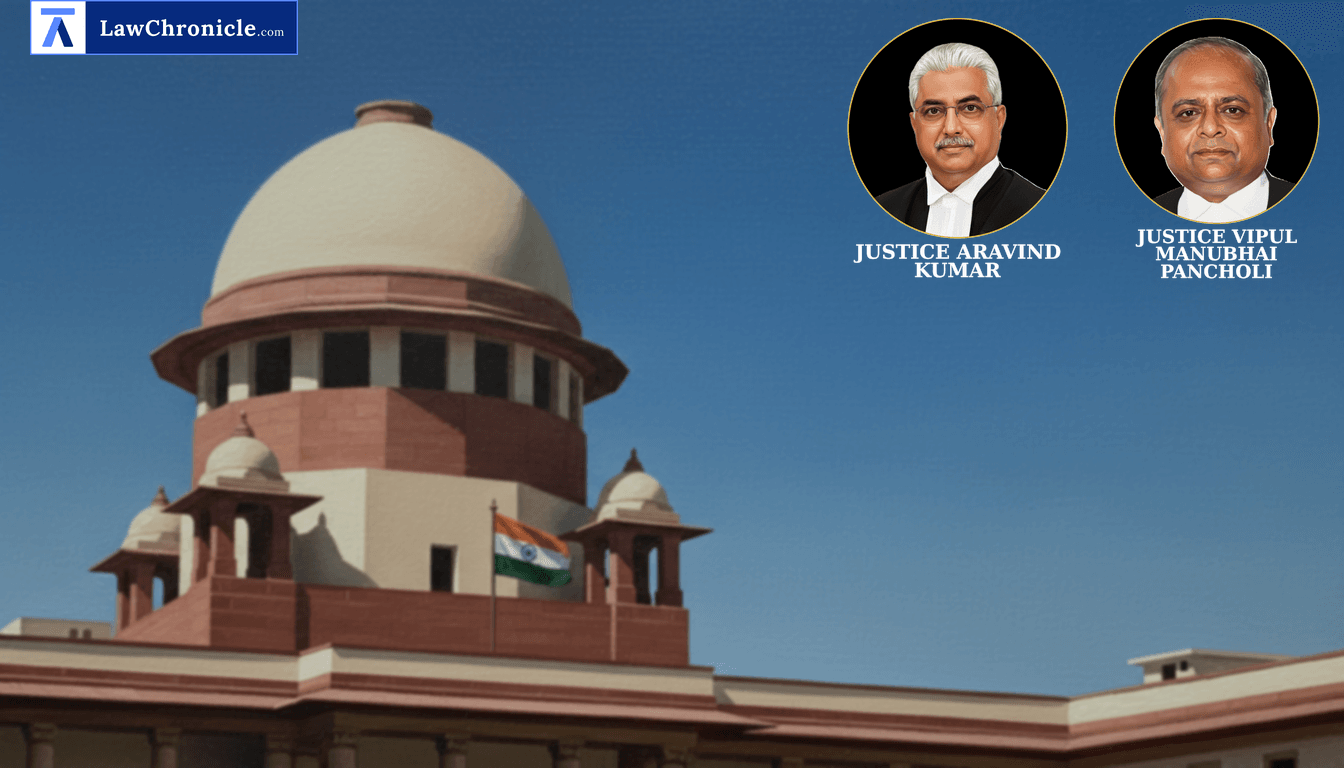
The Supreme Court has ruled that an arbitrator cannot award pre-award or pendente lite interest when contractual terms contain a residuary bar against interest claims. The bench held that contractual expressions like "or otherwise" operate as an absolute prohibition against pre-award interest under Section 31(7)(a) of the Arbitration and Conciliation Act, 1996.
A bench comprising Justice Aravind Kumar and Justice Vipul M. Pancholi dismissed an appeal against a High Court decision that had set aside pre-reference and pendente lite interest awarded to a sub-contractor.
Key Takeaways
Party Autonomy Prevails Over Arbitral Discretion: Arbitrators are bound by express contractual prohibitions regarding pre-award interest.
Wide Amplitude of Residuary Phrases: Phrases such as "or otherwise" cannot be restricted using ejusdem generis and serve as blanket bars.
Statutory Distinction in Interest Grant: Pre-award interest under Section 31(7)(a) yields to party agreements, whereas post-award interest under Section 31(7)(b) remains protected.
Pre-Award Interest
Evaluating the scope of contractual interest bars, the Court upheld the High Court's decision setting aside interest for pre-reference and pendente lite periods while retaining post-award interest. The Apex Court observed that "On perusal of Section 31(7)(a) of the 1996 Act, it is clear that the power of an Arbitral Tribunal to award interest for the pre-award period, i.e., from the date on which the cause of action arose up to the date on which the award is made (including both pre-reference and pendente lite periods), is expressly subject to the opening words - “Unless otherwise agreed by the parties”. Section 31(7) of the 1996 Act has to be construed harmoniously with Section 28(3) of the 1996 Act, which provides for the Arbitral Tribunal to decide in accordance with the contractual terms governing the parties."
Ratio
Under Section 31(7)(a) of the Arbitration and Conciliation Act, 1996, party autonomy is paramount, and an arbitrator has no statutory authority or jurisdiction to grant pre-reference or pendente lite interest where the underlying contract contains a clause barring interest claims including residuary expressions such as "or otherwise".
Background
The dispute stemmed from a 1991 sub-contract awarded by National Building Construction Corporation (NBCC) to M/s Sharma Enterprises for flooring and cladding works at Vashi Railway Station-cum-Commercial Complex. Following delays and contract termination in 1992, the sub-contractor invoked arbitration. Though initially governed by procedural uncertainty, this Court previously clarified that the proceedings were governed by the Arbitration and Conciliation Act, 1996.
In July 2016, the sole arbitrator awarded substantive financial claims along with 10% per annum interest spanning pre-reference, pendente lite, and post-award periods. NBCC challenged the award under Section 34 of the Arbitration and Conciliation Act, 1996. The Single Judge of the Delhi High Court, relying on Sayeed Ahmed and Company v. State of Uttar Pradesh & Ors. ( "(2009) 12 SCC 26": 2009 CaseBase(SC) 806), set aside the pre-reference and pendente lite interest, holding that Clause 26 of the Special Conditions of Contract (SCC) created an absolute bar. The Division Bench affirmed this decision under Section 37 of the Arbitration and Conciliation Act, 1996.
Before the Supreme Court, the appellant argued that Clause 26 of the SCC only restricted delayed interim payments and that the term "or otherwise" should be interpreted using ejusdem generis and noscitur a sociis, citing Oil and Natural Gas Corporation Ltd. v. G&T Beckfield Drilling Services Pvt. Ltd. and Ferro Concrete Construction (India) Pvt. Ltd. v. State of Rajasthan ( "2025 SCC OnLine SC 708": 2025 CaseBase(SC) 565). It was further urged that exclusion of statutory power under Section 31(7)(a) required explicit contractual language, as discussed in Union of India v. Larsen & Toubro Limited ( "2026 INSC 203": 2026 CaseBase(SC) 182).
Rejecting these contentions, the Supreme Court relied on precedents including Union of India v. Manraj Enterprises ( "(2022) 2 SCC 331": 2021 CaseBase(SC) 124), Union of India v. Bright Power Projects (India) Private Limited, Sree Kamatchi Amman Constructions v. Divisional Railway Manager (Works), and Jaiprakash Associates Limited (JAL) through its Director v. Tehri Hydro Development Corporation (India) Limited (THDC) through its Director ( "(2019) 17 SCC 786": 2019 CaseBase(SC) 1249), noting that disjunctively joined clauses using "or" do not form a single genus. The Court approved the interpretation in Lilavati Bai v. State of Bombay ( "(1957) 1 SCC 411": 1957 CaseBase(SC) 46) regarding words of extension and distinguished the narrower clause in Oil and Natural Gas Corporation Ltd. v. G&T Beckfield Drilling Services Pvt. Ltd. while aligning Clause 26 with the comprehensive bars analyzed in Sayeed Ahmed and Company v. State of Uttar Pradesh & Ors. ( "(2009) 12 SCC 26": 2009 CaseBase(SC) 806) and Jaiprakash Associates Limited (JAL) through its Director v. Tehri Hydro Development Corporation (India) Limited (THDC) through its Director ( "(2019) 17 SCC 786": 2019 CaseBase(SC) 1249). Emphasizing the distinction between pre-award interest under Section 31(7)(a) and post-award interest under Section 31(7)(b) of the Arbitration and Conciliation Act, 1996 read with the Interest Act, 1978, as underscored in R.P. Garg, the Supreme Court dismissed the appeal.
Case Details:
Case No.: Civil Appeal No. 13782 of 2026
Neutral Citation: 2026 INSC 1135
Case Title: M/s Sharma Enterprises v. National Building Construction Corporation
Source: 2026 CaseBase(SC) 8275
 Breaking News