Are Crackers Banned This Diwali? How Supreme Court's Approach to Firecrackers Evolved Over the Years
 Copy Link
 Share
 Save
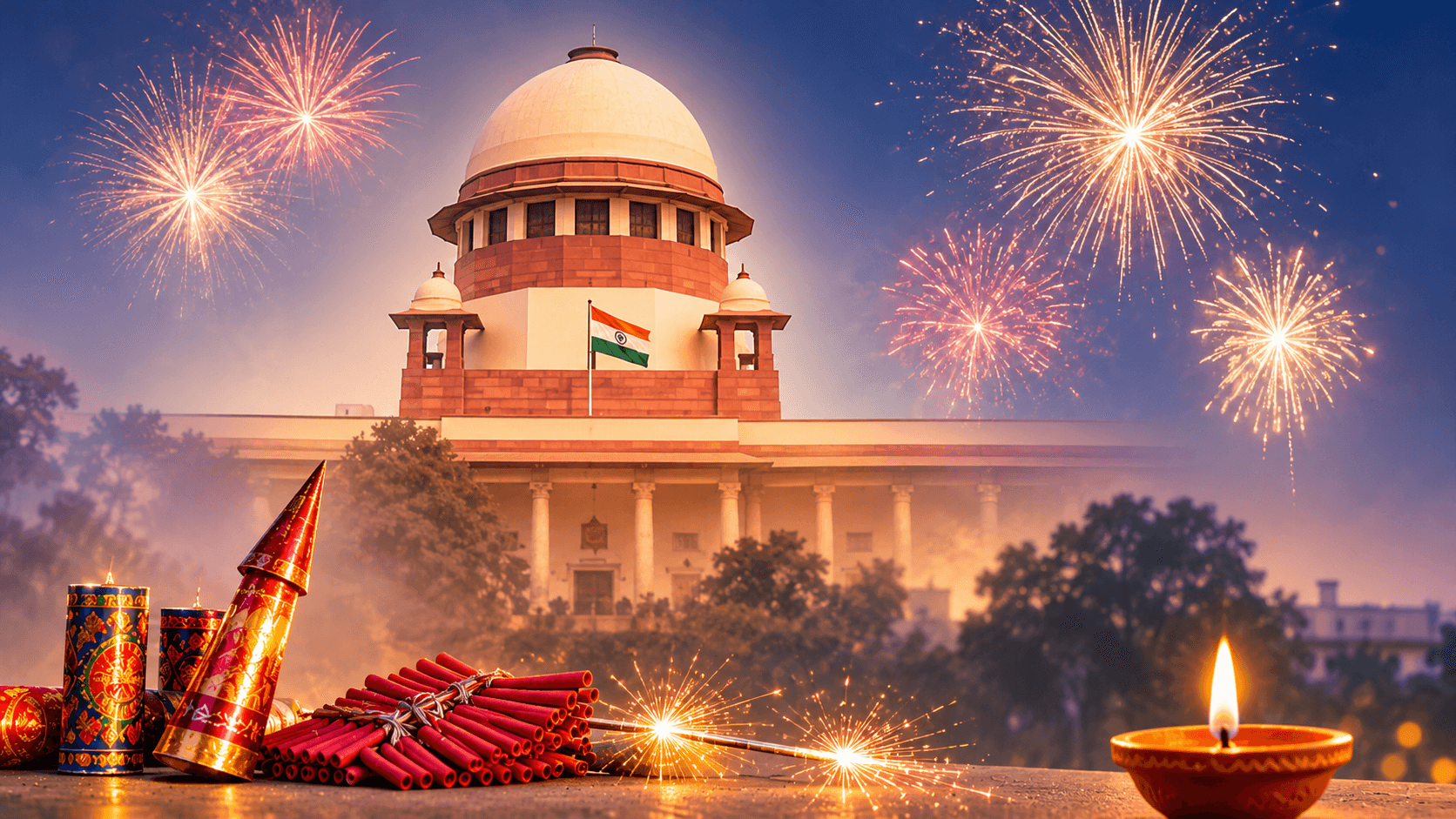
Are crackers banned this Diwali? For Delhi-NCR, the answer is: not entirely, and not for long. The Supreme Court has temporarily relaxed the year-round ban on firecrackers. However, T&C Apply, and only certified green crackers may be sold and burst for two days, within fixed time slots. The complete ban is to be restored from 9th November 2026.
Residents of the National Capital Region remember waking up to a thick blanket of smog the morning after Diwali in 2019. The reasons behind such mornings have been discussed every year since. Stubble burning plays its part in the October–November air, and the Odd-Even scheme for vehicles has been tried in emergency conditions. This article, however, stays with the Supreme Court's changing approach to firecrackers, from sales suspensions to green crackers, from a complete ban to conditional relaxation.
Short Answer for Diwali 2026
Will firecrackers be banned in Delhi in 2026?
A year-round ban on firecrackers has been in force in Delhi since 1st January 2025. The Supreme Court's order in 2026 CaseBase(SC) 9518 relaxes it for a limited window. Certified green crackers approved by CSIR-NEERI may be burst on 7th and 8th November, between 6 AM and 7 AM and between 8 PM and 10 PM. The complete ban on firecrackers resumes on 9th November 2026.
Can we burst crackers on 9th November?
Not in Delhi-NCR, since the Supreme Court order on firecracker ban directs that the restoration of complete ban from 9th November 2026. Outside NCR, the framework laid down in the 2018 judgment and the orders of the concerned State governments continue to apply, so it is worth checking local notifications.
Which crackers are banned?
Under the Supreme Court order in 2026 CaseBase(SC) 9518, the following remain prohibited in Delhi-NCR:
- Firecrackers containing barium, and any firecracker not approved as a green cracker by CSIR-NEERI.
- Firecrackers joined in series, known as ladis, and garlands.
- Online sale of firecrackers; sale is permitted only at locations designated by District Collectors in consultation with the police.
- Bursting within a 300-metre radius of hospitals, nursing homes, health centres, old-age homes, educational institutions and notified silence zones, which are declared "No-Cracker Zones".
Green crackers must be sold in sealed boxes carrying a product- and batch-specific QR code, which discloses the manufacturer, NEERI registration, licence and test certificate.
Evolution of Anti-Firecracker Law: From Noise Limits to Sales Suspension
1999–2001: Noise and Timing
The early regulation was about sound, not smoke. In 1999, noise standards for firecrackers were notified under the Environment (Protection) Rules, 1986. In October 2001, the Supreme Court directed the Centre and the States to enforce those limits, confined bursting to the hours between 6 PM and 10 PM, and barred crackers in silence zones. This was not a blanket ban on firecrackers.
2016: Sales suspended in Delhi-NCR
The first major intervention on sales came on 11 November 2016 in Arjun Gopal v. Union of India (2016 CaseBase(SC) 1188), a petition filed by three infants. After a severe deterioration in Delhi's air quality following Diwali that year, the Court suspended all licences for wholesale and retail sale of fireworks in Delhi-NCR. It reasoned that controlling supply was more practical than monitoring individual users. The Apex Court also asked the Central Pollution Control Board to examine the chemicals used.
2017: Relaxed, then restored for Diwali
In September 2017, the Supreme Court lifted the suspension on a temporary basis, favouring a graded approach over a complete ban. In October 2017, it restored the suspension for the Diwali period to test whether stopping sales would improve air quality. The experiment did not produce the clean Diwali morning that many expected, and the question of what actually works stayed open.
2018: Green crackers enter the picture
The judgment dated 23rd October 2018 in Arjun Gopal (2018 CaseBase (SC) 893), is the basis of the present regime. The Supreme Court did not impose a complete ban. It permitted only reduced-emission and green crackers, and:
- banned barium salts and joined crackers (laris);
- restricted sale to licensed traders and barred e-commerce platforms;
- fixed the bursting window at 8 PM to 10 PM on Diwali and other festivals, and 11:55 PM to 12:30 AM on Christmas and New Year's Eve.
2021–2023: No Blanket Ban
In 2021, the Supreme Court declined a plea for a complete ban on firecrackers across India, clarifying that crackers with banned chemicals or failing prescribed standards could not be sold or used. In November 2023, it reiterated that the prohibition on barium-based crackers applies throughout the country.
Complete Ban, and Its Limits
In October 2024, the Delhi Government prohibited the manufacture, storage, sale and use of all firecrackers, including green crackers. In December 2024, the Supreme Court extended the prohibition to the entire NCR, asking Haryana and Uttar Pradesh to impose similar restrictions. On 3rd April 2025, a Division Bench imposed a year-long blanket ban in the region, including green crackers.
The firecracker ban in Delhi-NCR did not hold on its own terms. While hearing the matter, the Apex Court noted there was no substantial difference in AQI between 2018, when green crackers were allowed, and 2024, when they were not. The Union and the Delhi Government supported conditional relaxation. On 15th October 2025, a Bench of Chief Justice B.R. Gavai and Justice K. Vinod Chandran, in M.C. Mehta v. Union of India (2025 CaseBase(SC) 2686), allowed the sale of NEERI-listed green crackers between 18th and 20th October 2025, with bursting limited to 6 AM–7 AM and 8 PM–10 PM, designated sale points, QR-code verification and police monitoring.
The 2026 Order: Regulate, Not Merely Prohibit
The order in 2026 CaseBase(SC) 9518 was passed by a Bench of Justice M.M. Sundresh and Justice Prasanna B. Varale in I.A. No. 245432 of 2026 and connected applications in Arjun Gopal & Ors. v. Union of India & Ors. (W.P.(C) No. 728 of 2015), heard with Suo Motu W.P.(C) No. 15 of 2026. The Amicus Curiae and the petitioners sought a complete ban and a health assessment of Delhi-NCR residents. Licensed traders and manufacturers argued that withholding licences would feed the trade in illegal crackers, and sought stricter enforcement through registration and QR codes.
The Apex Court held that the right to practice religion under Article 25(1) is subject to public order, health and morality, and that Article 21 includes the right to a healthy, pollution-free environment. It accepted that cracker-bursting contributes heavily to pollution in Delhi-NCR, but noted the religious, social and emotional significance of Diwali.
On whether to impose a complete ban or regulate, the Apex Court said it lacked adequate data to conclude that the 2024 ban had served its purpose, since AQI had not improved significantly. It found that the problem lies in implementation, that the State had failed to comply with the directions of 15th October 2025, and that conventional crackers were being sold under the guise of green crackers. The Bench held that the complete ban was facilitating illegal sales.
The matter is listed for compliance on 16 December 2026.
From Court Orders to Public Responsibility
The Supreme Court's stance this Diwali closes on a different note from its predecessors. The Apex Court has said that, regardless of its directions for the coming festival, the aim is a holistic change, for which public perception has to change. It asked members of the Bar and prominent personalities, including celebrities and particularly naming cricketer Virat Kohli, to join a voluntary public-awareness campaign. Schools in the NCR have been directed to sensitize children, and the Delhi Metro to broadcast awareness messages.
So, the question is, what would you choose? No-Firecracker Diwali 2026 in the hope for smog-free mornings? Or a grand celebration? - For Diwali only comes once a year.
 Breaking News