Auction Sale Invalid Without Strict Adherence To Statutory Timelines: SC
 Copy Link
 Share
Share Save
Save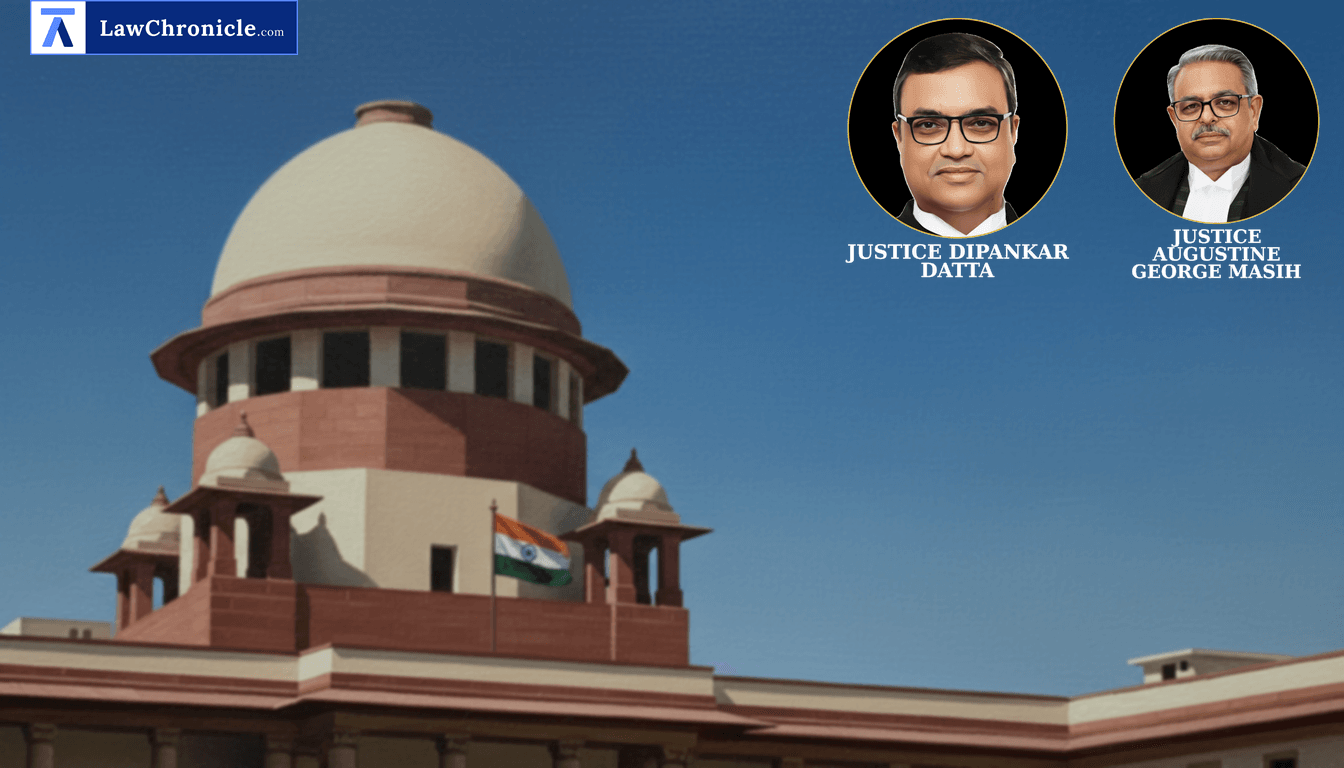
The Supreme Court has quashed an auction sale under the SARFAESI regime, ruling that the failure of an auction purchaser to deposit the balance sale price within the mandatory fifteen-day period, without a prior written agreement for extension, renders the entire process legally infirm. The Court emphasized that statutory rules governing such sales are mandatory and not merely ornamental.
A bench comprising Justice Dipankar Datta and Justice Augustine George Masih set aside a Madras High Court judgment that had declined to interfere with the recovery proceedings initiated by the Indian Bank. The apex court held that while the rights of bona fide auction purchasers merit protection, such protection must yield when the process itself violates the prescribed statutory framework under the Security Interest (Enforcement) Rules, 2002.
Mandatory Nature of Rule 9 for Auction Sales
The dispute arose from recovery measures taken against the heirs of a deceased guarantor. The primary legal question revolved around whether the auction purchaser had complied with the timelines for depositing the sale consideration. According to the facts, while the initial 25% was deposited on time, the balance 75% was paid beyond the fifteen-day limit without any written agreement for extension as required under the Security Interest (Enforcement) Rules, 2002.
Court's Rationale on Statutory Compliance
The Court, in its reasoning, observed: "Even upon a cursory perusal of Rule 9 of the SARFAESI Rules that existed at the time of the impugned sale, it is clear that these provisions are neither ornamental nor directory; they are couched in mandatory terms and go to the root of the validity of the sale. A conjoint reading of the relevant sub-rules of Rule 9 underscore the mandatory character of these provisions, particularly accentuating the requirement of balance deposit under sub-rule (4), which is integral to the sanctity and credibility of the auction mechanism. Any deviation therefrom, absent legally sustainable justification, would render the process vitiated."
The Court relied on the precedent set in Sri Siddeshwara Cooperative Bank Ltd. v. Ikbal to affirm that Rule 9(3) and 9(4) are mandatory, though they can be waived only through a mutual written agreement between the parties. In the present case, no such written agreement existed before the expiry of the deadline. The Court also referenced IDBI Bank Ltd. v. Ramswaroop Daliya ( "2024 SCC OnLine SC 2878": 2024 CaseBase(SC) 696) to reiterate that a default in payment must invite cancellation unless an extension is specifically agreed upon in writing.
Directions Issued to the Secured Creditor
The Court has the following directions:
"41. Consequently, the auction sale conducted in respect of the secured asset stands quashed and set aside.
42. However, having regard to the fact that the auction purchaser had participated in the process and deposited the bid amount pursuant thereto, interests of equity demand suitable restitution of interests of such purchaser. Although the sale is being set aside for reasons not attributable to him, he has remained deprived of the use of the monies deposited by him for a significant length of time. Accordingly, the auction purchaser shall be entitled to refund of the entire amount deposited by him together with interest thereon @ 7% per annum from the respective dates of deposit until payment. Such refund shall be effected by the secured creditor within a period of 6 (six) weeks from date.
43. At the same time, the appellant being the legal heir of G. Ramanujam would now be entitled to an opportunity to redeem the mortgage and seek restoration of the secured asset in her favour till such time a notice for a fresh auction is issued on her failure to redeem. We grant her such opportunity. Appellant shall be at liberty to approach the secured creditor within two weeks from date with a copy of this judgment to ascertain the amount due and payable. Upon payment being made within the time to be stipulated by the secured creditor (which will not be less than a month from the date intimation is given to the appellant), legal consequences will follow.
44. In moulding the relief, we have borne in mind the peculiar fact situation of the case. The demand notice issued under Section 13(2) of the SARFAESI Act quantified the outstanding dues at Rs.95,42,372.52p. At the same time, the appellant cannot be permitted to secure restoration of the mortgaged property without satisfying the liability which constituted the fulcrum of the measures initiated by the secured creditor. Balancing the competing equities and in order to do complete justice between the parties, we deem it appropriate to direct that the appellant shall be entitled to redeem the mortgage and obtain restoration of the secured asset upon payment to the secured creditor of a sum of Rs.95,42,372.52p together with 5% interest per annum thereon from the date the notice under Section 13(2) of the SARFAESI Act was issued until the date of such payment by the appellant. Upon payment being made within the period stipulated by the secured creditor in terms of paragraph 44 above, the secured asset shall stand restored to the appellant free from all encumbrances arising out of the subject loan transaction.
Background:
The case originated from a loan availed in 1984 by a sole proprietorship. G. Ramanujam stood as a guarantor, mortgaging his property. After he died in 2001, and following a preliminary decree passed in 1997, the bank initiated recovery under the Securitisation and Reconstruction of Financial Assets and Enforcement of Security Interest Act, 2002 in 2009. The property was auctioned in March 2010 for Rs. 2.11 crore. The daughter of the deceased guarantor challenged the sale, alleging procedural irregularities.
While the Limitation Act, 1963 was discussed regarding the applicability of Section 5 to Section 17 of the Securitisation and Reconstruction of Financial Assets and Enforcement of Security Interest Act, 2002, the Supreme Court focused primarily on the breach of the Security Interest (Enforcement) Rules, 2002. The Court concluded that the non-adherence to the payment timeline constituted a material irregularity. However, exercising its jurisdiction under Article 142 of the Constitution, the Court balanced equities by providing a one-time redemption opportunity to the appellant while ensuring the auction purchaser received a refund with interest.
Case Details:
Case No.: CIVIL APPEAL NO. 1606 OF 2026
NeutralCitation: 2026 INSC 633
Case Title: M. R. VASUMATHI v. THE AUTHORIZED OFFICER & ORS.
Appearances:
For the Petitioner(s): Mr. Ratnakar Dash, Senior Counsel
For the Respondent(s): Mr. Brijesh Kumar Tamber, Advocate for Respondent 1; Mr. Soumya Chakraborty, Senior Counsel for Respondent 2
Source: 2026 CaseBase(SC) 563
 Breaking News