


Bail Is The Rule Even Under UAPA When Trial Prolonged: SC
 Copy Link
 Share
Share Save
Save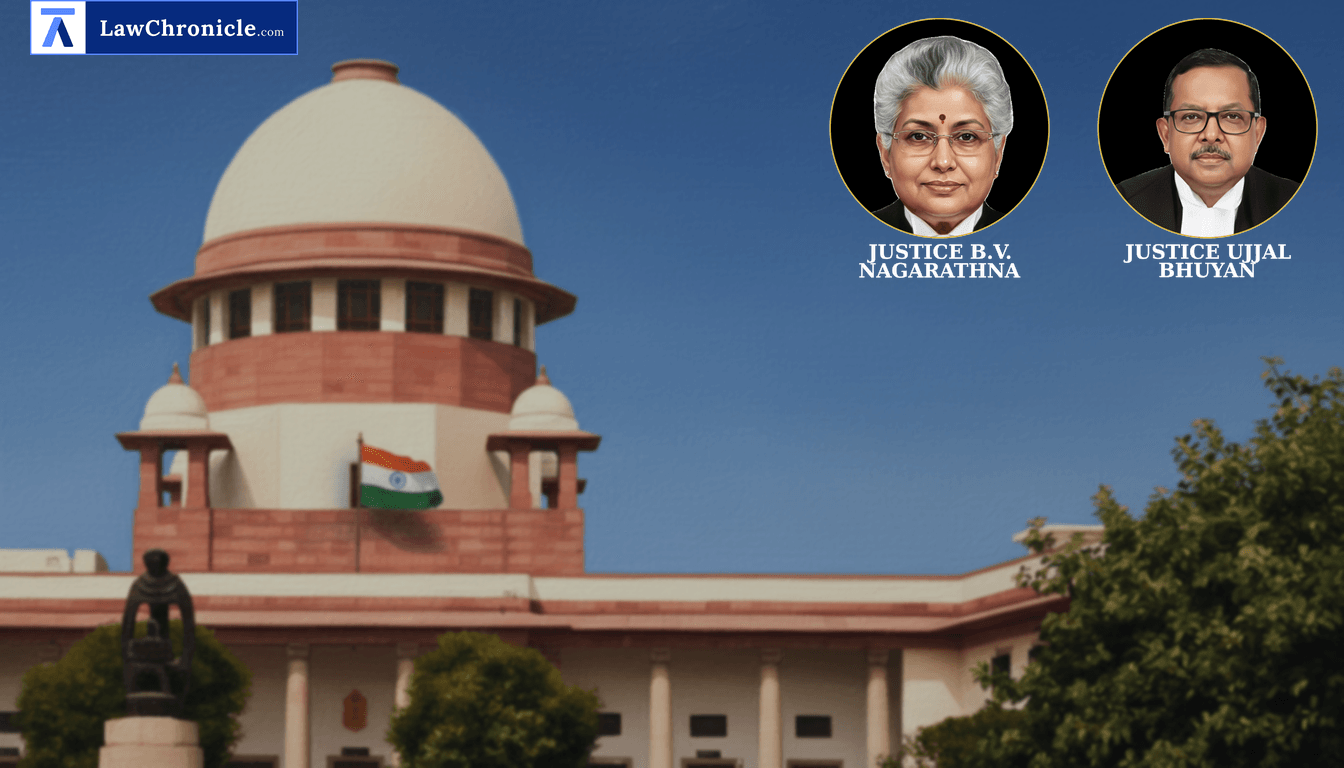
In a significant ruling reinforcing the primacy of personal liberty, the Supreme Court declared that statutory restrictions on bail under special laws like the Unlawful Activities (Prevention) Act, 1967 cannot override the fundamental right to a speedy trial. A Bench of Justice B.V. Nagarathna and Justice Ujjal Bhuyan emphasized that hollowing out the constitutional force of larger Bench decisions by smaller Benches is impermissible, granting bail to an accused incarcerated for nearly six years without any realistic prospect of a concluded trial.
Constitutional Primacy Over Statutory Embargo
The Court observed that while Section 43-D(5) of the Unlawful Activities (Prevention) Act, 1967 creates a rigorous limitation on the power of courts to grant bail, it remains subordinate to the guarantee of Article 21 of the Constitution of India, 1950. The Bench noted that once it becomes obvious that a timely trial is impossible and the accused has suffered significant incarceration, courts are obligated to enlarge them on bail.
The Court, in its reasoning, observed: "The presence of statutory restrictions like Section 43-D(5) of the UAPA per se does not oust the ability of the constitutional courts to grant bail on grounds of violation of Part III of the Constitution. Indeed, both the restrictions under a statute as well as the powers exercisable under constitutional jurisdiction can be well harmonised. Whereas at commencement of proceedings, the courts are expected to appreciate the legislative policy against grant of bail but the rigours of such provisions will melt down where there is no likelihood of trial being completed within a reasonable time and the period of incarceration already undergone has exceeded a substantial part of the prescribed sentence."
Hollowing Out Precedents: A Warning to Smaller Benches
Addressing recent divergent views, the Bench clarified that the law laid down in Union of India Vs. K.A. Najeeb ( "(2021) 3 SCC 713": 2021 CaseBase(SC) 830) by a three-Judge Bench is the binding law of the land. It noted with concern that decisions like Gurwinder Singh Vs. State of Punjab ( "(2024) 5 SCC 403": 2024 CaseBase(SC) 558) and Gulfisha Fatima Vs. State (Govt. of NCT of Delhi) ( "2026 SCC Online SC 10": 2026 CaseBase(SC) 1) had attempted to adopt a narrower reading of the Union of India Vs. K.A. Najeeb ( "(2021) 3 SCC 713": 2021 CaseBase(SC) 830) ratio. The Court stated: "Judicial discipline and certainty demands that Benches of smaller strength are mindful of the decisions rendered by larger Benches and are bound to follow the same. If the smaller Benches are unable to agree with the ratio laid down by the larger Bench then the proper and the only course of action open is to make a reference to the Hon’ble Chief Justice of India for placing the matter for consideration by a still larger Bench."
Low Conviction Rates as a Factor for Consideration
In a rare move, the Court examined statistics regarding the Unlawful Activities (Prevention) Act, 1967, noting that the country-wide conviction rate hovers between 2% to 6%, while in Jammu and Kashmir, it is less than 1%. The Court questioned whether detention should continue indefinitely when there is a 99% possibility of acquittal at the end of a trial, simply because the charges are serious.
Background:
The appellant, a former government employee and political activist, was arrested in June 2020 following an FIR alleging involvement in narco-terrorism. The prosecution claimed that funds generated from heroin smuggling were being used to fund the terrorist organization LeT. The appellant challenged the High Court of Jammu & Kashmir and Ladakh's order which denied him bail on the grounds of the seriousness of the charges.
Counsel for the appellant argued that the recovery of narcotics was not made from the appellant's person or premises and that the entire case rested on inadmissible confessions made before the police, hit by Section 25 of the Indian Evidence Act, 1872. They further highlighted that four co-accused had already been granted bail, including one by the Supreme Court in Romesh Kumar Vs. Union of India. The respondent, represented by the Additional Solicitor General, argued that the appellant was an overground worker (OGW) for terrorists and that the trial would be expedited. However, the Court noted that with over 350 witnesses yet to be examined, the trial's conclusion was not in sight.
Guided by the principles in Shaheen Welfare Association Vs. Union of India ( "(1996) 2 SCC 616": 1996 CaseBase(SC) 399), Sheikh Javed Iqbal Vs. State of U.P., Javed Gulam Nabi Shaikh Vs. State of Maharashtra ( "(2024) 9 SCC 813": 2024 CaseBase(SC) 254), Arvind Dham Vs. Directorate of Enforcement ( "2026 SCC OnLine SC 30": 2026 CaseBase(SC) 56), and Jalaluddin Khan Vs. Union of India ( "(2024) 10 SCC 574": 2024 CaseBase(SC) 319), the Court allowed the appeal, asserting that the fundamental right to speedy trial is not eclipsed by the nature of the offence.
Case Details:
Case No.: Criminal Appeal No. OF 2026 (Arising out of SLP (Criminal) No. 1090 of 2026)
NeutralCitation: 2026 INSC 503
Case Title: Syed Iftikhar Andrabi Vs. National Investigation Agency, Jammu
Appearances:
For the Petitioner(s): Mr. Shadan Farasat, Senior Counsel
For the Respondent(s): Mr. S.D. Sanjay, Additional Solicitor General of India
Source: 2026 CaseBase(SC) 433
 Breaking News