

Can a Litigant “Boycott” Court Proceedings?
 Copy Link
 Share
Share Save
Save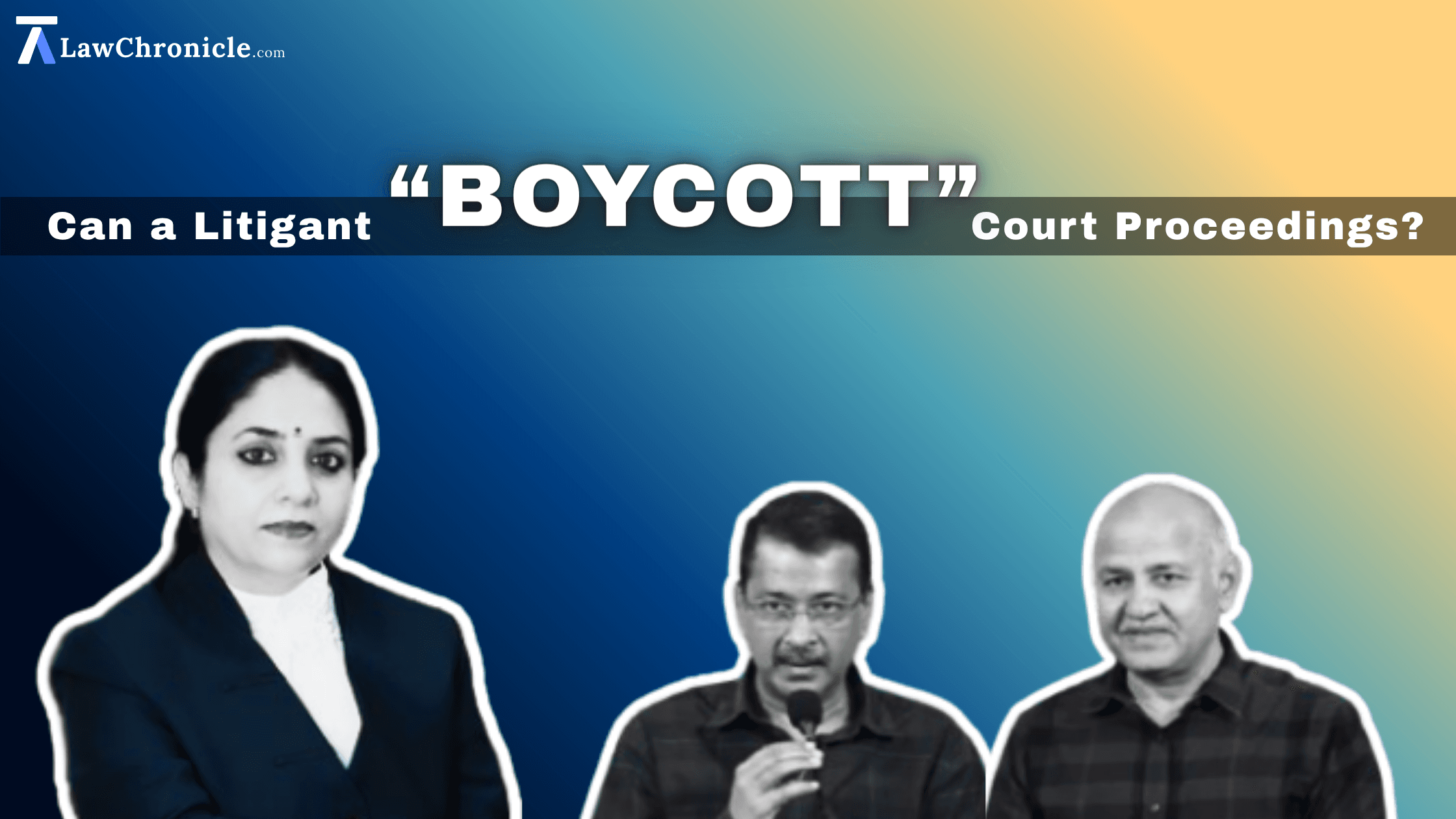
Recent developments in Justice Swarana Kanta and Arvind Kejriwal episode raised a set of questions that sit at the intersection of judicial ethics, procedural law, and constitutional conscience. Arvind Kejriwal has communicated an intention not to participate in further proceedings after recusal judgment in 2026 CaseBase(DEL) 253, in essence attempting to raise a question mark upon the fairness of the forum. Manish Sisodia followed suit through another letter, refusing participation in Court proceedings.
Now the question arises, what does the law say, when a litigant, rather than a bar association, decides to walk away from Court proceedings? What are the consequences? And where does the line fall between a legitimate conscientious stand and conduct that Courts may treat contemptuous? Let us understand as per applicable laws.
Is this Kejriwal vs Justice Swarana Kanta Sharma?
Looking back at the background of Arvind Kejriwal’s letter of “boycott”, it all started with Delhi Excise Policy Case. The Trial Court discharged Arvind Kejriwal and others, and rapped CBI for gaps in investigation. CBI approached the Delhi High Court in an appeal against the Trial Court. The matter was listed before Justice Swarana Kanta Sharma, and the accused persons filed a recusal application. Kejriwal personally argued before the Court, for alleged apprehension of bias. On 20th April, 2026, Justice Swarana Kanta Sharma refused to recuse from the case. Her recusal judgment discussed in detail the jurisprudence on grounds for recusal of judges.
After all this, Arvind Kejriwal shared a 4-paged lengthy letter on his social media, expressing his “inability, in conscience, to participate in further proceedings” before the Court. In essence, Kejriwal declared boycott of proceedings under the garb of “Satyagraha”. While acknowledging the fact that he may prejudice his own legal interests, Kejriwal clarified that his inability to participate in proceedings before Justice Swarana Kanta Sharma’s Court would be confined to “this matter and to such future proceedings in which these very apprehensions arise with equal force.”
Does the Right to Not Participate in Court Case Exist?
In India, there is no express obligation on a litigant to appear in person at every hearing. Parties appear in Courts through their counsels as a routine practice. There are times when neither party is physically present in the courtroom. However, can a party choose to withdraw that representation as a form of protest, and simply stay away?
A litigant can discharge their advocate and choose not to engage further. No Court can compel a citizen to argue their own case. The law does not punish strategic absence, nor does it treat deliberate non-participation as inherently contemptuous. However, there are consequences for such absence, as addressed below.
Ex Parte Proceedings
When a party fails to appear before a Civil or Criminal Court, the Courts are not supposed to indefinitely wait for them. The judicial system is designed to keep the proceedings moving, and a voluntary absence is not treated differently from an unintentional one.
Absence from Civil Court Proceedings
As per Order IX of the Code of Civil Procedure, 1908, Rule 16 empowers the Court to hear the matter ex parte if the plaintiff appears, but the defendant does not. Rule 8 empowers the Court to dismiss the suit where neither party appears. Rule 13 permits setting aside an ex parte decree, but only if accompanied with proof of sufficient cause, which means deliberate absence does not qualify.
Absence from Criminal Court Case
The Code of Criminal Procedure, now replaced by the Bharatiya Nagarik Suraksha Sanhita, governs appearance of parties. For a criminal revision petition pending before the High Court, the court may hear and decide the matter following submissions made by the appearing party, in case the petitioner or respondent fails to appear. A revision petition not pressed is a revision petition liable to be dismissed for non-prosecution. For a case where respondent boycotts the Court, the matter is heard to the tune of prosecution, while the other party loses its chance to place their defense on record.
Contempt of Court
Civil Contempt
As defined under Section 2(b) of the Contempt of Courts Act, 1971, it is the willful disobedience of any judgment, decree, direction, order, or writ of a court. If the court, during these proceedings, issues any order or direction binding the respondent, for example an order requiring presence, a direction to file documents, or an injunction, deliberate non-compliance may attract civil contempt proceedings.
Criminal Contempt
Section 2(c) of the Contempt of Courts Act, 1971 defines criminal contempt of court. It is more expansive, includes publication, either by words, spoken or written, by signs, or by visible representations, scandalizing or impacting the authority of Court, or interfering/prejudicing the due course of judicial proceedings, or obstructing administration of justice.
Any written communication addressed to a judge, or made publicly available, that characterises a judge as biased, conflicted, or incapable of impartial adjudication, stands in a constitutionally complex space. The Courts have time and again held that communication that goes beyond fair criticism, attributes mala fides, makes specific and grave accusations of partiality to a sitting judge, can constitute criminal contempt.
As per reports, a contempt notice has already been sent to accused persons for what happened in recusal arguments. This hints at Court’s prima facie reason to examine whether the conduct of the concerned party clears the contempt threshold.
The Possibilities
As the question of recusal by Justice Swarana Kanta Sharma in Arvind Kejriwal case follows developments on almost daily basis, she continues to allow certain recusal applications in various cases. The law per se does not punish a party for “boycott” or absence from Court proceedings. The outcome may not be so favourable, which is also clear. However, the way it all is being communicated, to the media, with videos of the Judge being circulated in social media, tampering what was said, conveying what’s not, is an attempt to diminish the institution of Judiciary. Whoever is behind such content, may bear the legal consequences.
 Breaking News