Can High Court replace Specific Performance with Monetary Refund? Supreme Court Answers
 Copy Link
 Share
Share Save
Save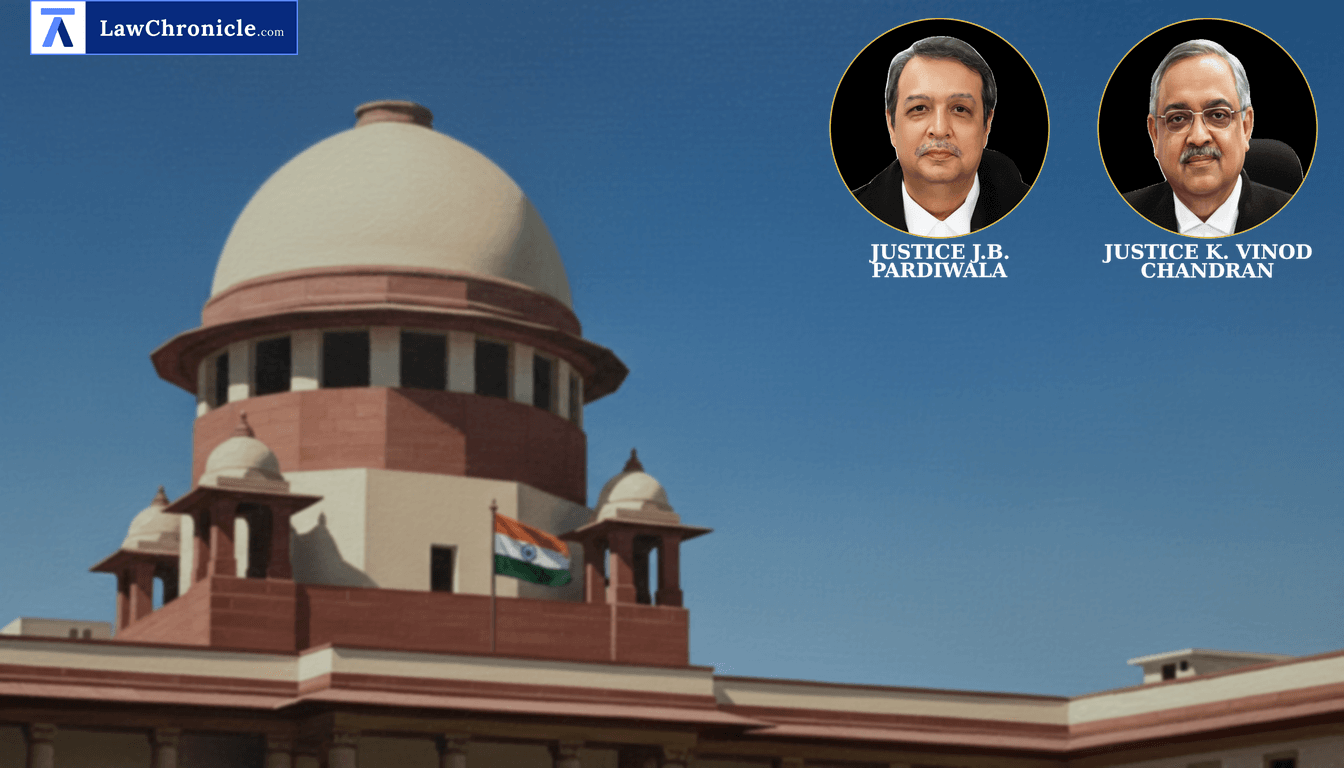
Overturning a High Court decree that arbitrarily altered a specific performance decree into a monetary refund despite court-executed sale deeds decades prior, the Supreme Court restored the absolute property rights of a buyer who has been in continuous possession since 1979.
A Division Bench comprising Justice J.B. Pardiwala and Justice K. Vinod Chandran set aside the rulings of the First Appellate Court and the High Court while hearing an appeal against a Second Appeal decision that had improperly enhanced a refund amount instead of sustaining the specific performance of a registered sale agreement.
Key Takeaways
Protection of Court-Executed Conveyances
Buyers holding valid ownership and possession through court decrees after full payment cannot be ousted decades later under the guise of equity.
Limits on Equitable Jurisdiction
High Courts cannot arbitrarily alter specific performance decrees into mere monetary refunds when the plaintiff holds valid long-standing title.
Rejection of Misapplied Precedents
Equitable enhancements of sale consideration are inapplicable where the agreement has already culminated in an executed sale deed and long-term possession.
Specific Performance in Equity
The Supreme Court underscored that equity must lie with a buyer who parted with consideration decades ago and obtained both ownership and actual possession through judicial process.
The Apex Court, in its reasoning, observed that "Equity, hence, has to be applied in favour of the plaintiff who parted with Rs.20,000/- more than four decades and a half back, and obtained the ownership and possession of the property."
Ratio
Equitable relief under Section 20 of the Specific Relief Act, 1963 cannot be invoked to displace a buyer’s lawful ownership and continuous possession established via a court-executed sale deed, simply due to the passage of time or monetary appreciation during litigation.
Background
The dispute originated from a registered agreement to sell dated June 16, 1975, for 5 bighas of agricultural land near Agra for a total consideration of Rs. 20,000, with an advance payment of Rs. 5,000. The defendant claimed the transaction was a loan security. However, the Trial Court rejected this defense, noting that the Urban Land (Ceiling and Regulation) Act, 1976 was inapplicable to agricultural land and that discretionary relief under Section 20 of the Specific Relief Act, 1963 was properly exercisable. The Trial Court decreed specific performance on February 28, 1979. Consequently, the court executed the sale deed on June 7, 1979, placing the plaintiff in continuous possession.
The First Appellate Court subsequently reversed the decree, citing lack of proof of readiness and willingness. On Second Appeal, the High Court concurred with the Trial Court's factual findings against the defendant's fabricated defense, but attempted to settle equities by ordering a refund of Rs. 15,00,000 to the plaintiff, relying on the precedent in Pratap Lakshman Muchandi and Others v. Shamlal Uddavadas Wadhwa and Others ( "(2008) 12 SCC 67": 2008 CaseBase(SC) 1269). Reversing the High Court, the Supreme Court distinguished Pratap Lakshman Muchandi and Others v. Shamlal Uddavadas Wadhwa and Others ( "(2008) 12 SCC 67": 2008 CaseBase(SC) 1269) on the ground that in the present matter, the sale deed had already been executed by the Court in 1979 and possession was delivered, thereby restoring the Trial Court decree in full.
Case Details:
Case No.: Civil Appeal No.12945 of 2026
Neutral Citation: 2026 INSC 1005
Case Title: Sobaran Singh (Dead) Through Lrs. v. Gordhan Singh (Dead) Thr. Lrs.
Appearances:
For the Petitioner(s): Sri Ashwani Kumar Singh, Senior Counsel
For the Respondent(s): Sri Jetendra Singh, Counsel
Source: 2026 CaseBase(SC) 7006
 Breaking News