Can Padma Awards Be Used as Titles? - An Analysis under Article 18 of the Constitution
 Copy Link
 Share
Share Save
Save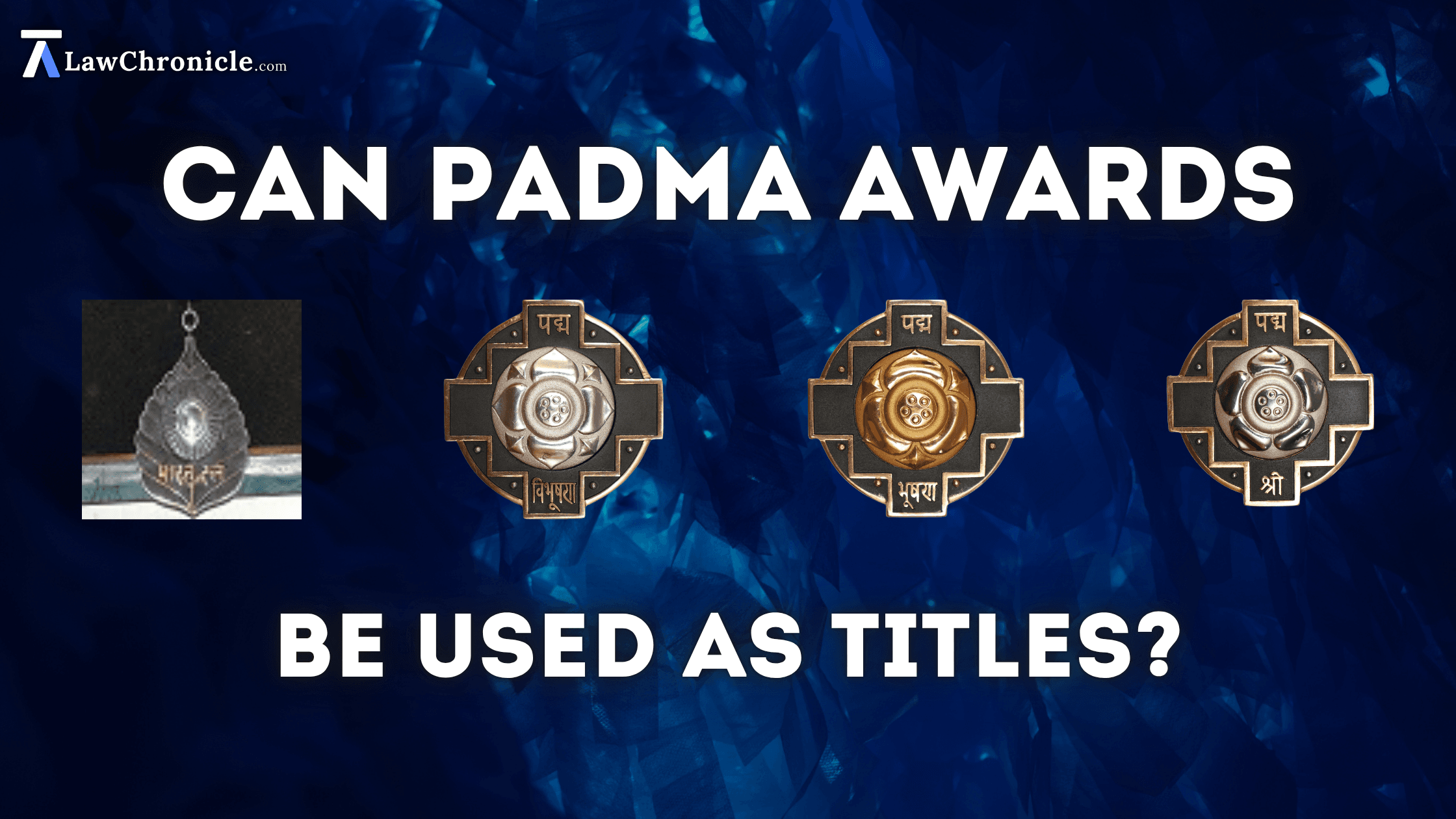
President Droupadi Murmu recently conferred Padma Awards 2026. People witnessed several known faces receiving national honour from the President of India for their contribution to various fileds including medicine, arts, Sports. Among various highlights, Rohit Sharma’s smile stole the show, while Alka Yagnik’s health raised some concerns among fans. That’s about the ceremony that took place at the Rashtrapati Bhavan. A set of legal questions that cloud every legal mind during this time of the year is “Can Padma Awards be used as Titles?” or “Are Padma Awards Titles as per Article 18 of Constitution?”.
Every year, on the eve of Republic Day, the Government of India announces the prestigious Bharat Ratna and Padma Awards, the nation’s highest civilian honours recognizing distinguished service across diverse fields. Almost inevitably, the names of awardees begin appearing with the award appended as a prefix or suffix: “Padma Shri Dr. XYZ,” or “Shri ABC, Padma Bhushan.” A pervasive misconception exists that Padma Awards function like titles, attachments to one’s name that signal rank or distinction. To be specific, Bharat Ratna and Padma Awards are not titles under Article 18(1) of the Constitution of India.
This article examines the constitutional framework, the governing rules, and the key judicial decisions that together establish why the answer to “Can Padma Awards be used as titles?” is an unequivocal NO!
Abolition of Titles under Article 18 of the Constitution
Article 18 under Part III of The Constitution of India reads as
“Abolition of titles.—(1) No title, not being a military or academic distinction, shall be conferred by the State.
(2) No citizen of India shall accept any title from any foreign State.
(3) No person who is not a citizen of India shall, while he holds any office of profit or trust under the State, accept without the consent of the President any title from any foreign State.
(4) No person holding any office of profit or trust under the State shall, without the consent of the President, accept any present, emolument, or office of any kind from or under any foreign State.”
The operative prohibition pertaining to the question of Padma Awards as titles lies in Article 18(1). It prohibits the State from conferring any title, with two important exceptions: military distinctions (such as Param Vir Chakra, Maha Vir Chakra, or military ranks) and academic distinctions (such as the title of Doctor, Professor, or similar designations conferred by statutory academic institutions).
The Intent Behind Abolition of Titles
The Constituent Assembly debates reveal that the framers of the Constitution were deeply conscious of the harm caused by the colonial British practice of conferring titles such as “Sir,” “Maharaja,” “Rai Bahadur,” “Khan Bahadur,” and similar honours upon Indians who served colonial interests. These titles sew the social hierarchy, created a class of individuals superior to ordinary citizens, and were widely viewed with contempt by the nationalist movement. As Dr. B.R. Ambedkar emphasized in the Constituent Assembly, the republic does not acknowledge masters, and that the titles that undermine equality have no place in a democratic order.
Article 18 of the Constitution was therefore embraced as a moral proclamation, that honour in India must relate to merit and service, not to the privilege of rank or birth.
The Padma Awards: Legal Framework and Governing Rules
Origin and Structure
The Padma Awards were instituted by Presidential Notifications on 2nd January 1954. The Government of India introduced four awards: the Bharat Ratna (the highest civilian honour), and three tiers of the Padma Vibhushan. In January 1955, the structure was reorganized into three distinct awards below Bharat Ratna:
- Padma Vibhushan: For exceptional and distinguished service
- Padma Bhushan: For distinguished service of a high order
- Padma Shri: For distinguished service in any field
The awards are open to persons without distinction of race, occupation, position, or sex. Government servants (other than doctors and scientists) are generally not eligible. Awards are announced on Republic Day (26 January) and presented by the President of India at a formal ceremony at Rashtrapati Bhavan.
1968 Government Press Note: The First Explicit Prohibition
In the absence of a significant ruling from Supreme Court, the Government of India was a step ahead in issuing a press note on 17 April 1968, which made it unambiguously clear that the practice of using Padma Awards such as Padma Vibhushan, Padma Bhushan, and Padma Shri, as titles on letterheads, invitation cards, posters, and books is against the scheme of the Government. The press note emphasized that civilian awards should not be attached as suffixes or prefixes to the names of awardees to give them the appearance of titles. This was reiterated by another press note in 1978.
Regulation 10: The Forfeiture Provision
Each of the four Presidential Notifications creating the Bharat Ratna and the three Padma Awards contains a Regulation 10, which empowers the President to cancel and annul the award of the decoration to any person. Upon such cancellation, the person’s name is erased from the official register, and the awardee is required to surrender the medallion and sanad.
The Supreme Court in Balaji Raghavan v. Union of India (1995) made explicit that the use of national awards as prefixes or suffixes activates Regulation 10. In other words, misuse of the award as a title is not merely a social impropriety, it is a ground for forfeiture of the award itself.
Following each award conferment, every recipient (except in posthumous cases) is individually informed about the rules of Padma awards as titles, and expressly advised not to prefix or suffix the award to their name. This is a standard administrative procedure.
Constitutionality of the Padma Awards
An important aspect to be underlined here is that while Padma Awards cannot be used as titles, the awards themselves are constitutionally valid. The Supreme Court has confirmed that the conferment of Bharat Ratna and Padma Awards does not violate Article 18 because they are recognitions of excellence, not titles that confer social rank. The Constitution permits the State to recognize merit. What it prohibits is the creation of a titled class, which these awards do not do, unless they are misused as name attachments.
Can Padma Awards Be Used as Titles? - Supreme Court Judgment
Balaji Raghavan v. Union of India (1995 CaseBase(SC) 1447)
In this case, the 5-Judge Constitution Bench of the Supreme Court addressed the question: "Are the National Awards, such as Bharat Ratna, Padma Vibhushan, Padma Bhushan, and Padma Shri, considered 'Titles' within the meaning of Article 18(1) of the Constitution of India, thereby prohibiting their conferment by the State?" The Court distinguished between "titles" that denote hereditary or feudal distinctions and "awards" that recognize merit, service, or achievement. It concluded that national awards like the Padma series and Bharat Ratna fall into the latter category. They are not meant to be permanent appellations or symbols of inherited status but rather acknowledgments of excellence.
The Court held that these awards are not 'titles' but are decorations for distinguished service in various fields. They do not violate the principle of equality as they are meant to recognize merit and not to create a class of nobility. However, the Court stipulated that these awards should not be used as prefixes or suffixes to the names of the awardees, as doing so would amount to a violation of Article 18(1). The Court directed that if an awardee uses the award as a title, they should forfeit the award. This judgment clarified and restricted the application of Article 18(1) to these national awards.
Padma Shri Dr. Sharad M. Hardikar Case (December 2025)
In what is the most recent judicial intervention on this question, the Bombay High Court in December 2025 dealt with a writ petition in which one of the respondents, a 2014 Padma Shri awardee, was described in the cause title of the case as “Padma Shree Dr. Sharad M. Hardikar.”
Justice Somasekhar Sundaresan took suo motu exception to this description while hearing the petition. The Court held that the use of “Padma Shree” as a prefix to the respondent’s name in court documents was impermissible in law, contrary to the settled constitutional position, and in direct violation of the 1995 Supreme Court Constitution Bench ruling in Balaji Raghavan.
The Court highlighted two facets:
- The Supreme Court’s 1995 Constitution Bench ruling in Balaji Raghavan is a declaration of law binding on all courts under Article 141 of the Constitution. This means that no court in India, including the High Courts, may permit Padma Awards to be used as prefixes or suffixes in cause titles, pleadings, or any official documents.
- Courts have an independent institutional duty to ensure compliance with the law as declared by the Supreme Court, particularly when it concerns constitutional provisions. Merely because a party chooses to describe itself with a Padma Award prefix does not obligate a court to accept that description.
The Bombay High Court’s order proves significant for several reasons. It is recent (December 2025), it arose in a courtroom context (underscoring that the prohibition applies even in legal proceedings), and it reaffirms the binding, non-negotiable nature of the 1995 ruling. The Court directed that the cause title be corrected to remove the impermissible prefix.
Are Padma Awards Titles? Correcting the Misconception
It is a widespread misconception that Bharat Ratna and Padma Awards are titles under Article 18(1) of the Constitution, which they are not. The misconception likely arises from two sources: first, the common everyday usage of terms like “Padma Shri” or “Bharat Ratna” in front of names, which has become socially normalized over decades; and second, a misreading of the Supreme Court’s 1995 ruling, which upheld the constitutional validity of these awards without recognizing that the Court simultaneously imposed a prohibition on their use as name appendages.
In simple words:
- Padma Awards are constitutionally valid honours for merit. Their conferment does not violate Article 18.
- Padma Awards are not “titles” in the constitutional sense. They confer no hereditary privilege, no social rank, and no legal status.
- Because they are not titles, they cannot be used as prefixes or suffixes to names. This is the direct legal consequence: if they were titles, attaching them to names might carry some legitimacy; precisely because they are not titles, using them as name attachments is prohibited.
- The prohibition is enforceable. Misuse triggers forfeiture proceedings under Regulation 10.
Practical Implications for Awardees and Institutions
The legal position has direct consequences in everyday life:
- An awardee cannot print “Padma Shri” or “Padma Bhushan” on their letterheads, visiting cards, book covers, invitation cards, or public advertisements as a prefix or suffix to their name.
- Organizers of public events, media outlets, television channels, and academic institutions cannot introduce or describe an individual as “Padma Shri [Name]” in an official or formal capacity, even as a mark of respect.
- Courts, in cause titles of cases, cannot describe a party as “Padma Shri Dr. [Name]”, the Bombay High Court’s December 2025 ruling makes this explicit.
- The award can be acknowledged factually, as in, “[Name], who is a recipient of the Padma Shri” or “Padma Shri awardee [Name]”, since this is a statement of fact, not a use of the award as a title.
- Authors may mention the award in biographical notes. Publishers may note it on book jackets as biographical information. The prohibition is specifically on the award being used as an attachment to the name itself.
 Breaking News