


Civil Disputes Cannot Be Given Criminal Colour To Harass Litigants: Supreme Court
 Copy Link
 Share
 Save
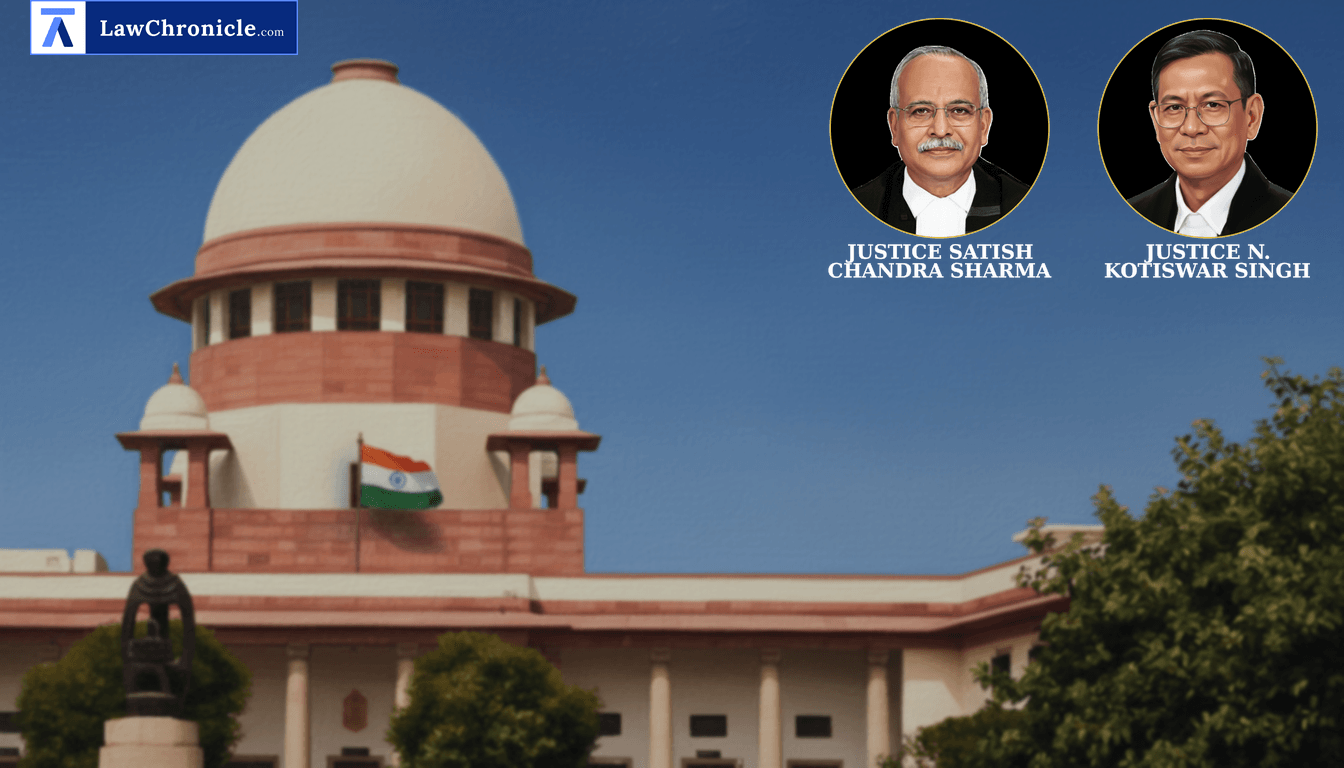
Rebuking the persistent tendency of litigants to convert civil breaches into criminal offences, the Supreme Court has quashed criminal proceedings against a Power of Attorney holder after similar charges against the primary landowners were previously set aside. The Apex Court held that coordinate benches must adhere strictly to judicial consistency and propriety, warning against stretching criminal culpability beyond the primary actors in transaction disputes.
Heading an Extra-Ordinary Criminal Jurisdiction bench, Justice Satish Chandra Sharma and Justice Nongmeikapam Kotiswar Singh allowed the appeal, setting aside a Karnataka High Court order that had refused to quash an FIR registered under Sections 420, 423, and 120-B read with Section 34 of the Indian Penal Code, 1860.
Key Takeaways
Judicial Consistency Binding on Coordinate Benches: Coordinate benches of High Courts are bound by principles of judicial propriety and must extend identical relief to co-accused similarly situated.
Protection for Power of Attorney Holders: A Power of Attorney holder or confirming party to a transaction cannot be saddled with criminal liability if no independent deception or unauthorized act is attributed to them.
Missing Ingredients of Cheating: A subsequent failure or delay in executing a sale deed does not convert a civil transaction into cheating unless fraudulent intent existed at the inception.
High Court Erred in Traversing Beyond Scope of Allegations
The Supreme Court observed that the High Court had committed a grave error by relying on speculative distinguishing features, such as whether the consideration received by the petitioner was transmitted to the landowners, even when the landowners had made no such grievance. The Apex Court emphasized that casting the shadow of criminality over pure civil disputes constitutes an abuse of the judicial process. The Bench expressed that "The tendency of litigants to colourize civil disputes into criminal offences is an open secret in the present times. The courts have tried to put their foot down to prevent the litigants from obliterating the fine distinction between the two. We have done so to prevent the abuse of criminal process."
Addressing the mis-invocation of criminal provisions, the Supreme Court noted: “Notably, the offence of cheating requires a deceptive act which leads to inducement for delivery of property/money. Even on bare perusal of the allegations, it becomes clear that the property... was not transferred on the basis of any deception. At that time, the property could have legitimately been transferred... Thus, the foundational ingredient of cheating is missing.”
Ratio
Where an FIR arising out of a contractual sale dispute is quashed against primary landowners due to its purely civil nature, criminal culpability cannot be extended to a confirming party or Power of Attorney holder in the absence of distinct acts of deception or unauthorized conduct. Coordinate benches of a High Court must adhere to principles of judicial consistency and judicial propriety when dealing with identically situated co-accused.
Background
The dispute originated from an agreement for sale executed in 2012 by the petitioner as a General Power of Attorney (GPA) holder on behalf of landowners for a parcel of land in Channasandra Village, Karnataka. The prospective buyers failed to pay the balance consideration within the stipulated seven-month timeframe or during the limitation period. Subsequently, in 2016, the landowners and the petitioner executed a final sale deed in favor of a third party.
Promptly after the sale, the prospective buyers filed a civil suit for specific performance and simultaneously lodged an FIR alleging cheating and fraud under the Indian Penal Code, 1860. While the High Court of Karnataka quashed the FIR against the landowners in 2017 observing the dispute was purely civil, a different bench later dismissed the petitioner's quashing petition in 2022. Aggrieved by the refusal to extend parity, the petitioner approached the Supreme Court.
Case Details:
Case No.: Special Leave Petition (Crl.) No. 12638 of 2022
Neutral Citation: 2026 INSC 1086
Case Title: Sudha Rakesh v. The State of Karnataka & Anr.
Source: 2026 CaseBase(SC) 8236
Similar Articles
 Breaking News


