CJI Surya kant Misquoted on "Cockroaches” Remark - What Exactly Happened?
 Copy Link
 Share
Share Save
Save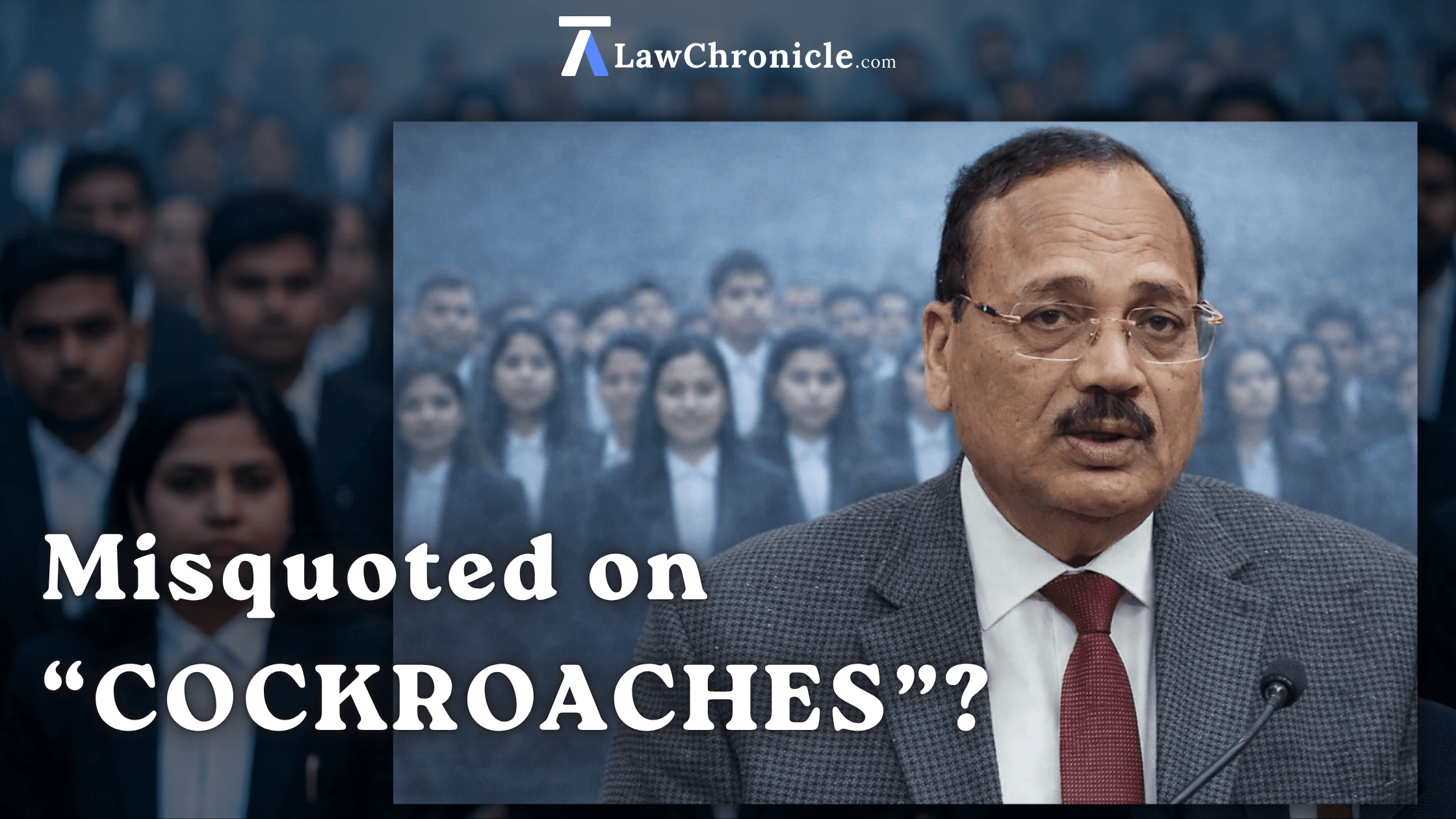
Chief Justice of India, Justice Surya Kant was at the centre of a recent controversy. The reason was some remarks made during a Supreme Court hearing, which were widely reported as comparing “unemployed youngsters” to “cockroaches” and “parasites”. The remarks, made while hearing a plea for designation of Senior Advocate, triggered sharp criticism across social media, particularly among the legal fraternity.
Soon after, the CJI issued a clarification stating that his observations had been “misquoted”. He suggested the reference specifically to individuals entering professions using “fake and bogus degrees,” not the youth of the nation at large.
CJI’s Cockroach Remarks
Reports quoted the CJI as saying that “some unemployed youngsters become media, social media, RTI activists and other activists” and “start attacking everyone.” The original remarks were harsh – true! In India, oral observations by judges shape public opinion, media narratives, and sometimes even future litigation strategies. Their impact is wide spreading, more so when coming from the Chief Justice of India, as happened in this very instance.
The “Proud Cockroach”
Amid the media reports about CJI Surya Kant’s remarks, young, struggling lawyers were outraged, for the very fact that their struggle was demeaned by the highest Constitutional designate in the Indian Judiciary. Posts of “I’m Proud Cockroach” have been surfacing everywhere since then. The fact that not everyone in the profession comes from NLU, wealthy families or English-medium institutions weighed upon this debate.
First generation lawyers having no Father/Uncle in the legal profession is already a sensitive nerve to strike upon the struggle of legal professionals. Those coming from small towns with broken English and no “godfather”, only receive rejections from big law firms. Senior Advocates refuse mentorship, and on top of it all, there is no easy money and awaiting opportunities for them, so they must carve their own paths.
All the aforementioned factors are the reason why, and how, an oral remark became a moment of national sensation, particularly in the name of cockroaches.
Two Sides of the Coin
The instant controversy has two sides – CJI Surya Kant whose remarks became the subject of a controversy, and the media reports which added fuel to fire. Several reports and social media posts amplified the “cockroach” analogy in isolation, framing it as a sweeping insult directed at unemployed youth generally. As expected, outrage followed from several sections, including those who were preparing for Judiciary, and those who were Junior lawyers and struggling in the profession.
In a country struggling with unemployment anxieties, exam scandals, shrinking professional opportunities, and rising frustration among educated youth, the phrase struck a raw nerve. Many interpreted it not as criticism of fraudulent professionals but as contempt for struggling citizens themselves.
Clarification by CJI Surya Kant
In his defense against the ongoing controversy, Justice Surya Kant claimed that the remarks were misquoted. He was clear that what he said pertained to those with fake law degrees, and then weaponising media or activism to attack institutions, and not the unemployed youth. The clarification issued by the CJI attempts to restore context. That distinction matters, since the Court has a duty to condemn fraud within the legal profession and beyond.
Oral Observations vs Twist and Turn Media
With technological advancements and live streaming of Courts, news travels kilometers within seconds. In recent years, oral observations from courts have become headline material before final orders are even uploaded. Fragments of hearings circulate instantly through live updates, tweets, reels, and commentary accounts. Judges often complain of being quoted out of context, while the public increasingly forms opinions based on snippets rather than judgments.
But this reality is now permanent. Courts are no longer insulated institutions operating beyond public interpretation. The judiciary today exists within a real-time information environment. Hence, the instant controversy is a two-folded lesson for the stakeholders.
Way Forward
For Media, the lesson is straightforward: courtroom reporting must resist sensational shorthand. Selective extraction of provocative lines without surrounding context can distort meaning and damage institutional credibility. Legal journalism carries a higher threshold of precision because judicial speech affects public trust in constitutional institutions.
At the same time, the judiciary cannot entirely dismiss criticism by blaming “misquotation.” Public offices perhaps demand some sort of linguistic restraint. Strong, dehumanizing metaphors like “cockroaches” or “parasites” are bound to escape their intended boundaries once spoken in open court. Even if directed at a limited category, or in a justified context, could, and should have been avoided.
Perhaps the real lesson from this episode is that constitutional communication in the digital age can no longer rely on assumptions of context. Every spoken word from a courtroom now travels instantly into a fractured public conversation. Once released into that arena, language develops a life of its own.
 Breaking News