


Commercial Disputes Cannot Be Given Criminal Overtone: SC Quashes BNS FIR
 Copy Link
 Share
 Save
Converting a commercial dispute arising out of a written contract into a criminal prosecution constitutes an abuse of the process of the court. Quashing an FIR registered for cheating and criminal breach of trust under the Bharatiya Nyaya Sanhita, 2023, the Supreme Court firmly reiterated that breach of contract cannot give rise to criminal proceedings without proof of fraudulent intention right from the inception.
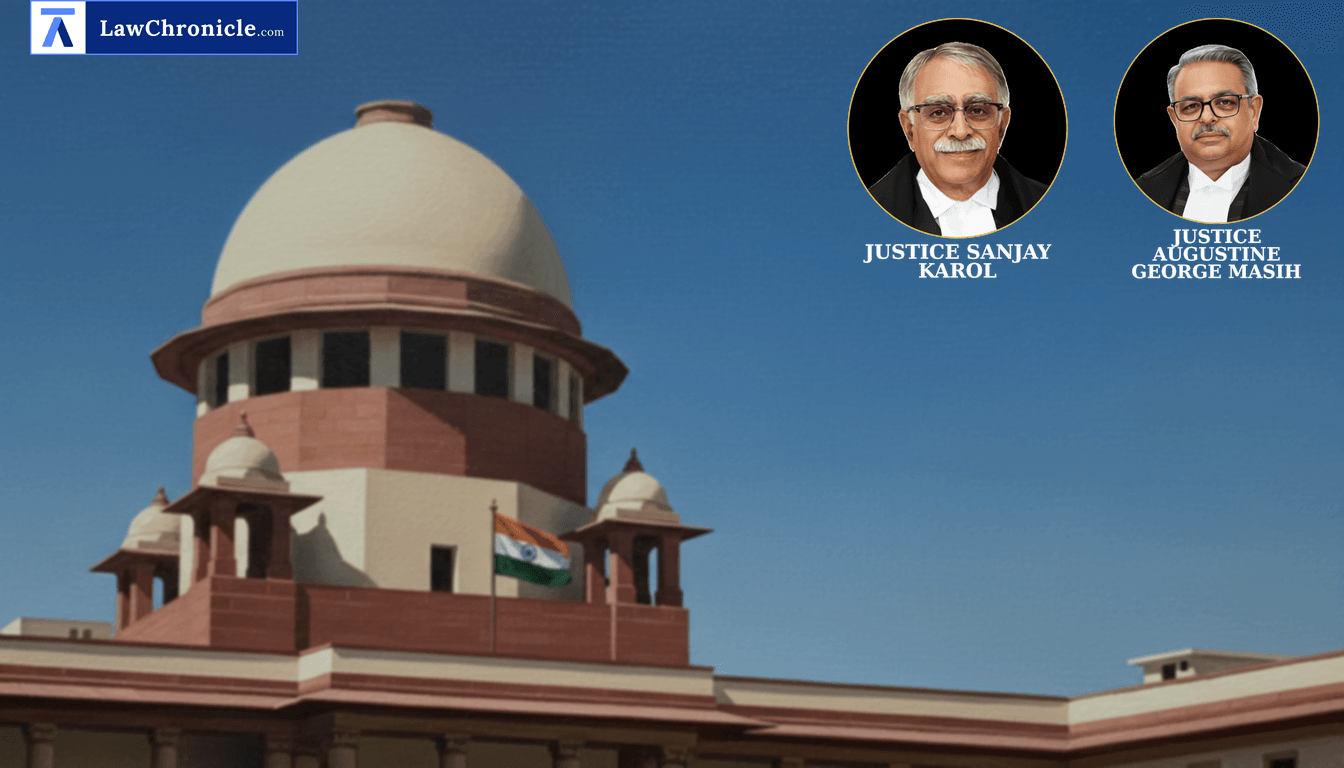
A bench comprising Justice Sanjay Karol and Justice Augustine George Masih was hearing appeals against the judgment of the High Court of Jharkhand, which had declined to quash an FIR registered under Sections 316(2), 318(4), and 3(5) of the Bharatiya Nyaya Sanhita, 2023 against company executives arising from a business distributorship dispute.
Key Takeaways
- Commercial vs Criminal Disputes: Ordinary contractual defaults or price disputes cannot be weaponized into criminal cases under Bharatiya Nyaya Sanhita, 2023.
- Cheating Requires Initial Deceit: Offence of cheating under Section 318(4) of Bharatiya Nyaya Sanhita, 2023 fails if there is no dishonest intention at the time of initial inducement.
- Advance Money Is Not Entrustment: Money paid towards advance supply of goods passes as consideration, ruling out criminal breach of trust under Section 316(2) of Bharatiya Nyaya Sanhita, 2023.
- Antithetical Offences: Alleging cheating and criminal breach of trust on identical facts reflects non-application of mind, as both offences are legally antithetical.
Court's Observations and Legal Principles
Analyzing the statutory scope, the Court observed that Section 318(4) of Bharatiya Nyaya Sanhita, 2023 corresponds to Section 420 of the Indian Penal Code, 1860, while Section 316(2) corresponds to Section 406 of the Indian Penal Code, 1860. Relying on Delhi Race Club (1940) Ltd. v. State of U.P. ( "(2024) 10 SCC 690": 2024 CaseBase(SC) 209) and Hridaya Ranjan Prasad Verma v. State of Bihar ( "(2000) 4 SCC 168": 2000 CaseBase(SC) 392), the Court stressed that mere breach of contract does not constitute cheating unless dishonest intention exists right from the beginning. Furthermore, under Section 482 of the Code Of Criminal Procedure and Article 226 of the Constitution of India, 1950, as illuminated in State of Haryana v. Bhajan Lal, criminal proceedings must be quashed if allegations taken at face value do not disclose any cognizable offence.
The Court, in its reasoning, observed: "Mere breach of contract cannot give rise to a criminal prosecution for cheating unless fraudulent or dishonest intention is shown right from the beginning of the transaction i.e. the time when the offence is said to have been committed. Therefore, it is this intention, which is the gist of the offence."
Addressing the allegation of criminal breach of trust, the Court clarified that advance payment made for goods does not constitute entrustment. Examining attending circumstances, as permitted in Mohammad Wajid v. State of U.P. ( "2023 SCC OnLine SC 951": 2023 CaseBase(SC) 817), the bench observed that the FIR was an afterthought following contractual disputes over pricing.
While the informant relied on C.S. Prasad v. C. Satyakumar ( "2026 INSC 39": 2026 CaseBase(SC) 24) and Neeharika Infrastructure Pvt. Ltd. v. State of Maharashtra ( "(2021) 4 SCR 1044": 2020 CaseBase(SC) 1378) to argue that civil and criminal liability can co-exist and legitimate investigation should not be thwarted, the Court held that a missing element of legal intention cannot be supplied by investigation.
The Court issued the following directions:
"In the result, both the appeals are allowed. The common judgment and order dated 19.02.2025 passed by the High Court of Jharkhand at Ranchi in W.P. (Cr.) No. 1041 of 2024 and W.P. (Cr.) No. 1042 of 2024 is set aside. The first information report registered as Kotwali P.S. Case No. 323 of 2024 at Police Station Ranchi Kotwali, District Ranchi, for the offences punishable under Sections 316(2), 318(4) and 3(5) of the Bharatiya Nyaya Sanhita, 2023, and all proceedings arising therefrom, stand quashed."
Ratio
A breach of a commercial contract does not attract criminal prosecution for cheating under Section 318(4) of Bharatiya Nyaya Sanhita, 2023 in the absence of specific factual allegations establishing fraudulent or dishonest intention at the time of initial inducement, nor does advance contractual payment constitute entrustment required for criminal breach of trust under Section 316(2) of Bharatiya Nyaya Sanhita, 2023.
Background
The informant, sole proprietor of M/s D.K. Enterprises, entered into an agreement on 29.03.2024 for distributorship of camphor manufactured by M/s Oriental Aromatics Limited. After remitting Rs. 73,00,000 as advance and receiving goods worth Rs. 31,49,167, disputes arose regarding higher supply pricing compared to other distributors. The company terminated the distributorship, prompting the informant to file an FIR naming company officials, alleging cheating and non-refund of Rs. 41,50,833.
The appellants approached the High Court of Jharkhand seeking quashing of the FIR, but the High Court dismissed their writ petitions. Reversing the High Court's decision, the Supreme Court found that the allegations failed to satisfy the essential ingredients of cheating or criminal breach of trust and quashed the FIR.
Case Details:
Case No.: Criminal Appeal No. of 2026 [Arising out of SLP (Crl.) No. 3933 of 2025]
Neutral Citation: 2026 INSC 846
Case Title: Parag Kishore Satoskar and Others v. State of Jharkhand and Another
Source: 2026 CaseBase(SC) 781
Similar Articles




 Breaking News


