Commercial Roadside Lands Can't Be Arbitrarily Allotted To Strangers: Supreme Court
 Copy Link
 Share
 Save
The Supreme Court has ruled that prime roadside land carrying immense commercial value cannot be arbitrarily stripped away from original tenure holders to enrich third parties under the guise of land consolidation schemes. Affirming the primacy of physical spot inspections over mechanical administrative orders, the Apex Court upheld the restoration of highly valued commercial land to its rightful original holders.
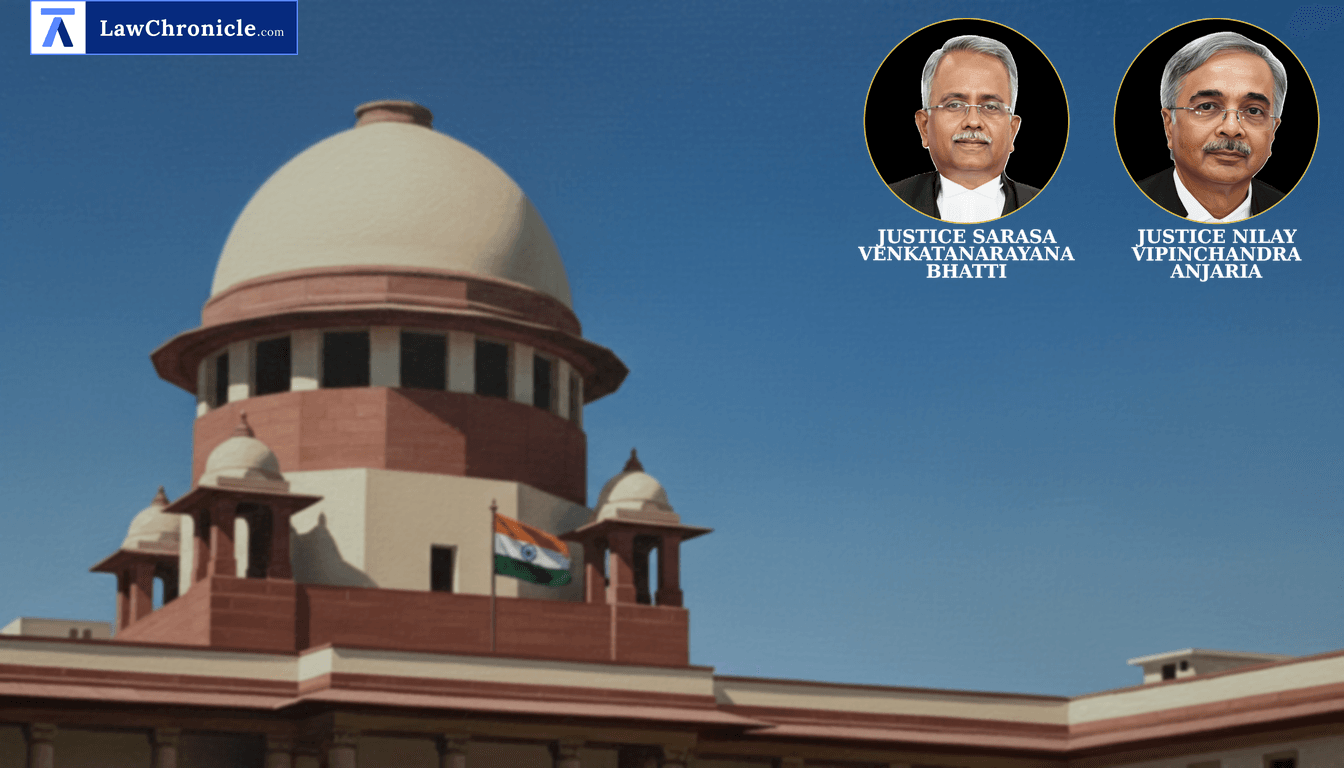
A bench comprising Justice S.V.N. Bhatti and Justice N. V. Anjaria dismissed an appeal challenging an order of the Allahabad High Court, which had set aside a order of the Deputy Director of Consolidation (DDC) that illegally allotted prime roadside land to strangers.
Key Takeaways
Protection of Commercial Tenure Rights: Authorities cannot dislodge original tenure holders from high-value roadside plots during consolidation operations to accommodate third parties with no prior rights.
Pragmatic Primacy of Spot Inspections: Orders passed by appellate consolidation officers based on actual physical spot reports hold greater evidentiary weight than mechanical administrative affirmations.
Strict Adherence to State Circulars: Executive instructions prohibiting the inclusion or arbitrary reallocation of prime commercial roadside land under the Uttar Pradesh Consolidation of Holdings Act, 1953 are binding on consolidation officers.
Court Observations and Directions
The Supreme Court observed that the records failed to demonstrate proper consideration of either the physical location or the commercial value of the subject plot during initial consolidation. The bench noted that the appellants possessed no underlying rights over the plot, whereas the respondents were the undisputed original tenure holders. It observed that “In the Consolidation Proceedings, the record does not make it clear whether the valuation of the subject matter or its physical location was properly considered. The Appellants, admittedly, did not hold any right vis-a-vis the subject matter. On the contrary, the Respondents are the original tenure holders. The SOC’s Spot Inspection Report and its Order dated 18.09.1992 make it clear that the subject matter abuts the highway. The inclusion of the subject matter and its allotment to the Appellants, who have no preferential right, is not supported by any valid reason.” Validating the High Court's findings, the Supreme Court held that the DDC committed a manifest illegality by recording mechanical reasons to set aside the Settlement Officer of Consolidation's (SOC) well-reasoned order.
Ratio
Under Section 19 of the Uttar Pradesh Consolidation of Holdings Act, 1953 read with administrative circulars, high-value roadside land must either be excluded from consolidation schemes or preferentially allotted to its original tenure holders. Allocating prime commercial roadside holdings to strangers lacking prior tenure rights while displacing original owners constitutes a manifest illegality and a violation of the statutory scheme.
Background
The dispute pertained to Plot No. 159 in Barahpur Pandey Village, Basti District, Uttar Pradesh. Consolidation operations commenced under Section 4(2) of the Uttar Pradesh Consolidation of Holdings Act, 1953 in October 1973. In April 1978, the Assistant Consolidation Officer (ACO) allotted portions of the roadside plot to the appellants, who admittedly had no pre-existing rights over the land. Possession was delivered in 1982, displacing the respondents, who were the original tenure holders.
In January 1986, the Assistant Director of Consolidation (ADC) set aside the allotment scheme upon finding that prime roadside land abutting the Ayodhya market road had been arbitrarily allotted in violation of executive instructions and regulatory forms (C.H. Form 23 Part 1). The matter was remanded to reconsider chak allotments. Although the Consolidation Officer again confirmed allotment in favour of the appellants in June 1992, the SOC reversed this in September 1992 after a spot inspection established that the land abutted the main road and original holders were wrongfully excluded.
However, the DDC reversed the SOC's decision on December 31, 1992. The respondents subsequently filed a writ petition before the High Court of Judicature at Allahabad under Section 11-A and Section 9 of the Act, referencing State Circulars dated 26.05.1981 and 09.09.1988. The High Court quashed the DDC's order, observing that consolidation schemes are not meant to dislodge tenure holders from prime land by allotting it to strangers, and rejected the appellants' equity claims regarding constructions raised in haste. The Supreme Court affirmed the High Court's judgment and dismissed the Civil Appeal.
Case Details:
Case No.: Civil Appeal No. OF 2026 [Arising out of S.L.P. (C) No. 15053 of 2017]
Neutral Citation: 2026 INSC 1199
Case Title: Rama Pandey and Others v. Ram Lal (Dead) Through LR. and Others
Appearances:
For the Petitioner(s): Mr. Punit Vinay, Advocate
For the Respondent(s): Mr. Pradeep Kumar Yadav, Advocate
Source: 2026 CaseBase(SC) 9616
 Breaking News