Commercial Suits Cannot Tolerate Piecemeal Evidence: SC Rejects Delayed Filing
 Copy Link
 Share
Share Save
Save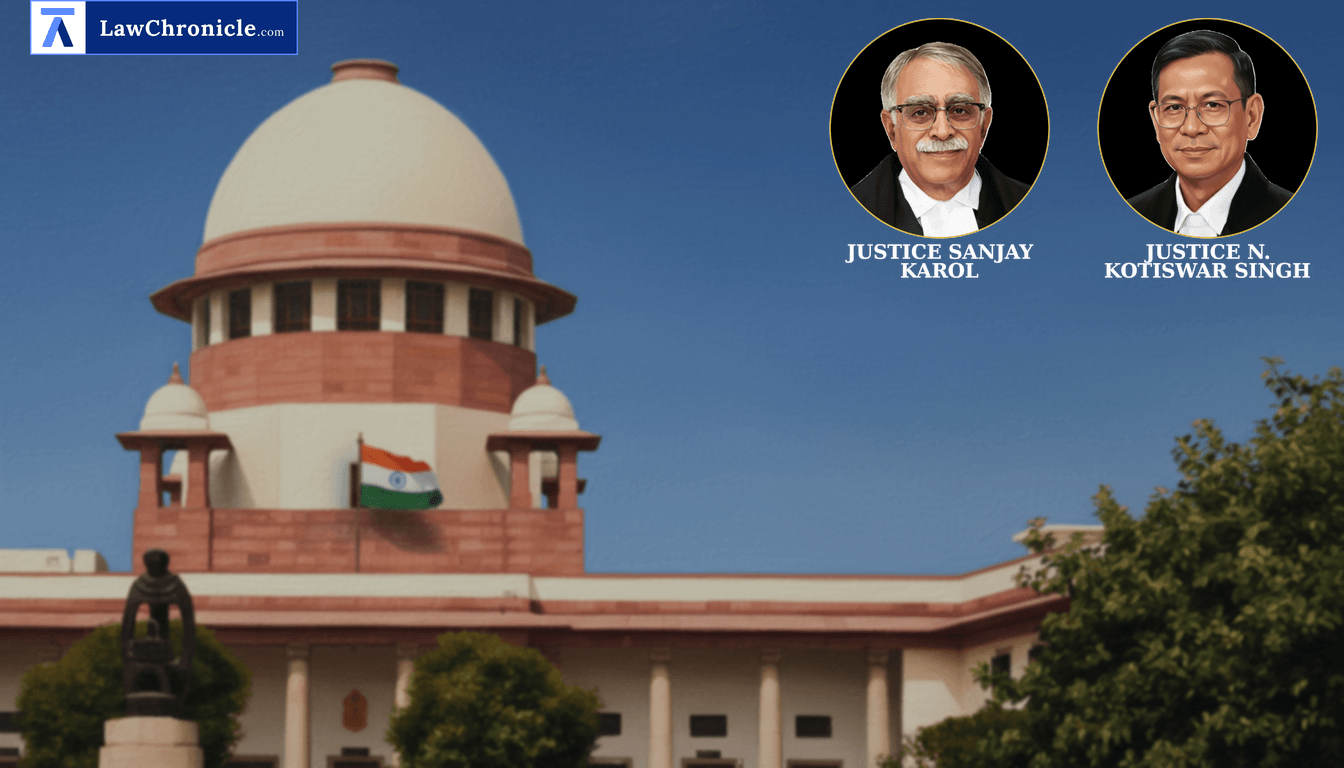
The Supreme Court has slammed the brakes on dilatory trial tactics in commercial disputes, ruling that the rigorous timelines of the Commercial Courts Act, 2015 leave no room for a 'stop and go' approach or the belated introduction of documents previously in a party's possession.
A bench comprising Justice Sanjay Karol and Justice Nongmeikapam Kotiswar Singh dismissed an appeal challenging a High Court order that had denied a plaintiff's request to bring additional documents on record eight years after the suit was instituted. The Court emphasized that the legislative intent of the Commercial Courts Act, 2015 is to ensure the highest level of expedition in commercial litigation to enhance the ease of doing business in India.
The Strict Rigour of the Commercial Courts Act
The Court undertook an extensive analysis of the Commercial Courts Act, 2015, noting its objective of providing a time-bound mechanism for resolving commercial disputes. While examining the interplay between the Civil Procedure Code, 1908 and the Commercial Courts Act, 2015, the bench observed that the specialized Act was designed to adapt to a changing business landscape.
Referring to the precedent in Ambalal Sarabhai Enterprises Ltd. v. K.S. Infraspace LLP ( "(2020) 15 SCC 585": 2019 CaseBase(SC) 1728), the bench noted that the Commercial Courts Act, 2015 requires proactive judicial management and strict construction of timelines. The Court also highlighted the mandatory nature of pre-institution mediation as established in Patil Automation (P) Ltd. v. Rakheja Engineers (P) Ltd., reiterating that commercial disputes must be extinguished with maximum expedition.
Rejection of 'Reasonable Cause' for Delay
The appellant argued that the delay was due to the voluminous nature of emails and that certain facts only emerged during cross-examination. However, the Court found these grounds uninspiring, particularly since the appellant had already been granted one opportunity for additional evidence in 2018.
As per Sudhir Kumar vs. Vinay Kumar G.B., any leave to file additional documents must be backed by a 'reasonable cause' for non-disclosure at the time of filing the suit. The Court clarified that while 'reasonable cause' might be a lower threshold than 'sufficient cause' discussed in State of Maharashtra vs. Borse Bros. Engineers & Contractors (P) Ltd. and Basawaraj v. LAO, it cannot be used to condone negligence or a piecemeal approach to evidence.
"Evidence, however voluminous, cannot water down the statutory intent and rigours of the statute... what this Court would be essentially doing is condoning a piecemeal approach to the proceedings of a commercial suit the procedure for which has entirely been conceived for promoting the ease of business and recognising the need for expediency in resolving high stakes disputes."
Applicability to Pending Suits
The Court rejected the argument that the strict standards of the Commercial Courts Act, 2015 should not apply to the current suit because it was filed in 2015. Under Section 15 of the Commercial Courts Act, 2015, all pending suits of a specified value must be transferred to Commercial Divisions, and once transferred, the procedures of the Commercial Courts Act, 2015 apply in full force.
The Court has the following directions:
"The appeal is dismissed with a direction, however, that the suit be decided as expeditiously as possible. No costs."
Key Takeaways:
Statutory Timelines are Inviolate
Procedural rigours of the Commercial Courts Act are mandatory and cannot be relaxed for voluminous evidence or lack of diligence.
No Second Chances for Negligence
Parties in possession of documents at the time of filing cannot seek to introduce them later to fill gaps in evidence or respond to cross-examination.
Expedited Trials as Economic Policy
Speedy resolution of commercial disputes is categorized as a vital aspect of judicial administration intended to attract global capital.
Mandatory Transfer and Application
Once a pending suit is renumbered as a commercial suit, the full spectrum of the Commercial Courts Act’s procedural amendments to the CPC becomes applicable.
Ratio Decidendi:
Under Order XI Rule 1 and Rule 5 of the Civil Procedure Code, 1908 (as amended by the Commercial Courts Act, 2015), a party cannot be permitted to lead evidence in a piecemeal manner or introduce additional documents at a late stage of trial when such documents were already in their possession, as the statutory intent of the Commercial Courts Act, 2015 necessitates expediency and proactive case management over equitable considerations of delay.
Case Details:
Case No.: Civil Appeal No. ___ of 2026 (Arising out of SLP (C.) No. 13250 of 2026)
NeutralCitation: 2026 INSC 674
Case Title: M/S. Levitate Mobile Technologies Pvt. Ltd. v. M/S. Standard Chartered Bank & Anr.
Appearances:
For the Petitioner(s): Mr. Gopal Sankaranarayanan, Senior Counsel
For the Respondent(s): Mr. Sanjay Gupta, Advocate; Mr. Ateev Mathur, Advocate
Source: 2026 CaseBase(SC) 630
 Breaking News