Conditional Deposit in Court does not stop Accrual of Interest: Supreme Court
 Copy Link
 Share
Share Save
Save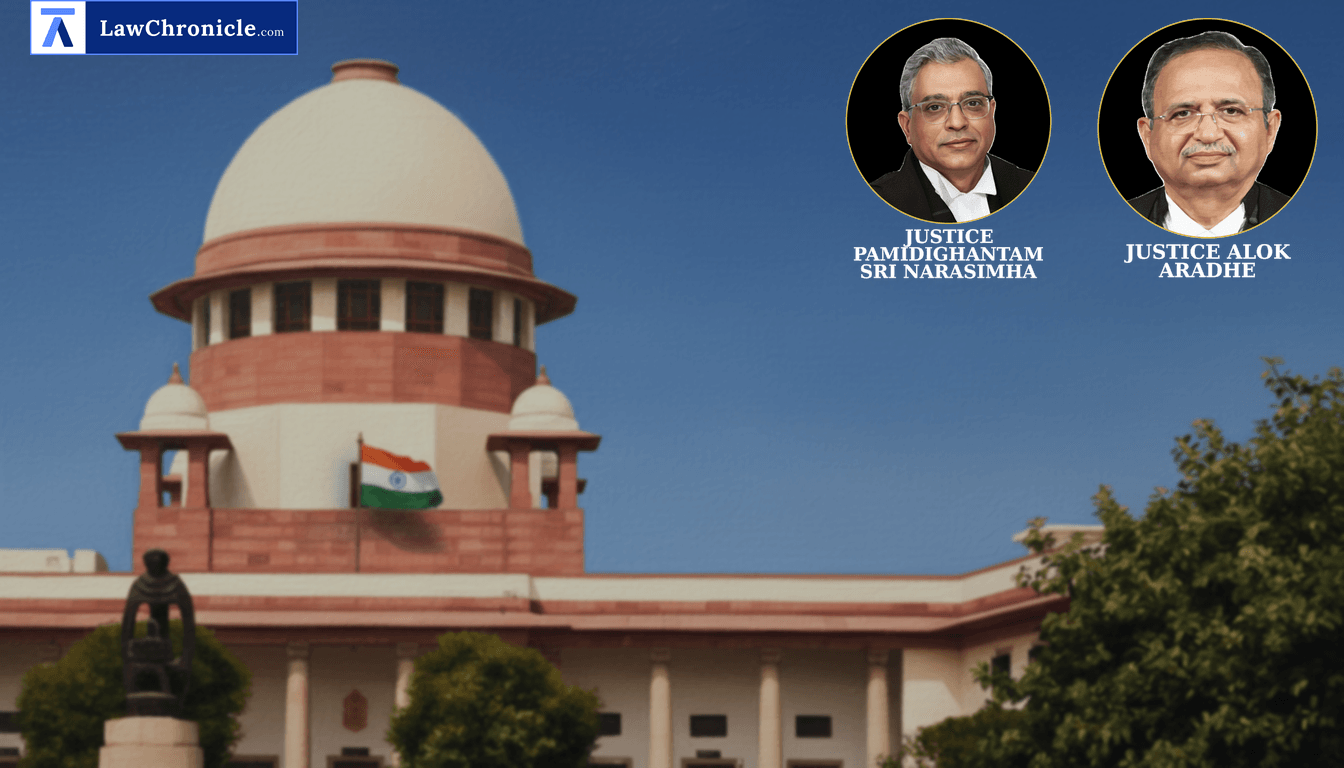
The Supreme Court has ruled that a conditional deposit of an awarded amount by a judgment-debtor does not absolve them from accrual of interest post-award, unless the award-holder can access and enjoy the funds unconditionally. Addressing the systemic problem of judicial asymmetry in managing Court Deposits, the Bench also made a formal reference to the Law Commission of India to draft a standardized framework for handling court registries and interest accruals nationwide.
A Division Bench comprising Justice Pamidighantam Sri Narasimha and Justice Alok Aradhe presided over the appeal challenging a High Court order enforcing execution and interest liabilities. The dispute centered on whether a conditional deposit made to obtain a stay on an arbitral award extinguishes the liability to pay interest during the pendency of judicial challenges.
Key Takeaways
Conditional Deposit Does Not Halt Interest: Depositing funds in court under stay conditions does not extinguish interest liabilities unless the decree-holder can access the money unconditionally.
Statutory Framework Gaps Highlighted: The court recognized that the Arbitration And Conciliation Act, 1996 lacks clear guidance on the interplay between conditional deposits and interest accrual.
Law Commission Reference: The Supreme Court requested the Law Commission of India to formulate a uniform national framework for managing court deposits in consultation with the RBI and the Finance Ministry.
Applicability of CPC in Execution: While arbitration is a self-contained code, Section 36 explicitly imports execution principles from the Code of Civil Procedure, 1908.
Conditional Deposit and Accrual of Interest
The Supreme Court underscored that placing a sum beyond the debtor's reach is fundamentally different from placing it in the hands of the creditor. When a decree-holder is required to furnish security to withdraw deposited amounts, the deposit cannot be treated as a satisfaction of the award under Order XXI Rule 1 of the Code of Civil Procedure, 1908.
The Apex Court observed that "A deposit is not synonymous with payment. A sum put beyond the debtor's own reach neither extinguishes his liability nor places it in the creditor's hands. Between the deposit of a sum in court and the final discharge of liability lies a spectrum of possibilities, attended by a corresponding degree of uncertainty... A deposit of the amount in the court has to be made unconditionally and the same must be available to the decree-holder for withdrawal, in order to make the deposit in consonance with Order XXI Rule 1 of the Code."
The Bench accordingly requested the Law Commission of India to examine the issues highlighted while considering laws enacted by other countries in terms of accruing interest on conditional deposit. The Supreme Court also found it necessary for the Law Commission to consult the Reserve Bank of India, Ministry of Finance and also the Nodal Ministry of Law and Justice.
Ratio
An award-debtor's liability to pay interest on an awarded sum under an arbitral award or money decree ceases only when an unconditional deposit is made and made fully accessible for withdrawal by the award-holder without requiring security. Conditional deposits made to secure a stay of execution do not constitute satisfaction of the decree or halt the running of post-award interest.
Background
An Arbitral Award was passed on June 13, 2019, directing the appellant to pay Rs. 1,46,40,005.02 along with interest at 12% per annum. Challenging the award under Section 34 of the Arbitration And Conciliation Act, 1996, the appellant obtained an ex-parte stay conditional upon depositing 50% of the principal sum. The appellant deposited Rs. 73,20,003/- via demand draft. After the Section 34 petition was dismissed, the respondent initiated execution proceedings, while the appellant pursued an appeal under Section 37 of the Arbitration And Conciliation Act, 1996 and subsequently a Special Leave Petition before the Apex Court.
During execution proceedings, the executing court directed the deposit of the balance amount, which the appellant complied with by depositing Rs. 1,53,17,792/-. However, the appellant consistently opposed the release of the funds to the respondent. When the High Court permitted a conditional release of Rs. 1 Crore subject to furnishing title deeds as security, the respondent was unable to fulfill the condition due to financial distress. The complete sum became available to the respondent unconditionally only on September 8, 2022, following the dismissal of the appellant's SLP.
The executing High Court held that the appellant remained liable to pay 12% interest per annum for the period from June 13, 2019, to September 8, 2022, since the funds were rendered unavailable for the decree-holder's use due to continuous opposition. Aggrieved, the appellant approached the Supreme Court.
The Supreme Court analyzed precedents including Fuerst Day Lawson Ltd. v. Jindal Exports Ltd., Sundaram Finance Limited & Anr. v. T. Thankam, Sundaram Finance Ltd. v. Abdul Samad & Anr. ( "(2018) 3 SCC 622": 2018 CaseBase(SC) 916), Pam Developments Private Ltd. v. State of West Bengal ( "(2019) 8 SCC 112": 2019 CaseBase(SC) 3841), K.L. Suneja & Anr. v. Dr. Manjeet Kaur Monga (Dead) Through her LR & Anr., P.S.L. Ramanathan Chettiar & Ors. v. O.R.M.P.R.M. Ramanathan Chettiar, Nepa Ltd. through its Senior Manager (Legal) v. Manoj Kumar Agrawal ( "2022 SCC OnLine SC 1736": 2022 CaseBase(SC) 1239), Delhi Development Authority v. Bhai Sardar Singh & Sons, DLF Limited & Anr. v. Koncar Generators & Motors Limited, Paramjeet Singh Patheja v. ICDS Ltd., and Gurpreet Singh v. Union of India ( "(2006) 8 SCC 457": 2006 CaseBase(SC) 411). Reaffirming the distinction between conditional deposits and actual payments, the Apex Court affirmed the High Court's order and dismissed the appeal.
Case Details:
Case No.: Civil Appeal No. OF 2026 (@ S.L.P. (C) NO. 5710 OF 2025)
Neutral Citation: 2026 INSC 1017
Case Title: National Seeds Corporation Ltd. v. National Agro Seed Corporation (India)
Appearances:
For the Petitioner(s): Mr. Yashvardhan, Advocate
For the Respondent(s): Mr. Ashutosh Kumar, Advocate
Source: 2026 CaseBase(SC) 7013
 Breaking News