


Courts should be Sensitive to Sentiments of Victim's Family while deciding Convict's Liberty: SC
 Copy Link
 Share
 Save
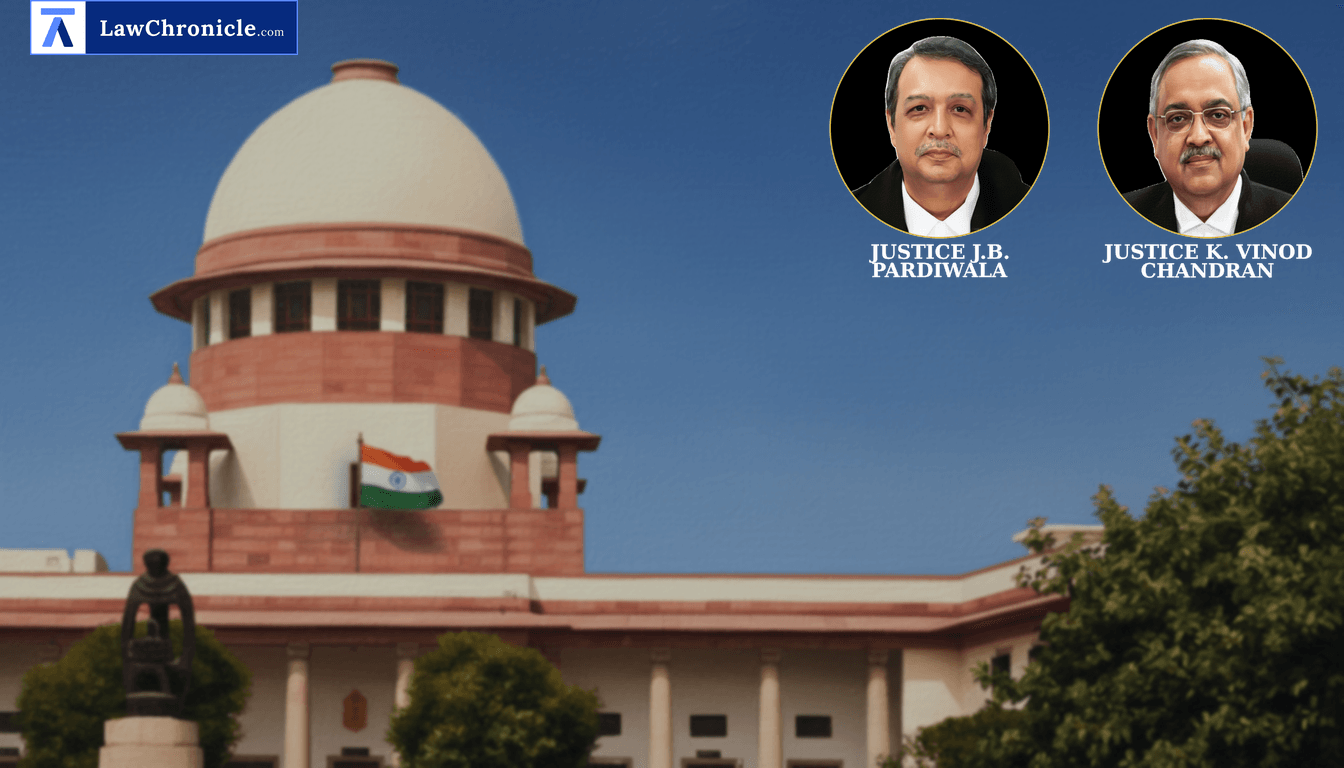
Rebuking the practice of routinely releasing convicts on bail due to docket explosion, the Supreme Court declared that judicial pendency cannot serve as an automatic passport to liberty for those convicted of heinous crimes. The apex court warned that granting bail in such cases without examining the prima facie evidence puts the civil society to grave peril and undermines the judicial system.
A Division Bench comprising Justice J.B. Pardiwala and Justice K. Vinod Chandran heard an appeal challenging the High Court's order that suspended the sentences of multiple convicts in a political assassination case primarily due to the heavy backlog of criminal appeals.
Key Takeaways
-
Systemic Fault Lines Exposed:
Docket explosion and pendency of appeals cannot justify knee-jerk suspension of sentences for convicts in heinous crimes. -
Prima Facie Scrutiny Mandatory:
Appellate courts must evaluate the compelling weight of evidence before suspending sentences rather than relying solely on incarceration length. -
Victim-Centric Approach:
Courts are required to balance individual liberty with the sentiments of victim families who suffer seeing convicted murderers walk free. -
Loss of Innocence Presumption:
Post-conviction, the legal presumption of innocence no longer applies to the accused, requiring higher judicial circumspection.
Evaluating the High Court's order, the Supreme Court cancelled the suspension of sentence granted to the main conspirator (A1), while affirming the relief granted to the co-accused due to lack of established evidence against them. The Court issued specific directions for the apprehension of the primary convict.
The Court has following directions:
"In the result, the suspension of sentence as granted by the High Court to A1 stands cancelled. He shall surrender before the Trial Court within a period of two weeks from today, failing which, proceedings shall be taken to apprehend him. Insofar as the other accused/respondents herein are concerned, we cause no interference to the order suspending their sentence."
Expressing deep concern over routine grant of bail in severe offenses, the Court, in its reasoning, observed: "Whatever be the reason for the pendency of cases, the Courts cannot be complacent and release criminals convicted for heinous offences, especially when they have not undergone sentence for any considerable period, since it puts to peril the life of the civil society; exposing the fault lines of the system, which we definitely cannot cover up but should always endeavour to overcome."
The Court further highlighted the plight of victim families, observing: "The Courts should be sensitive to the sentiments of the victims’ family too while being concerned with the liberty of an individual, especially when the accused stands convicted by a Court of law, no longer being enabled the presumption of innocence, like in this case. The father, day-in and day-out, has to contend with, watching the person convicted of the murder of his son, walking free while the Judges grapple with their pendency in Courts."
Ratio
The pendency of appeals and long judicial delays cannot automatically justify the suspension of sentence or grant of bail to persons convicted of heinous offenses, as the presumption of innocence no longer applies post-conviction. Judicial circumspection demands a prima facie evaluation of the evidence and gravity of the crime juxtaposed with actual incarceration, balancing individual liberty with societal safety and the victim's sentiments.
Background
The dispute stemmed from political rivalry during a Sarpanch election, where the candidate standing for election was assassinated. Prosecution alleged that A1, a Government Teacher, masterminded a conspiracy to eliminate his political rival through accomplices. A1 was convicted under Section 302 read with Section 120B of the Indian Penal Code, 1860 and sentenced to life imprisonment, while other co-accused were convicted under Section 120B of the Indian Penal Code, 1860 and sentenced to 10 years imprisonment.
The High Court suspended their sentences and granted bail, citing heavy appeal pendency and the impossibility of hearing the appeals in the near future. The father of the deceased challenged this order before the Supreme Court. The appellant contended that A1 had openly threatened the candidate prior to the crime and attempted to create an alibi, despite statements recorded under Section 161 of the Cr. PC.
Upon reviewing the trial court records, the Supreme Court noted strong prima facie evidence and motive against A1. Conversely, regarding the co-accused, key prosecution witnesses relating to changed vehicle number plates and SIM card purchases had turned hostile, leaving the evidence against them unestablished. Consequently, the Supreme Court partly allowed the appeals, cancelling A1's bail while leaving the suspension of sentence for the remaining respondents intact.
Case Details:
Case No.: Criminal Appeal Nos. of 2026 (@Special Leave Petition (Crl.) No.19778-19780 of 2026)
Neutral Citation: 2026 INSC 1180
Case Title: Hanuman Prasad @ Hanuta Ram v. State of Rajasthan & Ors.
Appearances:
For the Petitioner(s): Mr. Rishi Matoliya, AoR
For the Respondent(s): Mr. Rajan Kumar Chourasia, Counsel (for State); Mr. Abhishek Gupta, AoR (for A1); Mr. Vikas Verma, AoR (for A2, A8, A10)
Source: 2026 CaseBase(SC) 9520
Similar Articles


 Breaking News


