


Criminal Process Cannot Be Weapon of Harassment In Property Disputes: SC
 Copy Link
 Share
 Save
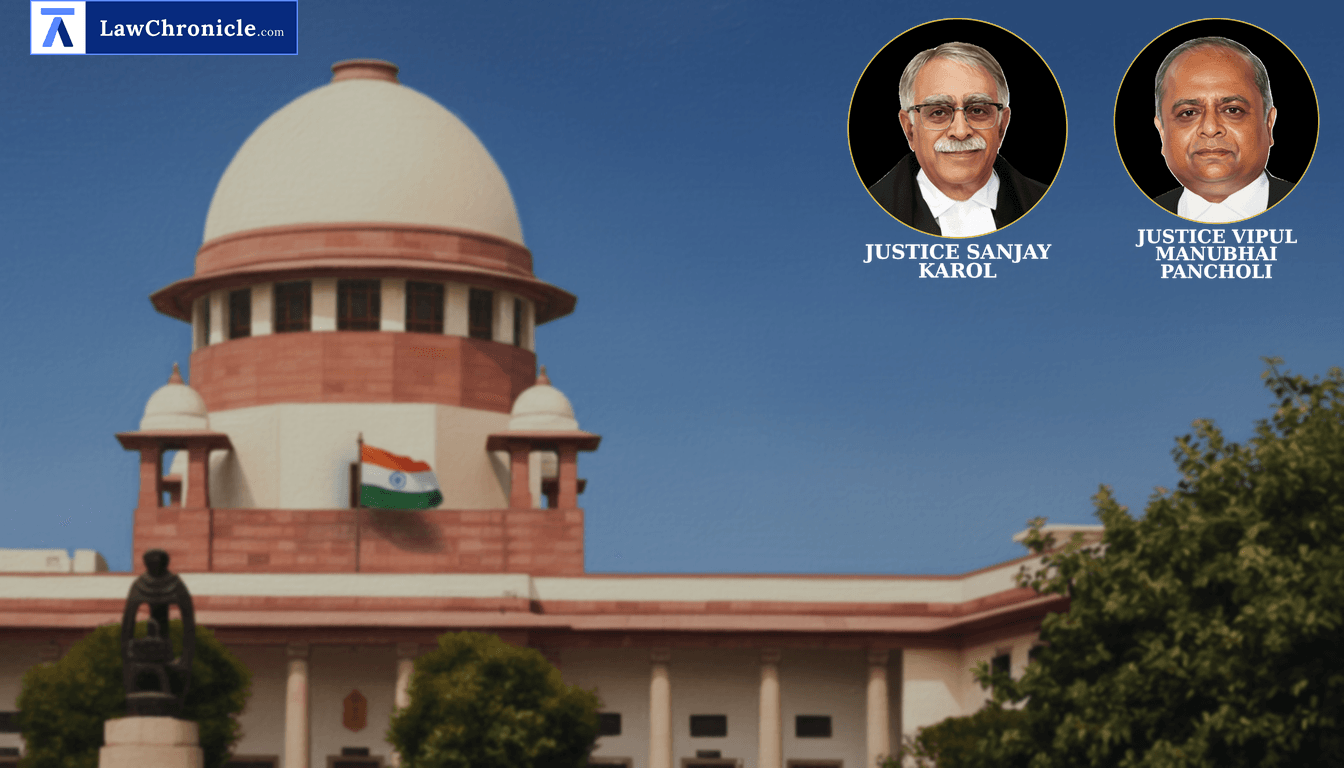
The Supreme Court has quashed criminal proceedings arising from a long-standing property dispute, emphasizing that criminal law cannot be used as a tool for coercion when a matter is essentially civil in nature. A bench comprising Justice Sanjay Karol and Justice Vipul M. Pancholi observed that attempts to give a 'criminal colour' to civil litigation through delayed FIRs and improved allegations constitute an abuse of the judicial process.
While hearing appeals against a Gujarat High Court judgment that refused to quash an FIR involving allegations of forgery, cheating, and extortion, the Court noted that the dispute over the ancestral land had been pending in civil courts since 2000 without any previous allegations of criminality. The Court held that a disputed claim of title does not automatically translate into the creation of a 'false document' or 'fraudulent representation' under the Indian Penal Code, 1860.
Legal Principles on Forgery and Cheating
The Court clarified that the execution of a document by a person claiming a property as their own, even if the claim is later found to be incorrect, does not amount to forgery. Drawing from the principles in Mohd. Ibrahim v. State of Bihar, the bench noted that since the signatures on the Power of Attorney were not forged and there was no impersonation, the essential ingredients of Sections 464 and 465 of the Indian Penal Code, 1860 were absent.
Regarding the charges of cheating under Section 420 of the Indian Penal Code, 1860, the Court found no evidence of fraudulent inducement or delivery of property. It remarked that a 'disputed civil claim cannot automatically be treated as fraudulent representation'.
Observations on Unexplained Delay and Improved Allegations
The Court expressed concern over a nine-year delay in lodging the FIR and the introduction of extortion allegations that were missing from the initial police complaint. It relied on the ratio in Mohd. Wajid v. State of U.P. to emphasize that courts must closely scrutinize FIRs that appear to be instituted with ulterior motives for 'wreaking vengeance'.
Judicial Reasoning on Abuse of Process
The Court, in its reasoning, observed: "The present case, viewed in its peculiar facts and circumstances, constitutes all the characteristics of a civil property dispute, which is sought to be converted into criminal proceedings, after several years of civil litigation. We are of the opinion that the criminal process cannot be permitted to become a weapon of harassment and coercion in disputes concerning title over immovable property."
Referring to the landmark guidelines in State of Haryana v. Bhajan Lal, the bench reiterated that the High Court is duty-bound to exercise its inherent jurisdiction under Section 482 of the Code of Criminal Procedure, 1973 when criminal proceedings manifestly amount to an abuse of process.
Background:
The dispute centered on approximately 5.5 acres of land in Village Panas, Surat, purchased in 1957. The appellants and respondent No. 2 were descendants of the original purchasers. While respondent No. 2 claimed exclusive ownership based on a 1987 settlement decree, the appellants asserted a 1/3rd share based on orders under the Urban Land Ceiling Act, 1976.
After years of civil litigation where no criminal conduct was alleged, respondent No. 2 lodged an FIR in 2009 alleging that the appellants forged a Power of Attorney and attempted to extort Rs. 1.5 crores. The High Court of Gujarat had refused to quash the FIR, citing the criminal antecedents of one of the accused and the need for investigation. However, the Supreme Court set aside this order, clarifying that Neeharika Infrastructure Pvt. Ltd. v. State of Maharashtra ( "2021 SCC OnLine SC 315": 2020 CaseBase(SC) 1378) dictates that while threshold interference should be rare, it is necessary when allegations fail to disclose cognizable offences or are purely civil in nature.
Case Details:
Case No.: Criminal Appeal No. _______________________ OF 2026 (Arising out of SLP (Crl.) No. 15537 of 2023)
NeutralCitation: 2026 INSC 532
Case Title: BHIKHUBHAI GOVINDBHAI PATEL & ANR. v. THE STATE OF GUJARAT & ANR.
Appearances:
For the Petitioner(s): Mr. Nachiketa Joshi, Senior Counsel
For the Respondent(s): Mr. Dhaval D. Vyas, Senior Counsel
Source: 2026 CaseBase(SC) 456
Similar Articles




 Breaking News


