Criminal Prosecution Invalid After DRT-Approved Loan Settlement: SC
 Copy Link
 Share
Share Save
Save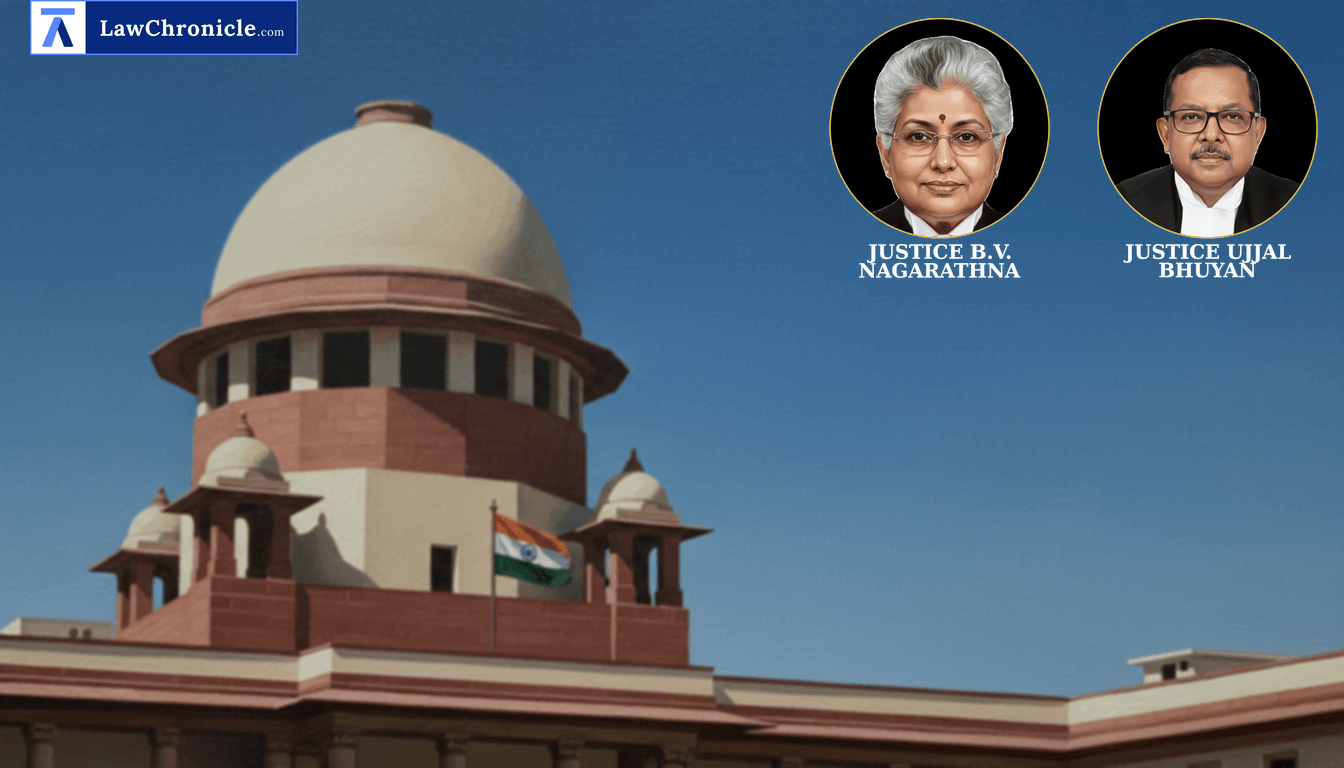
The Supreme Court has quashed criminal proceedings against borrowers who had already settled their loan accounts through a compromise approved by the Debts Recovery Tribunal, safeguarding the sanctity of commercial settlements. The Court emphasized that allowing criminal prosecution to continue after a full and final settlement of a predominantly civil dispute would result in the abuse of the judicial process.
A bench comprising Justice B.V. Nagarathna and Justice Ujjal Bhuyan heard the appeal challenging a High Court decision that had refused to quash a chargesheet filed by the Central Bureau of Investigation (CBI). The dispute arose when the UCO Bank initiated criminal proceedings for cheating and forgery against the appellants, years after a compromise settlement under the SARFAESI Act was recorded and the loan account was closed.
Court Observations on Commercial Settlements and Criminal Prosecution
The Court observed that the dispute was essentially a commercial transaction with a predominantly civil flavour. It noted that the Bank had previously certified that there were no lapses in documentation and had voluntarily entered into a compromise. The Bench remarked that if banks are allowed to initiate criminal proceedings after such settlements, it would deter entities from seeking resolutions, thereby impacting the economy.
The Court, in its reasoning, observed: "If the respondent-Bank is permitted to go ahead with the criminal prosecution initiated after settlement of the loan account before the DRT, it would adversely impact the sanctity of such settlement which has become part of the judicial proceeding and which had the approval of a judicial forum like the DRT. If such a conduct is overlooked and prosecution is allowed to continue, many persons including commercial entities would be hesitant to come forward and seek resolution of their disputes arising out of banking transactions which are after all commercial transactions, having predominantly elements of civil dispute(s)."
The Quashing of the Charge Sheet and Trial Proceedings
The Court has the following directions:
"For the aforementioned reasons, we allow this appeal and set aside the impugned order of the High Court dated 05.07.2024. Consequently, chargesheet dated 27.11.2018 and the charge framing order of the Special Judicial Magistrate dated 20.02.2023 are hereby quashed."
Background:
The appellants had availed credit facilities from UCO Bank between 2006 and 2009. Due to business difficulties following the death of a proprietor, the account was declared a Non-Performing Asset (NPA). The Bank initiated recovery proceedings under the Securitisation and Reconstruction of Financial Assets and Enforcement of Security Interest Act, 2002 and approached the Debts Recovery Tribunal (DRT). During the pendency of these proceedings, a compromise was reached where the appellants paid Rs. 4.25 crores, leading to the issuance of a 'No Dues Certificate' in 2015.
However, in 2018, the Bank lodged a complaint with the CBI alleging that the appellants had used forged audit reports to enhance credit limits and substituted mortgaged properties with encroached land. The CBI filed a chargesheet under Section 420 and Section 471 of the Indian Penal Code, 1860. The High Court dismissed the appellants' quashing petition under Section 482 of the Code of Criminal Procedure, 1973, prompting the appeal to the Supreme Court.
In its analysis, the Supreme Court relied on K. Bharthi Devi Vs. State of Telangana ( "(2024) 10 SCC 384": 2024 CaseBase(SC) 734), which dealt with similar facts of a banking settlement. The Court also referred to Nikhil Merchant Vs. Central Bureau of Investigation ( "(2008) 9 SCC 677": 2008 CaseBase(SC) 504) and the principles laid down by the larger bench in Gian Singh Vs. State of Punjab ( "(2012) 10 SCC 303": 2012 CaseBase(SC) 854) and Narinder Singh Vs. State of Punjab ( "(2014) 6 SCC 466": 2014 CaseBase(SC) 101) regarding the quashing of non-compoundable offences. The Court noted that even if Section 471 is non-compoundable, the High Court has the power to quash proceedings if the conviction is remote and bleak. The Bench further cited Mohammed Ibrahim Vs. State of Bihar and Deepak Gaba Vs. State of Uttar Pradesh ( "(2023) 3 SCC 423": 2023 CaseBase(SC) 173) regarding the specific ingredients of cheating and forgery, concluding that the Bank's conduct in initiating prosecution after a two-year delay betrayed a lack of good faith.
Case Details:
Case No.: CRIMINAL APPEAL NO. OF 2026 (ARISING OUT OF SLP (CRIMINAL) NO. 18035 OF 2024)
NeutralCitation: 2026 INSC 588
Case Title: VIJAY KUMAR KELA & ANR. VERSUS CENTRAL BUREAU OF INVESTIGATION & ANR.
Appearances:
For the Petitioner(s): Dr. Vineet Kothari, Senior Counsel
For the Respondent(s): Mr. Rajkumar Bhaskar Thakare, Additional Solicitor General
Source: 2026 CaseBase(SC) 507
 Breaking News