


Defense Witnesses Entitled To Equal Weight At Par With Prosecution: Allahabad HC
 Copy Link
 Share
 Save
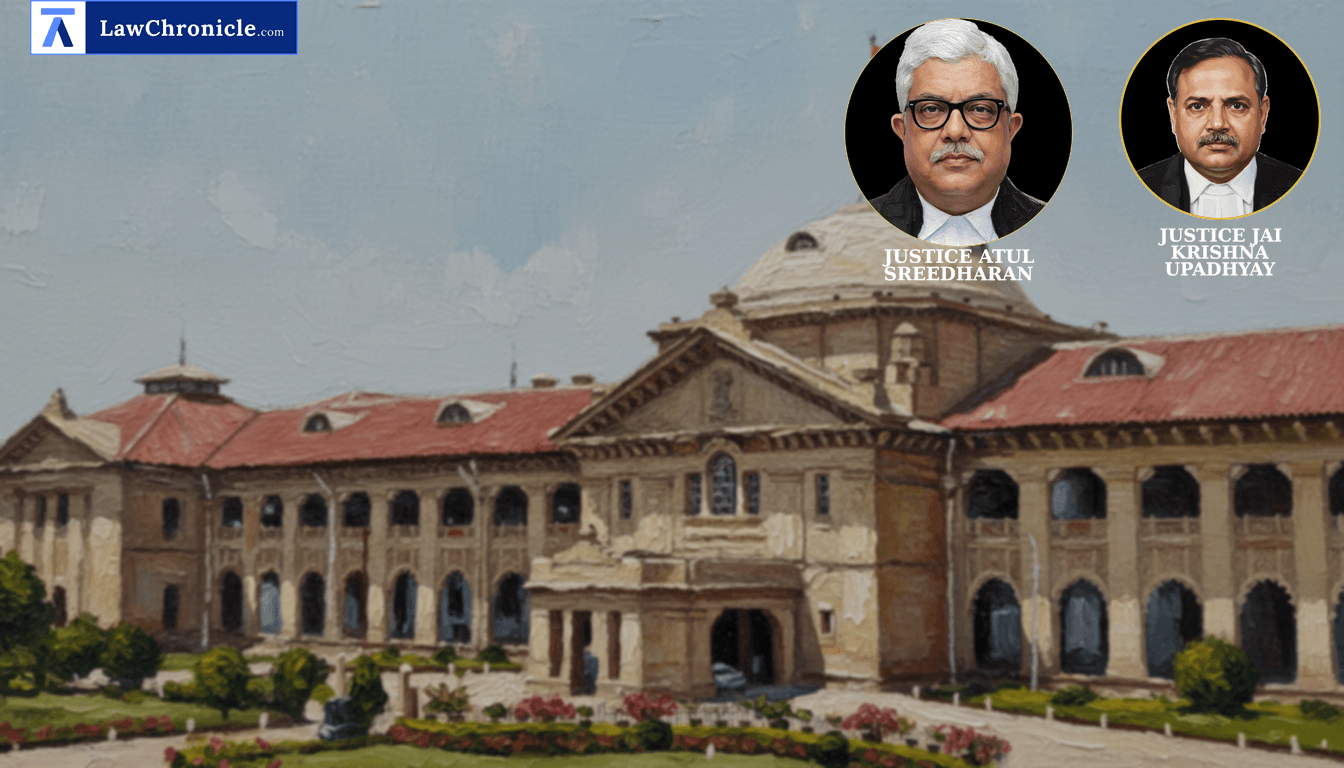
Exposing glaring inconsistencies in eyewitness testimonies and the failure to consider crucial defense evidence, the Allahabad High Court acquitted an appellant accused of murder after four decades. The ruling reinforces the vital evidentiary principle that defense witnesses must be evaluated on the same touchstone of reliability as prosecution witnesses, rather than being discarded as inherently biased.
A Division Bench comprising Justice Atul Sreedharan and Justice Jai Krishna Upadhyay delivered the verdict while setting aside a 1989 conviction order passed under Section 302 read with Section 34 of the IPC.
Key Takeaways
Parity in Evidence Evaluation: Defense witnesses cannot be brushed aside as tainted; their testimony carries equal evidentiary value to prosecution witnesses.
Unnatural Eyewitness Conduct: Passive behavior and contradictions from related witnesses destroy the credibility of alleged ocular evidence.
Rejection of Uncorroborated Testimonies: Material contradictions regarding scene lighting and shop operations undermine the core prosecution story.
The Court in its reasoning observed: "It is a well-entrenched principle that the testimony of a defence witness must be evaluated on the same anvil as that of a prosecution witness. In Munshi Prasad v. State of Bihar ( "(2002) 1 SCC 351": 2001 CaseBase(SC) 1104), the Hon'ble Supreme Court categorically held that the evidence tendered by defence witnesses is entitled to equal treatment and respect, and it cannot be brushed aside merely because they are examined on behalf of the accused. Defence witness cannot always be termed as tainted or biased, and their deposition must be weighed on the standard touchstone of reliability at par with the prosecution's own witnesses. The Apex Court further crystallized this position in the case of Sanjiv Kumar vs. State of Punjab reiterating that defence witnesses must not be held to be untruthful, merely because they support the case of the accused."
The Court has following directions:
"Accordingly, criminal appeal is allowed and the conviction and sentence imposed upon the surviving accused appellant - Rama Kant for the offence punishable under Section 302 read with Section 34 IPC is set-aside as the accused appellant found not guilty for the aforesaid offences. He is acquitted of all the charges framed against him. Accused appellant is on bail, he need not surrender. His bail bonds are cancelled and sureties are discharged."
Ratio
Every defense witness is entitled to equal respect and evaluation under the law as a prosecution witness, and their deposition cannot be dismissed merely for supporting the accused. Where ocular evidence is riddled with irreconcilable contradictions and unnatural post-event conduct, it cannot form the sole basis of conviction.
Background
The case stems from an incident on November 11, 1983, where the victim was stabbed to death near a local pan shop in Firozabad. The trial court convicted two accused under Section 302 read with Section 34 of the IPC in 1989. During the pendency of the appeal, the primary assailant died, leaving Rama Kant, who was assigned the role of holding the victim, as the surviving appellant.
The prosecution relied heavily on two eyewitnesses, PW-2 and PW-3, who claimed to be present at the spot. However, the defense presented DW-1, the pan shop owner, who testified that no murder occurred in front of his shop and that a massive power outage was in effect at the time of the incident, directly contradicting claims of functional electric lighting.
Upon a thorough scrutiny under Section 313 of the CrPC and evidence on record, the High Court held that the prosecution failed to prove its case beyond reasonable doubt, granting the benefit of doubt to the surviving appellant.
Case Details:
Case No.: Criminal Appeal No. - 1106 of 1989
Case Title: Anil Kumar and Others v. State of U.P.
Appearances:
For the Petitioner(s): Krishna Copoor, Nrapendra Kumar Chaturvedi, Rahul Misra, Salilendu Kumar Upadhyay
For the Respondent(s): A.G.A.
Source: 2026 CaseBase(ALL) 604
Similar Articles




 Breaking News


