


Degrees From Unrecognised Institutes Have No Legal Effect: SC
 Copy Link
 Share
 Save
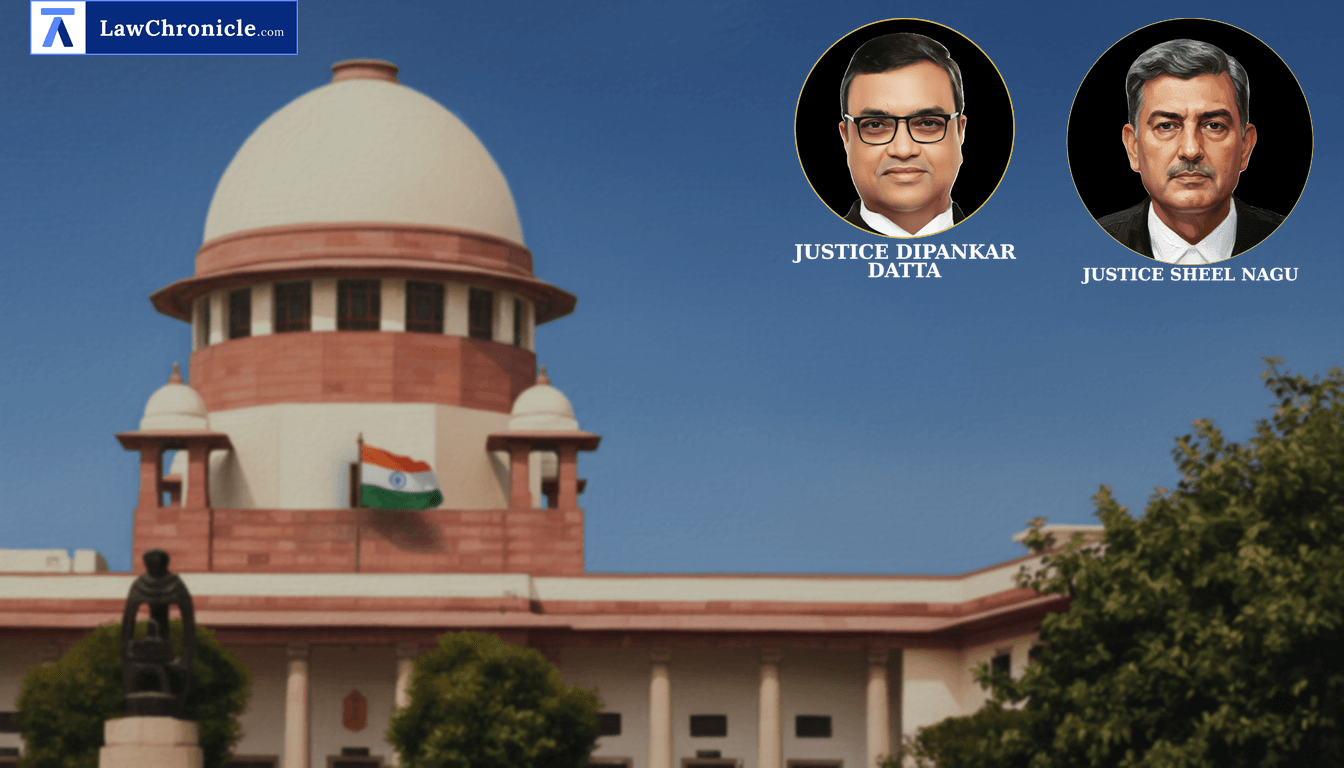
In a decisive blow to unrecognised educational credentials, the Supreme Court ruled that a teaching degree obtained from an institution lacking statutory recognition carries no legal value and renders any claim to employment unenforceable. The Court affirmed that procedural formalities, such as natural justice or statutory inquiry requirements, cannot be invoked to salvage an inherently invalid appointment when no actual prejudice is demonstrated.
A Division Bench comprising Justice Dipankar Datta and Justice Sheel Nagu set aside a judgment of the Telangana High Court, which had erroneously quashed the termination of a probationer teacher whose B.Ed. degree was issued by an unrecognised institution. The Bench held that neither Section 79 nor Section 83 of the A.P. Education Act, 1982 applied to a simple discharge of a probationer, and even if they did, holding an inquiry would be an empty formality when facts regarding the unrecognised status of the degree were undisputed.
Key Takeaways
- Degrees from Unrecognised Institutes Are Void: Teaching qualifications issued by institutions lacking recognition under the National Council for Teacher Education Act, 1993 carry no legal effect and cannot form the basis of a valid appointment.
- Natural Justice Is Not an Empty Ritual: Failure to conduct a domestic inquiry does not invalidate a termination where facts are admitted, and no different outcome could have been reached.
- Probationer Discharge Is Not Punitive: Releasing a probationer due to lack of essential statutory qualifications constitutes non-stigmatic discharge, where the qualification defect acts as a motive rather than a foundation.
Court Observations and Rationale
The Supreme Court thoroughly examined the provisions of the National Council for Teacher Education Act, 1993 alongside the A.P. Education Act, 1982 to determine the validity of the respondent's continuation in service.
The Court, in its reasoning, observed:
"In view of the provisions of Sections 14, 16 and 17(4) of the NCTE Act, any degree pertaining to teacher’s training obtained from an institution not enjoying the recognition of the NCTE has no legal effect; thus, the consequence is, no candidate can be appointed as a teacher without obtaining B.Ed. degree or any other teacher’s training degree, which is an essential qualification, from an institution recognised by the NCTE. In fact, any such degree from an unrecognised institution is not worth the paper on which it is printed."
Addressing the natural justice arguments and statutory protections claimed under the A.P. Education Act, 1982, the Court relied on Dipti Prakash Banerjee v. Satyendra Nath Bose National Centre for Basic Sciences ( "(1999) 3 SCC 60": 1999 CaseBase(SC) 239) and noted that the discharge of a probationer based on an unrecognised degree is merely driven by motive rather than a punitive foundation.
Furthermore, the Bench emphasized the futility of holding an inquiry when facts are indisputable. Applying the principles set out in Chairman, Board of Mining Examination and Chief Inspector of Mines v. Ramjee, Escorts Farms Ltd. v. Commissioner, Kumaon Division, Nainital, U.P., Viveka Nand Sethi v. Chairman, J&K Bank Ltd, and State of Uttar Pradesh v. Sudhir Kumar Singh and Ors. ( "(2021) 19 SCC 706": 2020 CaseBase(SC) 728), the Court affirmed that procedural non-compliance alone does not vitiate an order unless real prejudice is caused to the employee.
Ratio
A candidate possessing a professional teaching degree from an unrecognised institution possesses no legally enforceable right to continue in service. Where essential statutory qualifications are lacking and undisputed, non-compliance with statutory inquiry procedures or natural justice principles does not invalidate a termination order in the absence of demonstrable prejudice.
Background
The case originated when the appellant school appointed the first respondent as an ad hoc teacher in June 2003, subsequently placing her on probation for one year starting January 1, 2006. During verification, it was discovered that her B.Ed. degree, obtained in 1997 from Bhartiya Shiksha Parishad, Lucknow, was not recognized by the National Council for Teacher Education or the University Grants Commission. The school consequently allowed her to work only until the end of the academic year 2006–2007.
The respondent challenged this order before the High Court, contending that her probationary period had ended, making her a regular teacher protected under Sections 79 and 83 of the A.P. Education Act, 1982, which mandate an inquiry and prior approval before termination or retrenchment. A Single Judge allowed her writ petition, and a Division Bench affirmed the decision.
Reversing both judgments, the Supreme Court allowed the appeal and dismissed the writ petition, holding that the High Court committed a gross error in granting relief to an unqualified candidate.
Case Details:
Case No.: Civil Appeal No. 2026 of 2026 (Arising out of SLP (C) No. 17336/2023)
Neutral Citation: 2026 INSC 833
Case Title: M/S Bharatiya Vidya Bhavan’s Public School v. M. Vimala & Ors.
Source: 2026 CaseBase(SC) 833
Similar Articles


 Breaking News


