Delhi HC: Internal Society Election Disputes Do Not Attract Writ Jurisdiction
 Copy Link
 Share
Share Save
Save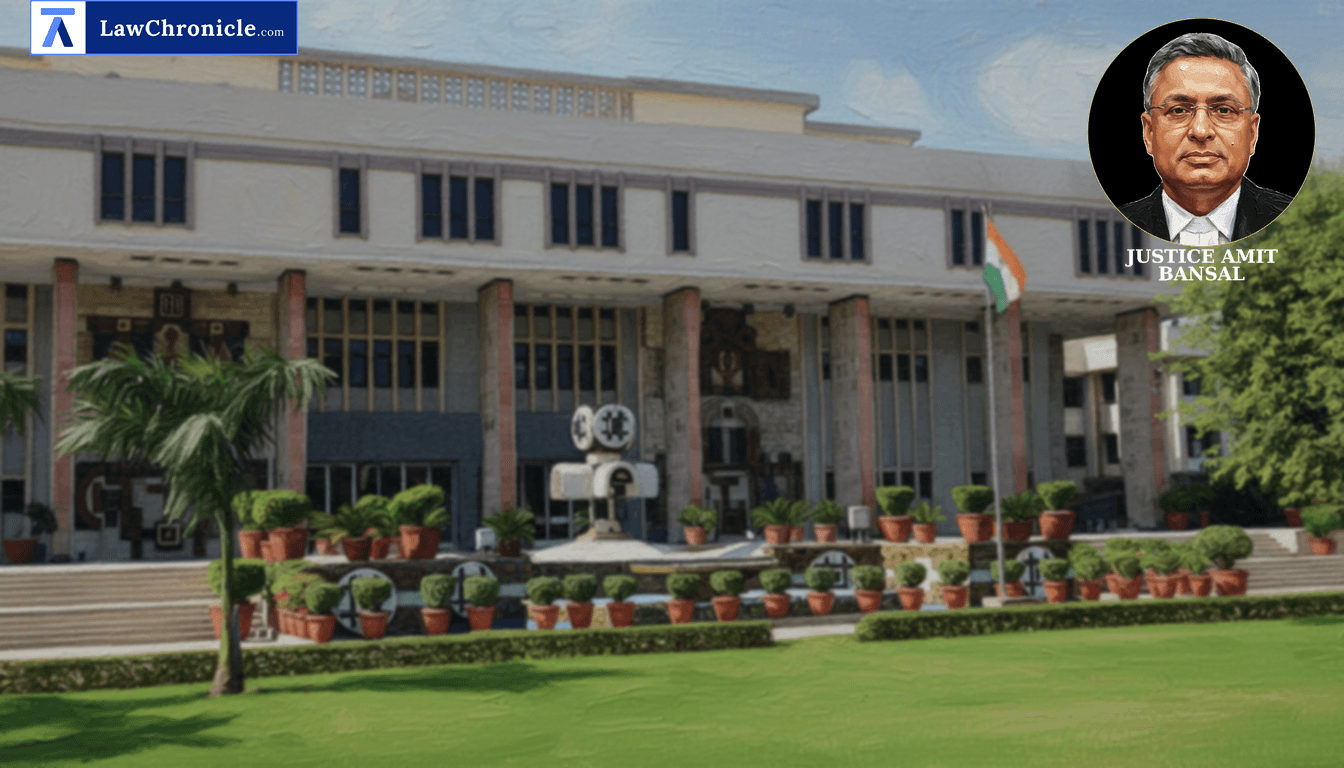
The Delhi High Court has clarified that internal management and electoral disputes of a private autonomous society, even if registered as a public trust, do not warrant the exercise of writ jurisdiction under the Constitution of India, 1950 unless a public law element is established. The court dismissed a petition challenging the cancellation of a candidate's election results following a technical audit that revealed the use of malicious bots for multiple voting.
Justice Amit Bansal, presiding over the matter, heard a challenge against the Indian Sociological Society's decision to annul election results and debar a candidate for ten years. The Court emphasized that a body does not become an instrumentality of the State merely by being registered under statutes or receiving nominal government grants.
Maintainability of Writ Petitions Against Private Societies
In its reasoning, the Court observed: "The dispute in the present case solely pertains to the elections and internal management of the respondent no.1 society. The petitioner is aggrieved by the decision of the respondents to hold fresh re-elections and his debarment from participating in the elections. Clearly, this does not involve any public law element."
Addressing the scope of the Constitution of India, 1950, the Court noted that the respondent society, registered under the Societies Registration Act, 1860 and Maharashtra Public Trusts Act, 1950, is not performing any public functions nor is it involved in teaching or imparting education. The Bench relied on S.D. Siddiqui v. University of Delhi and Governing Body Raisina Bengali School v. Ashish Kumar Haldar & Anr to reiterate that writ proceedings do not lie against private bodies unless they are entrusted with public duties or subject to deep and pervasive State control.
Funding and the 'Substantial Financing' Test
Regarding the petitioner's claim that the society is government-funded, the Court applied the principles from K.K. Saksena v. International Commission on Irrigation and Drainage & Ors ( "(2015) 4 SCC 670": 2014 CaseBase(SC) 727) and D.A.V. College Trust And Management Society & Ors V. Director Of Public Instructions & Ors. ( "(2019) 9 SCC 185": 2019 CaseBase(SC) 2717). It found that a grant of approximately 7.92% received years prior does not constitute 'substantial funding'. The Court held that the society remains a self-financing body primarily funded through membership fees and donations.
Court Observations on Election Malpractices
While holding the petition non-maintainable, the Court also examined the merits. It found that the technical audit conducted by the service provider clearly identified 'malicious actors' using automated scripts for fraudulent voting. The Court validated the appointment of an Enquiry Committee, noting that the power to conduct elections naturally includes the power to investigate irregularities. The Court, in its reasoning, observed: "From the aforesaid Bye-Laws, it is evident that the Election Committee has the powers to conduct elections, which would necessarily include appointment of an Enquiry Committee to enquire into allegations of malpractices/irregularities in the election process."
The Court has the following directions:
"In view of the discussion above, I do not find any merit in the present writ petition. Accordingly, the present petition is dismissed on the ground of maintainability as well as merits."
Background:
The petitioner, a life member of the Indian Sociological Society, contested for the post of Secretary in the 2025 elections. During online voting, technical irregularities were detected, leading to an audit by the service provider. A subsequent Enquiry Committee report found the petitioner guilty of using malicious bots to cast multiple votes. Consequently, his candidature was cancelled, he was debarred for ten years, and a re-poll was ordered. The petitioner challenged these actions as arbitrary and punitive, alleging a violation of natural justice.
The respondents argued that the society is a private autonomous body and that the petitioner had an alternative remedy under Section 41(B) of the Maharashtra Public Trusts Act, 1950. The Court agreed, citing Ram Chandra Choudhary & Ors. v. Roop Nagar Dugdh Utpadak Sahakari Samiti Limited ( "2026 INSC 347": 2026 CaseBase(SC) 307) to emphasize that disputes pertaining to the internal management of societies do not attract writ jurisdiction just because they are incorporated under a statute.
Case Details:
Case No.: W.P.(C) 19389/2025 & CM APPL. 80838/2025, CM APPL. 1161/2026
Case Title: Dr. Sanjay Tewari v. Indian Sociological Society And Ors
Appearances:
For the Petitioner(s): Ms. Pinky Anand, Senior Advocate with Mr. Amit, Mr. Sandeep Malik, Mr. Abhishek Gaur, Ms. Samrat Pasricha, Ms. Aditi Salooja, Ms. Mayoleeka Purty, Ms. Chanya Jaitly and Mr. Neeraj Sharma, Advocates
For the Respondent(s): Mr. Akhil Sibal, Senior Advocate with Mr. Abhik Chimni, Ms. Pranjal Abrol, Mr. Krishnesh Bapat, Mr. Gurupal Singh and Ms. Aeshna Salwan, Advocates for R-1, R-4, R-5 and R-6; Mr. Amit George, Mr. Dushyant K. Kaul and Mr. Vasnth Tripathi, Advocates for R-7
Source: 2026 CaseBase(DEL) 467
 Breaking News