Demand and Initial Handover to Intermediary not enough to prove Bribery: Supreme Court
 Copy Link
 Share
Share Save
Save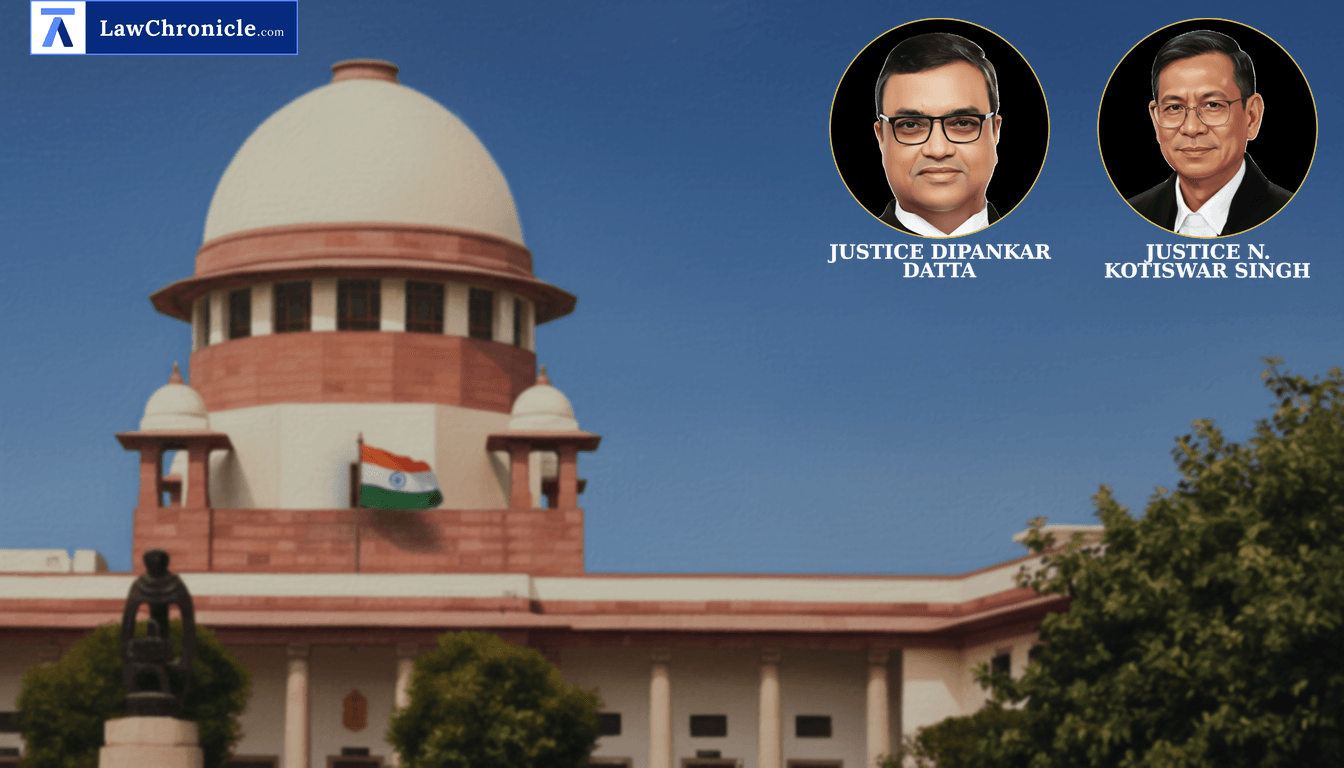
The Supreme Court acquitted a public servant in bribery case wherein a chain of evidence was incomplete. The Bench emphasized that uncorroborated approver testimony and recovery of tainted money from an intermediary without independent proof of demand or receipt by the accused cannot sustain a conviction under anti-corruption law.
A bench of Justice Dipankar Datta and Justice Nongmeikapam Kotiswar Singh set aside the conviction of a former Divisional Security Commissioner of the Railway Protection Force, Palakkad, holding that suspicious circumstances and unverified intermediary accounts cannot substitute for proof beyond reasonable doubt.
Key Takeaways
- Demand is Pre-requisite: Mere recovery from an intermediary does not prove guilt of the public servant without independent proof of demand.
- Approver Testimony Needs Corroboration: Statements of pardoned accomplices require independent corroboration on material particulars directly connecting the accused.
- Section 20 Presumption Limited: Statutory presumption of guilt under Prevention of Corruption Act, 1988 applies only after foundational facts of demand and acceptance are established.
Proof of Demand and Approver Reliability
The Supreme Court observed that criminality under anti-corruption statutes does not arise merely because money changes hands. To establish an offence under Sections 7 and 13 of the Prevention of Corruption Act, 1988, the prosecution is bound to establish that the public servant demanded, accepted, or obtained illegal gratification.
Reiterating the principles laid down in R.P.S. Yadav v. CBI, B. Jayaraj v. State of Andhra Pradesh ( "(2014) 13 SCC 55": 2014 CaseBase(SC) 529), C.M. Girish Babu v. CBI, and P. Satyanarayana Murthy v. District Inspector of Police ( "(2015) 10 SCC 152": 2014 CaseBase(SC) 611), the bench observed that proof of demand is a sine qua non for convicting a public servant. Referring to the Constitution Bench decision in Neeraj Dutta v. State (Government of NCT of Delhi), the Supreme Court stressed that while demand can be proved via circumstantial evidence, the presumption under Section 20 of the Prevention of Corruption Act, 1988 cannot be invoked unless foundational facts showing voluntary acceptance or obtainment are conclusively established.
The Apex Court observed that "Over the years, this Court has consistently held that proof of demand and acceptance of illegal gratification constitutes the gravamen of the offence and forms the indispensable foundation upon which a conviction under the Act must rest... The PC Act does not countenance any such straitjacketed formulation limiting to acts of demand and acceptance of bribe by the official himself as explained by expansive provision of Explanation 2... However, before criminal liability can be fastened upon the public servant, the prosecution must establish by reliable evidence that the intermediary was acting under the authority, direction or for the benefit of the accused and that the demand itself was attributable to the accused."
Analyzing the evidentiary value of approver testimony under Section 133 and Section 114 Illustration (b) of the Indian Evidence Act, 1872, and applying Sarwan Singh v. State of Punjab, the Supreme Court highlighted that accomplices who secure pardon have strong incentives to shift blame, requiring independent corroboration in material particulars directly connecting the accused to the crime.
Ratio
Under the Prevention of Corruption Act, 1988, receipt of money by a third-party intermediary or an uncorroborated statement by an approver cannot establish acceptance or obtainment by a public servant unless the prosecution proves beyond reasonable doubt, through independent evidence, a complete chronological chain of demand, authorization, and receipt attributable directly to the accused.
Background
The case originated from FIR No. RC19(A)/2005/KER/CBI registered by the CBI Anti-Corruption Branch, Kochi, alleging that the appellant, while serving as Divisional Security Commissioner (RPF), Palakkad, demanded illegal gratification through subordinate intermediaries for transfers and postings. Following a trap operation, two subordinates were turned approvers under Section 306 of the Code of Criminal Procedure, 1973.
The trial court convicted the appellant in C.C. No. 2 of 2014 and C.C. No. 3 of 2015 for offences under Section 7 and Section 13(2) read with Section 13(1)(d)/13(1)(a) of the Prevention of Corruption Act, 1988, which was largely affirmed by the High Court of Kerala. Re-evaluating the evidence, the Supreme Court noted critical infirmities, including the lack of hand-wash tests on the appellant, reliance on contradictory statements of approvers, non-production of telephonic call records, and failure of the CBI to track the trap money to the appellant's actual residence.
Furthermore, the appellant's travel diary proved an unrefuted alibi for one of the alleged dates. Consequently, the Supreme Court allowed both Criminal Appeal No. 4732 of 2024 and Criminal Appeal No. 4733 of 2024, setting aside the convictions and acquitting the appellant of all charges.
Case Details:
Case No.: Criminal Appeal No. 4732 of 2024 with Criminal Appeal No. 4733 of 2024
Neutral Citation: 2026 INSC 999
Case Title: Bharat Raj Meena v. Central Bureau of Investigation
Source: 2026 CaseBase(SC) 7005
 Breaking News