


Doubtful Last Seen and Unverified Recoveries Break Chain of Circumstantial Evidence: Madras HC
 Copy Link
 Share
 Save
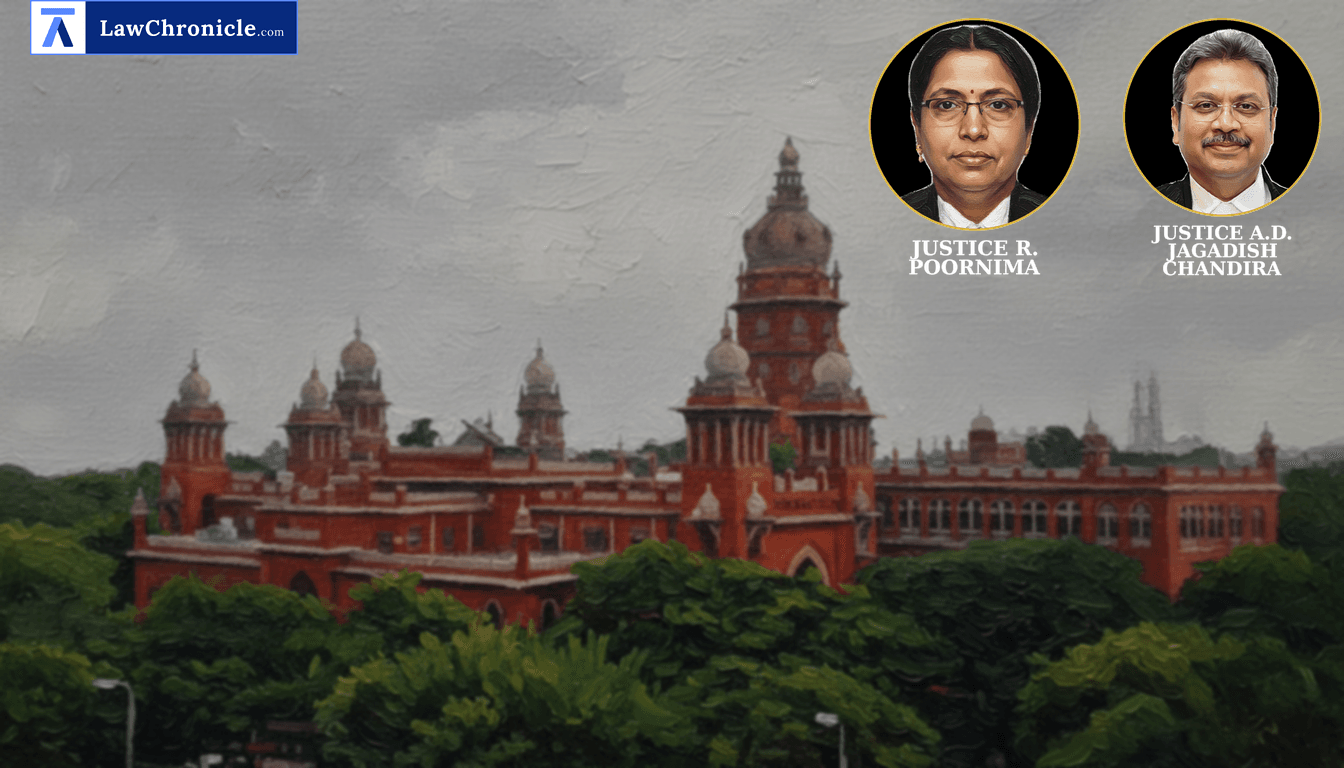
Exposing critical lapses in circumstantial evidence, the High Court has set aside a murder conviction after finding that unverified jewel recoveries and unreliable 'last seen' testimonies completely shatter the prosecution's chain of events.
In a fresh judicial evaluation, a Division Bench of Justice A. D. Jagadish Chandira and Justice R. Poornima examined an appeal challenging a trial court judgment that had sentenced an accused woman to life imprisonment for murder and robbery.
Key Takeaways
Unverified Property Recovery Fatal: Failure to conduct a formal test identification parade for recovered stolen items creates severe doubt on property ownership.
Police Station Identification Inadmissible: Identifying recovered items solely before police officers during investigation falls under Section 162 of Code Of Criminal Procedure, 1973 and is legally inadmissible.
Suspect Testimony Unreliable: Witness testimonies from individuals who were themselves investigated as primary suspects fail to inspire judicial confidence.
Incomplete Circumstantial Chain: Missing critical links in circumstantial cases entitle the accused to the benefit of doubt regardless of moral suspicions.
Summarizing the main holding, the Court clarified that where a case rests purely on circumstantial evidence, every single link in the evidentiary chain must be proved beyond reasonable doubt. The Court observed that when the last seen theory and the recovery of missing property remain shrouded in doubt, the benefit of doubt must strictly extend to the accused.
The Court has following directions:
"In the result, this criminal appeal is allowed and the impugned judgment passed by the Trial Court is hereby set aside and the appellant is acquitted of all the charges. Bail bond, if any, executed by the appellant shall stand discharged. Fine amount, if any paid, shall be refunded to the appellant."
The Court, in its reasoning, observed: "...when the proved links in the prosecution’s chain of circumstances is not complete so as to show that in all human probability, the deceased was murdered by the appellant, the appellant is entitled to the benefit of doubt in view of the missing links in the prosecution’s chain of circumstances."
Ratio
To sustain a conviction based solely on circumstantial evidence, the circumstances established must be fully proved, conclusive in nature, and must exclude every possible hypothesis except the guilt of the accused. Uncorroborated, doubtful recovery of property and unverified last-seen circumstances cannot form the legal basis for conviction.
Background
The case arose from the murder of a elderly woman engaged in money lending who was found dead in her residence. The prosecution alleged that a neighboring debtor, burdened by surmounting debts, trespassed into the victim's house, struck her with a billhook machete, and stole pledged gold ornaments. Following investigation, the trial court convicted the accused under Sections 302, 404, and 450 of the Indian Penal Code, 1860.
On appeal, the High Court highlighted that the deceased's relatives failed to mention any missing jewels in the initial complaint or early testimonies. Re-evaluating the evidence, the Court noted that identifying recovered jewels before police officers violates Section 162 of Code Of Criminal Procedure, 1973, citing Arumugam v. State. Relying on the landmark principles in Sharad Birdhichand Sarda v. State of Maharashtra ( "(1984) 4 SCC 116": 1984 CaseBase(SC) 194), the Bench underscored that the chain of evidence remained incomplete. Addressing unexhibited blood-group matching reports, the Court drew support from Sonvir @ Somvir v. State (NCT of Delhi) ( "(2018) 8 SCC 24": 2018 CaseBase(SC) 163) to hold that mere matching of blood group without comprehensive serological link cannot prove culpability. Consequently, the High Court allowed the appeal and acquitted the appellant.
Case Details:
Case No.: Crl.A(MD) No.623 of 2023
Case Title: Thangeswari v. The Inspector of Police, Thalavaipuram Police Station, Virudhunagar
Appearances:
For the Petitioner(s): Mr.M.Jothi Basu
For the Respondent(s): Mr.Christopher, Counsel for State of Tamil Nadu (Criminal Side)
Source: 2026 CaseBase(MAD) 8870
Similar Articles




 Breaking News


