Dropping Crucial Spot Witnesses Fatal to NDPS Prosecution: Himachal Pradesh HC
 Copy Link
 Share
Share Save
Save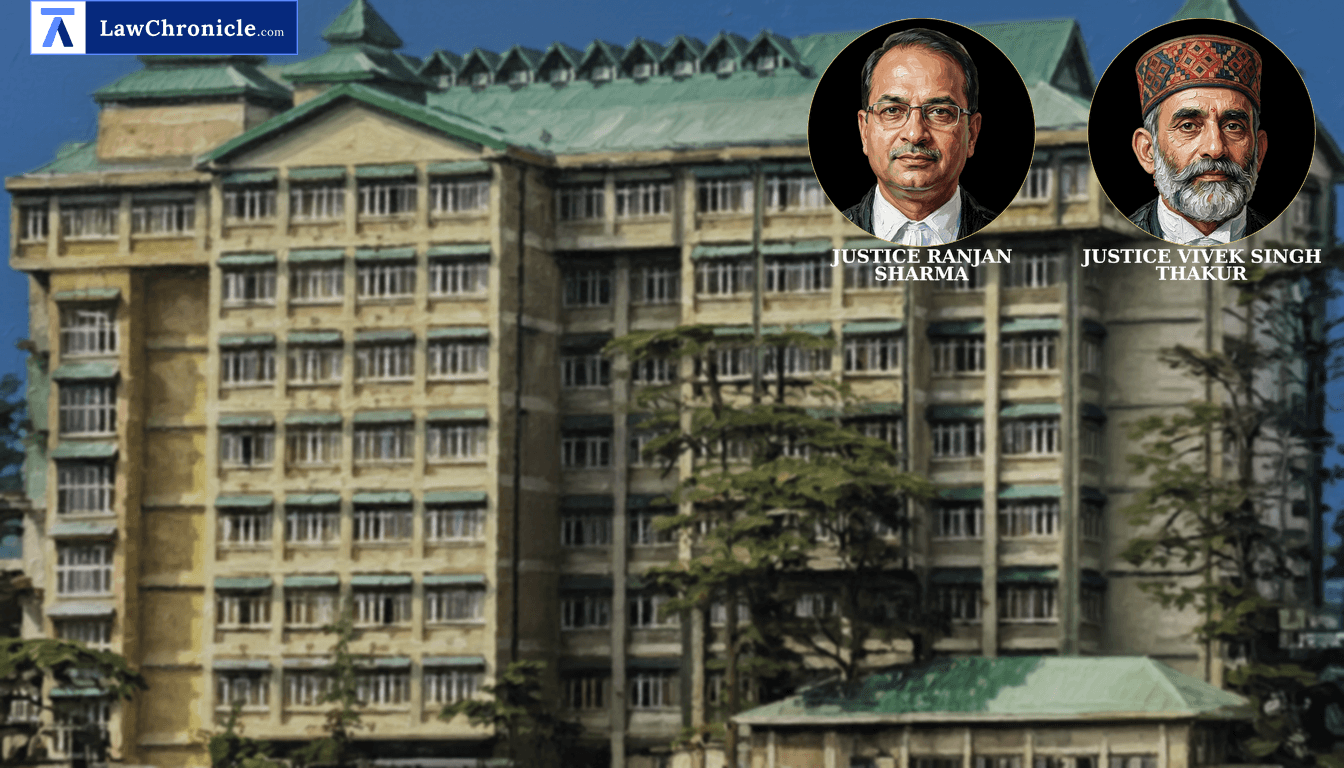
Exposing glaring loopholes in police search and seizure procedures under drug laws, the Himachal Pradesh High Court has affirmed the acquittal of a man accused of carrying commercial-quantity contraband after the prosecution failed to examine key spot witnesses. The Court underscored that abandoning police officials present during the recovery creates irreparable gaps, making it impossible to uphold a conviction without independent corroboration.
A Division Bench comprising Justice Vivek Singh Thakur and Justice Ranjan Sharma upheld the acquittal of an accused charged under Section 20 of the Narcotic Drugs and Psychotropic Substances Act, 1985. The Court observed that when independent witnesses are absent, the prosecution is under a strict legal obligation to examine all official spot witnesses who witnessed the search and arrest.
Key Takeaways
· Mandatory Examination of Official Witnesses
Failing to examine all official spot witnesses in the absence of independent public witnesses proves fatal to the prosecution's case under the Narcotic Drugs and Psychotropic Substances Act, 1985.
· Contradictions in Document Preparation
Inconsistencies regarding whether spot memos were prepared at the scene under torchlight or at the police station cast serious doubt on the genuineness of the recovery.
· Loss of Sealing Stamp Material
The casual admission by a police official regarding the loss of the official seal handed over after seizure severely compromises the chain of custody.
· Presumption of Innocence Strengthened
An order of acquittal by the trial court double-fortifies the presumption of innocence, requiring overwhelming evidence of material error for an appellate court to reverse it.
Evaluating the evidential deficiencies, the High Court pointed out that out of the four official members of the police team, one officer was not cited as a witness at all while another was dropped during the trial on the erroneous pretext of being 'repetitive'. The Court held that relying on a single spot witness while ignoring other available official witnesses undermines the entire search mechanism.
The Court, in its reasoning, observed: "Even if it is presumed that it was a secluded place and no independent witness was available and two official witnesses were associated by way of compulsion, it was incumbent upon the prosecution to examine both spot official witnesses who were associated in the search and seizure process... In the aforesaid facts, non-citing of ASI Dheeraj Singh as a witness in the list of witnesses and non-examination of PSI Yog Raj, despite mentioning him as a witness of the spot in the list of witnesses, is fatal for the prosecution case."
Highlighting further suppression of material facts, the Court held:
"From the aforesaid discrepancy, it appears that incident has not taken place as alleged and there is something which is being hidden from the Court and prosecution has not come to the Court with clean hands."
Ratio
In prosecutions under the Narcotic Drugs and Psychotropic Substances Act, 1985 where independent public witnesses are not associated, the prosecution is bound to cite and examine all official spot witnesses who participated in the search, seizure, and arrest. The failure to examine key official witnesses, combined with irreconcilable contradictions regarding the site of document preparation and custody of the seal, breaks the chain of evidence, entitling the accused to the benefit of the doubt.
Background
The case originated from an incident on January 26, 2013, when a police patrolling party in Kullu district intercepted Khem Singh. The prosecution alleged that upon searching his bag in torchlight, 2.00 kilograms of charas was recovered. The accused was charged under Section 20 of the Narcotic Drugs and Psychotropic Substances Act, 1985. However, the Special Judge, Kullu acquitted the accused on June 4, 2014, prompting the State of Himachal Pradesh to prefer an appeal before the High Court.
During the appeal, the State argued that the recovery was supported by official witnesses and that independent witnesses could not be associated as the spot was secluded. Rebutting this, the defense highlighted serious material contradictions between the testimony of the Investigating Officer and the head constable. While the Investigating Officer claimed all spot documents were prepared inside the police vehicle using a torch, he admitted in cross-examination that statements were recorded later at the police station due to darkness. Furthermore, the official who received the seal after use casually admitted in court that he had lost the seal.
Finding no merit in the State's appeal against the judgment of acquittal, the High Court dismissed the appeal and discharged the bail bonds of the accused.
Case Details:
Case No.: Cr. Appeal No. 293 of 2014
Neutral Citation: 2026:HHC:36924-DB
Case Title: State of H.P. vs. Khem Singh
Appearances:
For the Petitioner(s): Mr. Yash Wardhan Chauhan, Senior Additional Advocate General
For the Respondent(s): Mr. Lovneesh Singh Thakur, Advocate
Source: 2026 CaseBase(HP) 7972
 Breaking News