Dying Declaration Can Form Sole Basis Of Conviction If Voluntary And Truthful: Madras HC
 Copy Link
 Share
Share Save
Save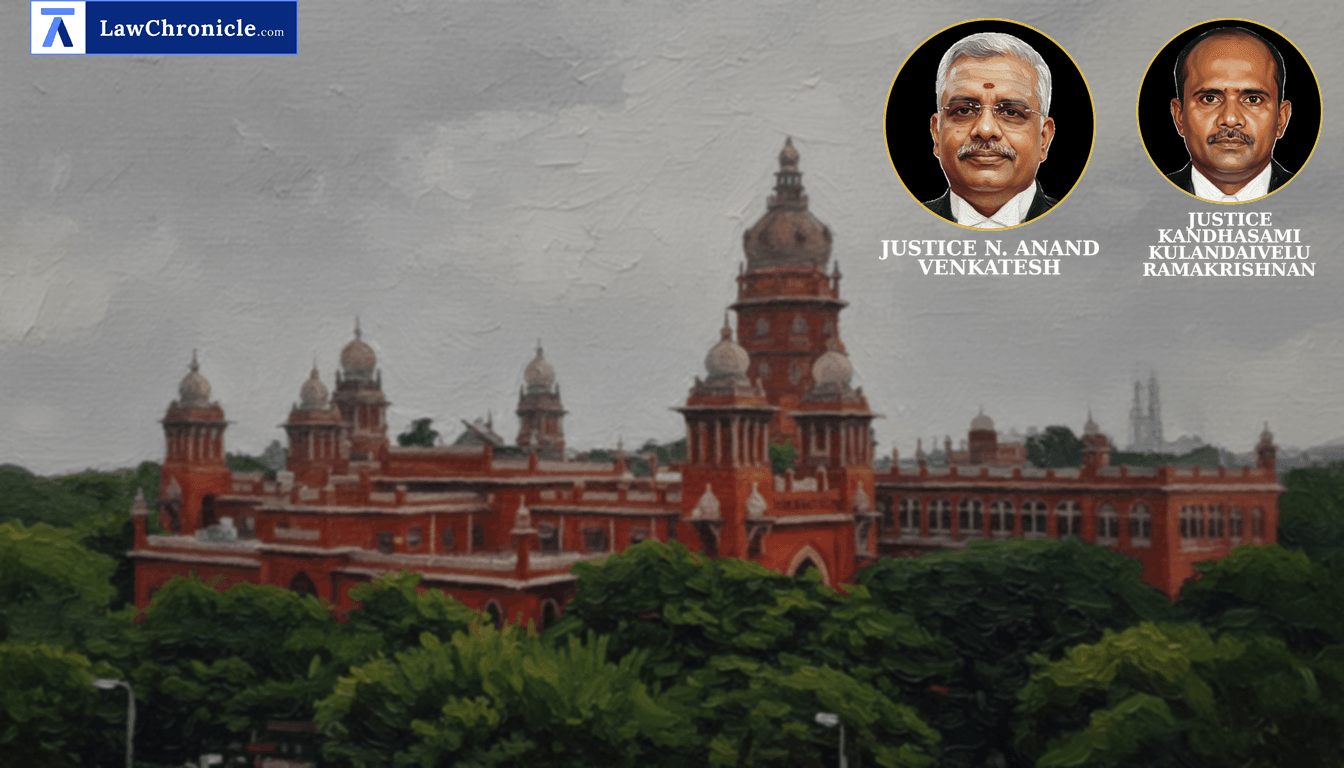
The Madras High Court recently underscored that a truthful and voluntary dying declaration, particularly one recorded by a Judicial Magistrate, can independently sustain a conviction for grave offences without the need for additional corroboration. The court maintained that the legal weight of such declarations is grounded in the jurisprudential maxim that a person at the brink of death is unlikely to speak lies.
A division bench comprising Justice N. Anand Venkatesh and Justice K.K. Ramakrishnan delivered this observation while hearing a criminal appeal challenging a conviction for sexual assault and abetment of suicide. The Court dismissed the appeal, affirming the life sentence awarded to the accused under the Protection of Children from Sexual Offences Act, 2012 and the Indian Penal Code.
The Veracity of Dying Declarations
The Court, in its reasoning, observed: "A dying declaration, as contemplated under Section 32(1) of the Indian Evidence Act, constitutes a statement made by a person as to the cause of his death or the circumstances resulting in his death. The underlying jurisprudential basis rests on the maxim nemo moriturus praesumitur mentiri a person on the verge of death is not presumed to lie. A truthful and voluntary dying declaration can form the sole basis for conviction without the necessity of corroboration. A dying declaration recorded by a Judicial Magistrate stands on a higher evidentiary footing, owing to the presumption of procedural sanctity and absence of external influence."
The bench further clarified that the percentage of burn injuries is not a determinative factor for admissibility. Referring to Laxman v. State of Maharashtra ( "(2002) 6 SCC 710": 2002 CaseBase(SC) 476) and Mafabhai Nagarbhai Raval v.State of Gujarat, the Court noted that even in cases of 99% or 100% burns, a declaration is valid if the declarant is proven to be in a fit state of mind.
Admissibility of Electronic Evidence without Section 65B Certificate
A significant point of law addressed by the Court involved the admissibility of electronic evidence. The Court found the trial court's rejection of mobile phone data for lack of a certificate under Section 65B of the Indian Evidence Act to be erroneous. Relying on the principles in Arjun Panditrao Khotkar v. Kailash Kushanrao Gorantyal ( "2020 (5) CTC 200": 2020 CaseBase(SC) 775), the Court held:
"Where the original electronic device itself is produced and forms the primary evidence, the requirement of a certificate under Section 65B(4) may not arise. In such circumstances, the requirement of a certificate under Section 65B may not arise. Therefore, the trial Court erred in discarding the electronic evidence."
Background:
The prosecution alleged that the appellant lured a 17-year-old girl into a relationship, committed penetrative sexual assault, and clandestinely recorded the act. He subsequently threatened to circulate the video on social media and instigated her to end her life. Under extreme distress, the victim committed self-immolation and later succumbed to 100% burn injuries. Before her death, her statement was recorded by both the police and a Judicial Magistrate.
The appellant's counsel argued that the victim, having suffered extensive burns, could not have been in a fit state of mind to provide a coherent statement and suggested possible tutoring. However, the Court rejected these contentions, noting that the Judicial Magistrate (P.W.11) and the attending doctor (P.W.6) had certified her mental fitness. The Court also referred to Nallapati Sivaiah vs. SDO and Lakhan vs. State of M.P. ( "(2010) 8 SCC 514": 2010 CaseBase(SC) 449) to emphasize that the testimony of a Magistrate regarding the declarant's fitness carries significant weight.
Following the precedents in Khushal Rao vs. State of Bombay ( "AIR 1958 SC 22": 1957 CaseBase(SC) 18) and Nanhau Ram v. State of M.P. ( "1988 Supp SCC 152": 1988 CaseBase(SC) 30), the Court found the dying declaration consistent and natural. The Court also noted that the accused failed to rebut the statutory presumption under Section 29 and 30 of the Protection of Children from Sexual Offences Act, 2012. Consequently, the appeal was dismissed, and the sentence for the remainder of his natural life was upheld.
Case Details:
Case No.: Crl.A.(MD).No. 698 of 2023
NeutralCitation: 2026:MHC:1796
Case Title: M.Vigneshwaran v. The State rep by its, The Inspector of Police
Appearances:
For the Petitioner(s): Mr. Gopalakrishna Laxmana Raju, Senior Counsel assisted by Mr.S.G.L.Rishwanta
For the Respondent(s): Mr.A.Thiruvadikumar, Additional Public Prosecutor
Source: 2026 CaseBase(MAD) 270
 Breaking News