Election Petition Sole Remedy for Challenging Results: Madras HC
 Copy Link
 Share
Share Save
Save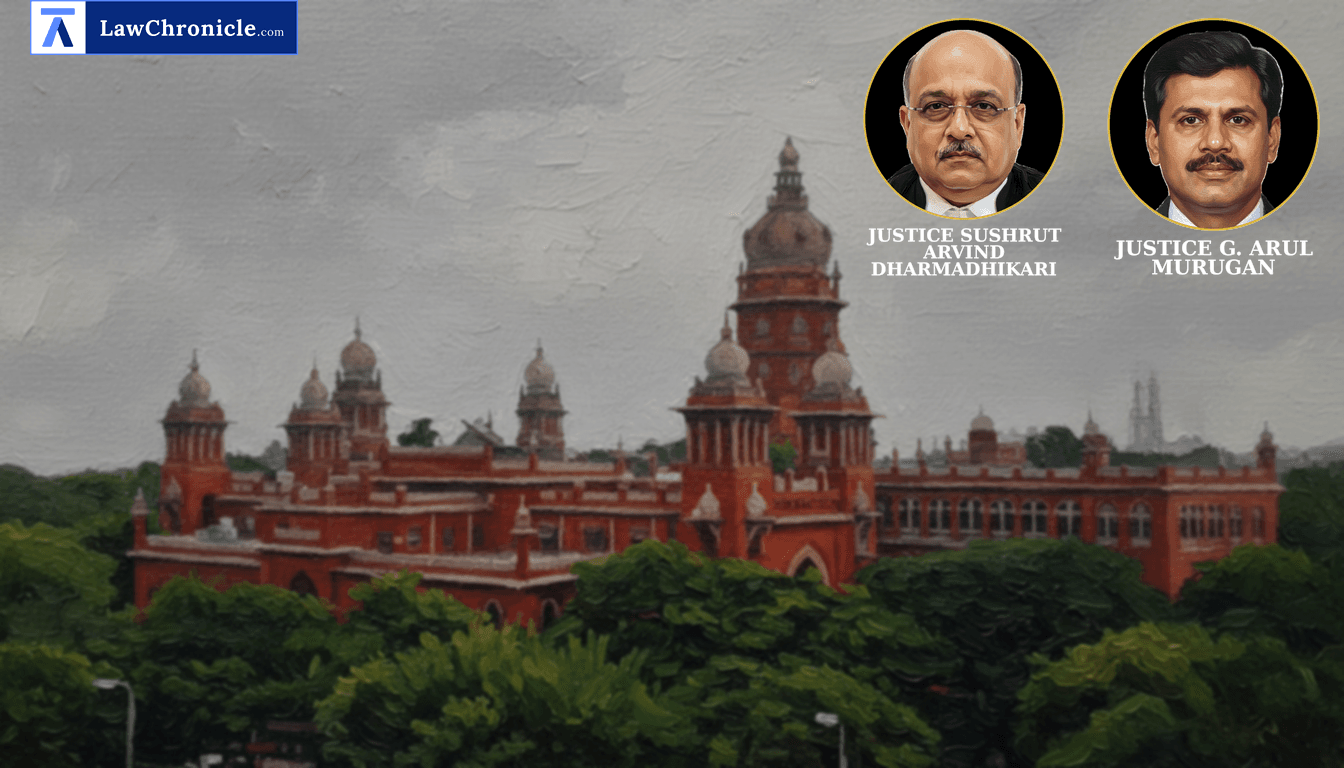
The Madras High Court has slammed the door on attempts to bypass the statutory election petition framework, ruling that post-poll verification grievances seeking to unseat a returned candidate cannot be entertained under writ jurisdiction. In a decisive stance on democratic finality, the court held that any challenge directed at the validity of a declared election result is constitutionally barred from Article 226 interference, regardless of alleged procedural infirmities in EVM-VVPAT checking.
Chief Justice Sushrut Arvind Dharmadhikari and Justice G. Arul Murugan heard the writ petition filed by a candidate who secured the second-highest votes in the Kolathur Assembly Constituency during the 2026 Tamil Nadu Legislative Assembly elections. The petitioner challenged an administrative order certifying the completion of the post-result checking and verification process for Electronic Voting Machines (EVMs) and Voter Verifiable Paper Audit Trail (VVPAT) units.
Key Takeaways
Primacy of Election Petitions
Judicial interference under Article 226 of the Constitution of India is strictly prohibited once an election result is declared if the relief sought involves invalidating the election of a returned candidate.
EVM Verification as Evidence
Post-poll verification mechanisms introduced by the judiciary are additional safeguards to boost public confidence, intended to provide evidentiary support for election petitions rather than serving as independent causes of action for writ petitions.
Statutory Bar on Recounts
Demands for 100% counting of VVPAT slips or full-constituency machine verification are matters of trial that must be established through evidence before an Election Tribunal, not through summary writ proceedings.
Anti-Circumvention Principle
Litigants cannot use 'artful drafting' to frame election disputes as administrative challenges to circumvent the strict 45-day limitation period prescribed for election petitions.
Constitutional Bar Under Article 329(b)
The Court observed that while the petitioner ostensibly challenged an administrative order regarding the verification process, the substantive reliefs sought including declaring the election of the fourth respondent void fell squarely within the definition of 'calling in question' an election. The Bench noted that the word 'election' in Article 329(b) of the Constitution of India is used in a wide sense, covering the entire process from notification to the declaration of the result.
The Court, in its reasoning, observed: "No matter how the pleadings are structured, a prayer of this description is, in substance, nothing but a challenge to the correctness of the election and squarely attracts the bar under Article 329(b) of the Constitution of India. When a petitioner asks this court to declare a duly notified return void, and to declare himself elected in place of the returned candidate, he is doing precisely what Article 329(b) of the Constitution of India forbids him from doing outside the framework of an election petition."
Applicability of the Representation of the People Act
The Bench highlighted that the irregularities alleged such as malfunctioning VVPATs and breaches of Rule 49-T of the Conduct of Elections Rules, 1961 are grounds specifically covered under Section 100 of the Representation of the People Act, 1951. The Court emphasized that such issues require a full-fledged trial, including expert evidence, to determine if the result was 'materially affected.'
The Court has following directions:
"The writ petition is, accordingly, dismissed as not maintainable, with liberty to the petitioner to pursue such remedy as may be available to him in law. There shall be no order as to costs. Connected miscellaneous petitions, if any, are closed."
Ratio
Where the relief sought in a writ petition would have the effect of adjudicating upon the validity of a declared election result or substituting the returned candidate, resort to Article 226 of the Constitution of India is impermissible. Such grievances must be addressed solely through an election petition under Section 80 of the Representation of the People Act, 1951, as the post-result EVM verification process does not create an independent cause of action to bypass the constitutional bar under Article 329(b) of the Constitution of India.
Background
The dispute arose following the 2026 Tamil Nadu Legislative Assembly Election where the petitioner, representing the Dravida Munnetra Kazhagam (DMK), lost to the fourth respondent from Tamilaga Vettri Kazhagam. Relying on the Supreme Court's decision in Association for Democratic Reforms v. Election Commission of India ( "(2025) 2 SCC 732": 2024 CaseBase(SC) 164), the petitioner sought verification of 5% of the EVMs. The petitioner alleged several technical discrepancies, including VVPAT malfunctions during mock polls and irregular sealing of EVM cases, and eventually moved the High Court when the District Election Officer certified the process as successfully completed.
The Election Commission raised a preliminary objection on maintainability, citing K.Venkatachalam v. A.Swamickan ( "(1999) 4 SCC 526": 1999 CaseBase(SC) 391), Election Commission of India v. Ashok Kumar ( "(2000) 8 SCC 216": 2000 CaseBase(SC) 1068), and N.P.Ponnuswami v. Returning Officer ( "AIR 1952 SC 64": 1949 CaseBase(RAJ) 19) to argue that the judiciary should not intervene in election matters post-declaration except through an election petition. The High Court upheld this objection, noting that entertaining such writs would open a 'Pandora's box' and render the statutory scheme of the Representation of the People Act, 1951 illusory.
Case Details:
Case No.: W.P.No.34892 of 2026
Neutral Citation: 2026:MHC:3609
Case Title: M.K.Stalin v. The Election Commission of India and Others
Appearances:
For the Petitioner(s): Mr.Kapil Sibal, Senior Counsel; Mr.J.Ravindran, Senior Counsel; M/s.Aruna Elango and Agilash Kumar
For the Respondent(s): Mr.Dama Seshadri Naidu, Senior Counsel; Mr.G.Rajagopalan, Senior Counsel; Mr.Niranjan Rajagopalan, Standing Counsel for R1 to R3; Mr.V.Raghavachari, Senior Counsel for R4; Mr.G.Murugendran for R37
Source: 2026 CaseBase(MAD) 19256
 Breaking News