Electricity Act Framework Does Not Per Se Block Interim Third-Party Hearing: SC
 Copy Link
 Share
Share Save
Save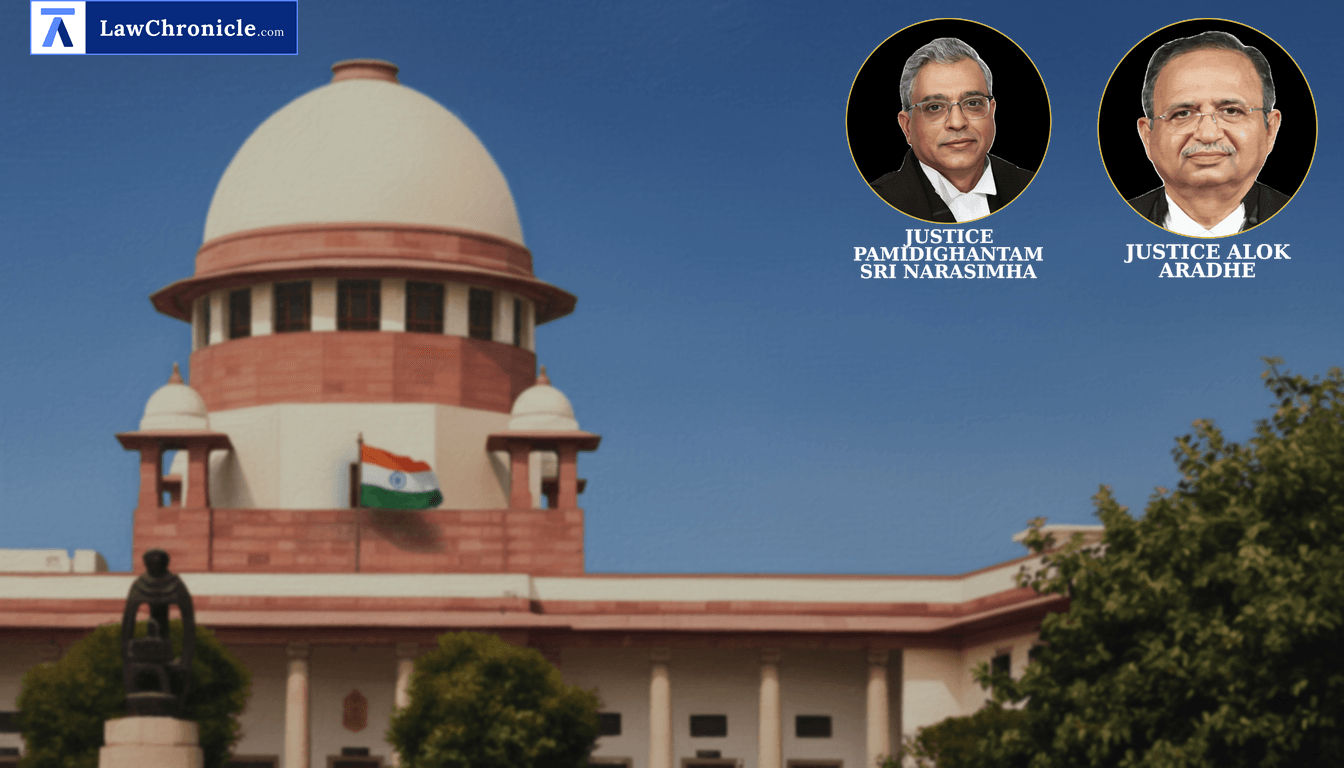
Refusing to scuttle an interim mechanism permitted by the High Court, the Supreme Court has upheld an order allowing a consumer advocacy group to participate in state utility inquiry proceedings over alleged illegal power supply and cross-subsidy evasions.
A Bench comprising Justice Pamidighantam Sri Narasimha and Justice Alok Aradhe declined to interfere under Article 136 of the Constitution of India against an interim order of the Jharkhand High Court permitting a third party to present facts during a departmental show-cause process.
Key Takeaways
Third-Party Information Access Validated: Non-parties to power supply agreements may be permitted to place material before utilities in administrative inquiries under exceptional circumstances.
Regulatory Framework Integration: High Courts must holistically consider the statutory regulatory architecture of the Electricity Act, 2003 before issuing final orders in public interest litigations.
Preservation of Statutory Scope: Oral hearings granted to third parties in administrative inquiries serve as information-gathering tools rather than formal judicial adjudications.
Court Observations and Directions
The Apex Court observed that while the statutory framework under the Electricity Act, 2003 creates an exhaustive mechanism, the High Court’s interim measure was intended to bring complete facts to light regarding the alleged unauthorized power supply.
The Court, in its reasoning, observed: "We are conscious of the fact that proceedings have been initiated by JBVNL against the petitioners for violation of the CPP Agreement, and respondent no. 1 is not privy to the aforesaid agreement. However, in the peculiar facts and circumstances of the case, High Court came to the conclusion that it is necessary to bring full facts to the notice of JBVNL through a party other than the petitioners so that an appropriate decision could be reached. The High Court has found it compelling to adopt an interim measure in the peculiar facts of the case which in our opinion cannot be termed as perverse, warranting any interference at this stage under Article 136 of the Constitution of India."
The Court issued the following directions:
"While we decline to interfere with the interim order passed by the High Court, we make it clear that we have not expressed any opinion on merits of the matter. At the time of final hearing, the High Court will consider all aspects of the matter, including the scope and ambit of third-party intervention in proceedings arising under the Electricity Act."
Ratio
Interim discretionary measures by a High Court permitting a third party to submit facts to an administrative body during an inquiry do not warrant interference under Article 136 of the Constitution of India when aimed at facilitating complete factual discovery without expanding statutory adjudicatory roles.
Background
The dispute originated from a Captive Power Plant (CPP) Agreement entered into on 17.05.2012 between M/s. Amalgam Steels and Power Ltd. (Petitioner No. 1) and Jharkhand Bijli Vitran Nigam Ltd. (JBVNL) for the supply of surplus power, which was subsequently renewed in 2017 and 2023.
Respondent No. 1, Energy Watchdog, submitted a complaint alleging that Petitioner No. 2 was consuming electricity generated by Petitioner No. 1 without maintaining valid captive user status under Rule 3 of the Electricity Rules, 2005. It sought action under Section 135 of the Electricity Act, 2003. Subsequently, Respondent No. 1 filed a Public Interest Litigation before the High Court of Jharkhand at Ranchi, seeking a declaration that the power supply was illegal in the absence of Open Access Approval and demanding recovery of state utility losses.
Following show cause notices and demand notices issued by JBVNL seeking cross subsidy surcharges amounting to Rs. 176.74 crores from Petitioner No. 1 and Rs. 108.17 crores from Petitioner No. 2, Petitioner No. 1 filed an interlocutory application challenging the maintainability of the PIL. The High Court rejected the preliminary objection and directed that Respondent No. 1 be heard alongside the petitioners in the ongoing show-cause proceedings.
Challenging the interim order, Senior Advocate Dr. A.M. Singhvi argued on behalf of the petitioners that Respondent No. 1 was a stranger with no locus standi, relying on Ayaaubkhan Noorkhan Pathan v. State of Maharashtra and Others ( "(2013) 4 SCC 465": 2012 CaseBase(SC) 440), D.N. Jeevaraj v. Chief Secretary, Government of Karnataka and Others, and Kunga Nima Lepcha & Ors. v. State of Sikkim & Ors ( "(2010) 4 SCC 513": 2010 CaseBase(SC) 1518). He contended that the Electricity Act, 2003 is an exhaustive self-contained code as recognized in PTC India Ltd. v. Central Electricity Regulatory Commission ( "(2010) 4 SCC 603": 2010 CaseBase(SC) 938) and Southern Power Distribution Company of Andhra Pradesh Ltd. & Anr. v. Green Infra Wind Solutions Ltd. & Ors. ( "2026 SCC OnLine SC 479": 2026 CaseBase(SC) 265), and that the High Court erred by judicially introducing a tripartite procedure. Advocate Prashant Bhushan appeared for Respondent No. 1 and supported the High Court's directions.
The Supreme Court observed that statutory functions under Section 79, Section 86, and Section 94 of the Electricity Act, 2003 must be evaluated by the High Court during the final hearing, and accordingly disposed of the Special Leave Petition.
Case Details:
Case No.: Special Leave Petition (C) No. 10538/2026
Neutral Citation: 2026 INSC 954
Case Title: M/S. Amalgam Steels and Power Ltd. and Anr. v. Energy Watchdog and Ors.
Appearances:
For the Petitioner(s): Dr. A.M. Singhvi, Senior Advocate
For the Respondent(s): Mr. Prashant Bhushan, Advocate
Source: 2026 CaseBase(SC) 2578
 Breaking News