


Encroachers cannot claim fundamental right to re-occupy government land after rehabilitation: Andhra Pradesh HC
 Copy Link
 Share
 Save
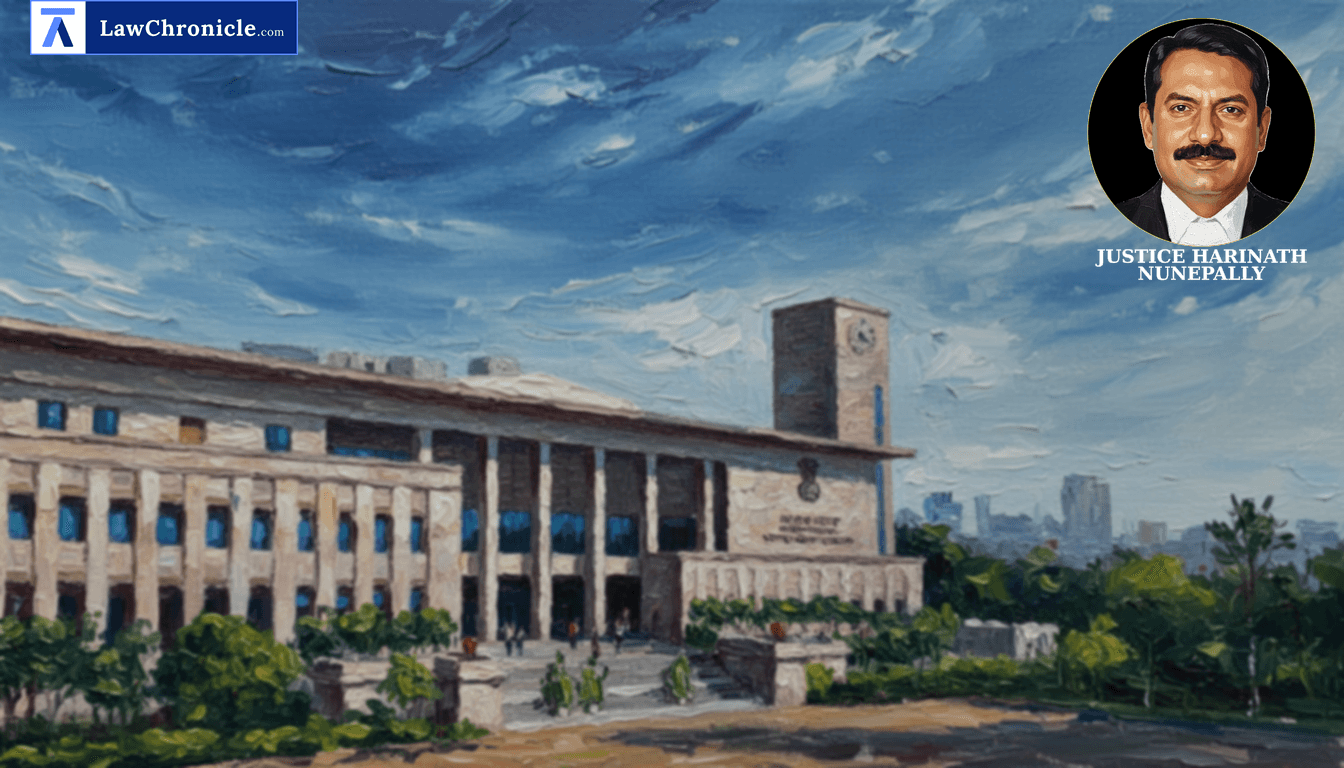
In a stern warning against the illegal re-occupation of public utilities, the Andhra Pradesh High Court has ruled that encroachers who have already received alternative rehabilitation housing cannot resurface on government irrigation land and seek judicial protection. The Court dismissed a plea seeking to stall demolition, holding that the payment of municipal taxes does not confer ownership over encroached public property.
A Single Judge bench of Justice Harinath.N heard the writ petition filed under Constitution of India by an individual challenging the proposed demolition of his residential structure in Vijayawada by municipal authorities. The petitioner alleged that the 5th respondent attempted to demolish his house without following the due process of law or issuing prior notice, seeking a Writ of Mandamus to prevent interference with his possession.
Key Takeaways
Rehabilitation bars re-occupation
Encroachers who accept alternative housing under government schemes for displacement cannot legally return to the original encroached site and claim fundamental rights.
Tax payment is not title
Assessment and payment of municipal taxes or water charges do not create a legal title or vest ownership rights in favor of an illegal occupant on government land.
Irrigation land protection
Public lands, specifically irrigation canal lands, are protected from private claims of adverse possession or ancestral rights without valid documentary evidence.
No relief for suppressed facts
Litigants who fail to establish a bona fide right to the subject land or suppress the fact of prior rehabilitation are not entitled to discretionary relief under writ jurisdiction.
Court Observations on Illegal Encroachment and Rehabilitation
The Court scrutinized the petitioner's claim of ancestral possession and noted the lack of any supporting documentation to establish a valid title. The bench emphasized that once the State has provided rehabilitation for displacement from encroached land, the individual cannot claim a right to stay on government property.
The Court, in its reasoning, observed: "The petitioner, having been allotted a residential unit for the displacement from the encroached property, cannot resurface on the government irrigation land and claim a stay as a matter of fundamental right. The petitioner has failed to establish his bona fide right to the subject land, and, as such, he is not entitled to any relief."
The Court has following directions:
"Accordingly, the writ petition is dismissed. There shall be no order as to costs. As a sequel, miscellaneous petitions pending, if any, shall stand closed."
Ratio
An individual who has been allotted alternative accommodation under a government rehabilitation scheme (such as JNNURM) due to displacement from encroached public land is legally estopped from re-occupying the same or adjacent government land. Payment of municipal taxes and utility charges does not transform illegal encroachment into a vested legal right or title over government irrigation land.
Background
The petitioner claimed to be the owner of 130 square yards in Gandhiji Colony, Vijayawada, asserting that the property was inherited from ancestors. He argued that despite paying house and water taxes since 2006-07, the Ward Planning Secretary (Respondent No. 5) threatened demolition without notice. The petitioner further contended that while 70 square yards of his original 200 square yards were acquired for a railway over-bridge in 2011, he remained in possession of the rest.
Conversely, the Vijayawada Municipality through the Vijayawada Municipality argued that the land belongs to the Irrigation Department. The authorities revealed that the petitioner’s wife had already been allotted a flat under the JNNURM Housing Scheme as compensation for the 2011 displacement. The respondents alleged that the petitioner had sold the allotted flat and returned to encroach upon the irrigation canal land. They also cited instances where the petitioner allegedly threatened officials with cases under the SC/ST Prevention of Atrocities Act to prevent eviction.
Upon reviewing the material, the Court found that the petitioner was an encroacher who had already benefited from state rehabilitation. It held that the petitioner failed to prove how his ancestors occupied the land and ruled that he had no legal right to remain on the property.
Case Details:
Case No.: WRIT PETITION NO: 16665/2024
Neutral Citation: 2026:APHC:36592
Case Title: NALLURI MOHAN RAO v. THE STATE OF ANDHRA PRADESH AND OTHERS
Appearances:
For the Petitioner(s): S BALA MOHAN RANGA
For the Respondent(s): GP FOR REVENUE, GP MUNCIPAL ADMN AND URBAN DEV AP, S.V.S.S.SIVARAM SC For VMC
Source: 2026 CaseBase(AP) 15657
Similar Articles



 Breaking News


