


Enhanced Sentence Under Amending Law Cannot Be Applied Retrospectively: SC
 Copy Link
 Share
 Save
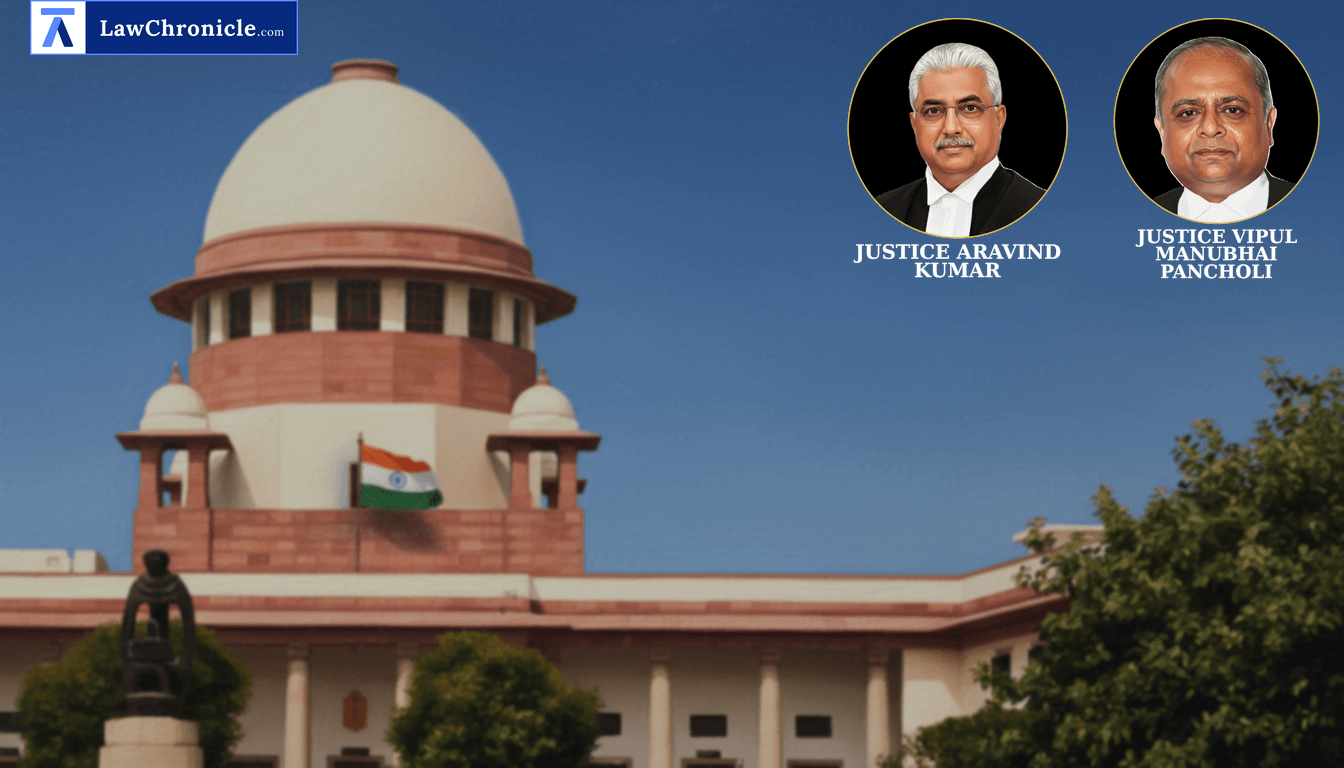
Barring the retrospective application of enhanced penal provisions, the Supreme Court has ruled that a convict cannot be subjected to a higher minimum sentence introduced by a statutory amendment post the date of the crime. Reaffirming constitutional protection under Article 20(1) of the Constitution of India, 1950, the apex court restored life imprisonment without life-long incarceration stipulations for an aggravated child abuse convict.
A Division Bench comprising Justice Aravind Kumar and Justice Vipul M. Pancholi heard the appeal against a High Court judgment that had erroneously applied the 2019 amendment of the Protection of Children from Sexual Offences Act, 2012 to modify a convict's life sentence to 20 years of rigorous imprisonment.
Key Takeaways
- Protection Against Ex-Post Facto Laws: The Supreme Court reiterated that penal laws enhancing minimum punishments operate strictly prospectively under Article 20(1) of the Constitution of India, 1950.
- Discretion in Life Sentences: Courts retain the judicial discretion to determine the scope of life imprisonment without automatically mandating incarceration till natural death unless specifically warranted.
- Child-Centric System Safeguards: Legal and law enforcement processes must be structured to be non-intimidating, supportive, and protective for minor victim-survivors.
Court Observations and Directions
The Supreme Court emphasized that penal provisions cannot be retrospectively enhanced to the detriment of an accused. Evaluating the interplay between Section 376(2)(i) of the Indian Penal Code, 1860 and Section 6 of the Protection of Children from Sexual Offences Act, 2012 alongside Section 42 of the Protection of Children from Sexual Offences Act, 2012, the Bench observed that judicial discretion governs the spectrum of life imprisonment.
Reflecting on the psychological trauma inflicted on minor victims, the Court highlighted the imperative for compassionate judicial and statutory interventions. The Court, in its reasoning, observed: "The invocation of Article 20(1) of the Constitution also makes it clear that every person has a fundamental right only to be convicted of an offence under the law that was in operation at the time of commission of the criminal act. Thus, on prima facie construction, we are of the view that the High Court erred in applying the punishment prescribed under the Amended Act of 2019, enhancing the minimum punishment under Section 6 of the POCSO Act."
The Court issued the following directions:
"With greatest concern to our children, we deem it appropriate to direct all the appropriate authorities concerned, right from the police, to ensure that the legal process is less intimidating and more reassuring to the children who are unfortunate sufferers of harsh illegal acts. There has to be timely and effective enforcement of justice and protection to the child victims at all times."
Ratio
Under Article 20(1) of the Constitution of India, 1950, a penal amendment that enhances statutory minimum punishment cannot be applied retrospectively to offences committed prior to its enforcement. Further, where life imprisonment is awarded alongside non-amended statutory provisions, courts maintain full discretion regarding whether the sentence shall extend for the remainder of the convict's natural life.
Background
The case originated from an incident in February 2016 involving the aggravated penetrative sexual assault of a 3-year-old girl. Following an investigation, charges were framed under Section 376(2)(i) of the Indian Penal Code, 1860 and Sections 6 and 8 of the Protection of Children from Sexual Offences Act, 2012. The Trial Court convicted the accused and sentenced him to concurrent life imprisonment with a fine under both statutes.
Upon appeal, the High Court of Chhattisgarh affirmed the conviction but reduced the sentence to 20 years of rigorous imprisonment by relying on Section 42 of the Protection of Children from Sexual Offences Act, 2012 and the 2019 Amendment to the Protection of Children from Sexual Offences Act, 2012. The appellant challenged this modification before the Supreme Court.
Evaluating precedents, including Satauram Mandavi v. State of Chhattisgarh & Anr. ( "2025 INSC 892": 2025 CaseBase(SC) 542) and Swamy Shraddananda v. State of Karnataka ( "(2008) 13 SCC 767": 2008 CaseBase(SC) 1365), the Supreme Court held that statutory minimums cannot be retrospectively altered. Reaffirming Union of India v. V Sriharan alias Murugan and Ors ( "(2016) 7 SCC 1": 2015 CaseBase(SC) 480) and Gyanendra Singh @ Raja Singh v. State of Uttar Pradesh ( "2025 INSC 335": 2025 CaseBase(SC) 130), the apex court set aside the High Court's sentence reduction and restored the Trial Court's life imprisonment sentence under Section 6 of the pre-amended Protection of Children from Sexual Offences Act, 2012 and Section 376(2)(i) of the Indian Penal Code, 1860, without the stipulation that life term shall extend till natural life. Provisions under Section 42 of the Protection of Children from Sexual Offences Act, 2012 and Section 67B of the Information Technology Act, 2000 were noted regarding alternate enhanced punishments.
Case Details:
Case No.: Criminal Appeal No. of 2026 (@ Special Leave Petition (Criminal) No. 7030 of 2026)
Neutral Citation: 2026 INSC 850
Case Title: Balesh Kumar Kuraiti v. State of Chhattisgarh
Source: 2026 CaseBase(SC) 784
Similar Articles




 Breaking News


