


Enmity No Ground to Discard Reliable Eye-Witness Testimony: Allahabad HC
 Copy Link
 Share
 Save
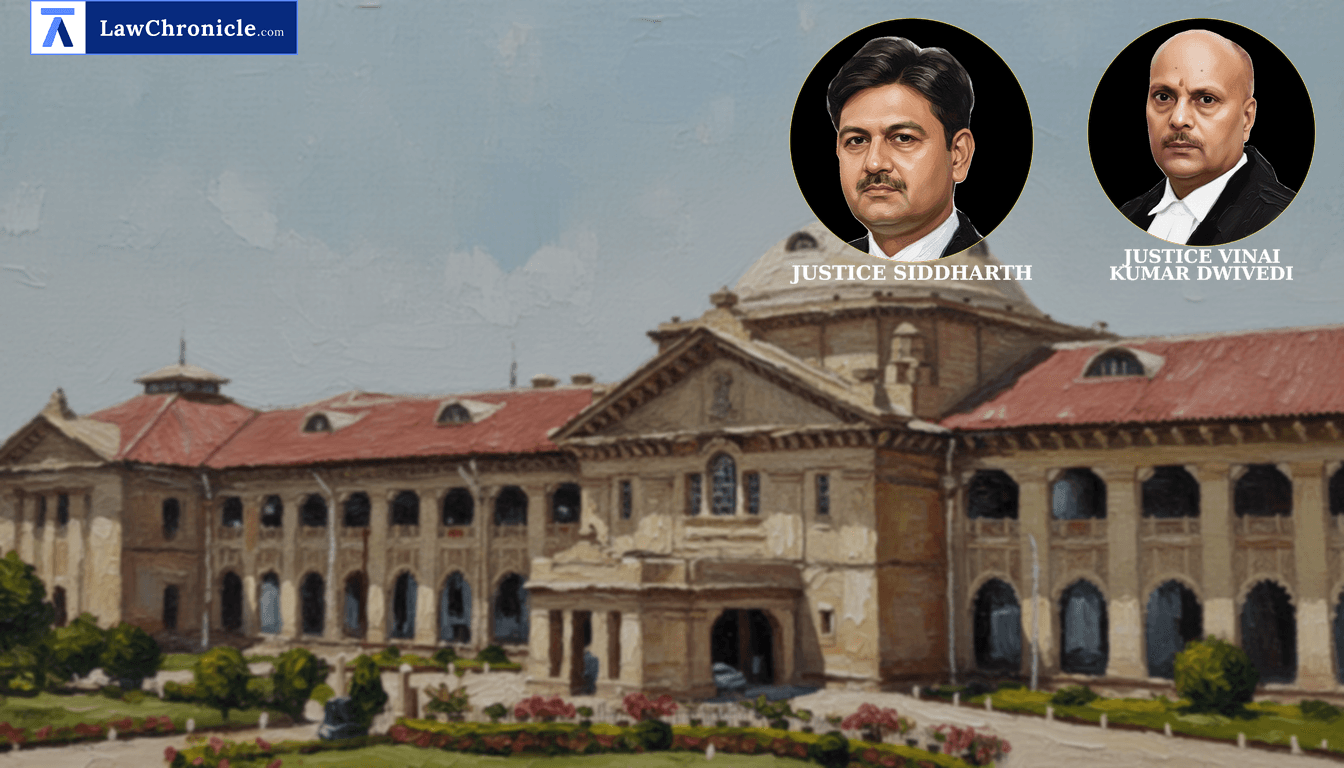
The Allahabad High Court affirmed the conviction of multiple appellants for murder, emphasizing that the existence of deep-rooted enmity between parties cannot be a sole basis to reject the credible and corroborated testimony of natural eye-witnesses.
Justice Siddharth and Justice Vinai Kumar Dwivedi presided over the appeals challenging a 1983 trial court verdict. The Court held that when ocular evidence is consistent, supported by medical reports, and the witnesses' presence at the crime scene is established, the prosecution's case remains robust despite the non-recovery of murder weapons or the lack of independent witnesses.
Consistency Between Ocular and Medical Evidence
The Court noted that the testimonies of the informant and an injured eye-witness were natural and free from artificiality. These accounts were further bolstered by forensic reports from the Forensic Science Laboratory (FSL) confirming human blood on the witnesses' clothes and the soil at the scene. Referring to the legal principles on witness credibility, the Court highlighted that the evidence of an injured witness carries significant weight and should not be discarded unless there are major inconsistencies.
Rationale on Enmity and Witness Scrutiny
Addressing the defence’s argument regarding long-standing litigation and enmity between the families, the Court, in its reasoning, observed: "What is required where witnesses are inimical towards the accused persons is that careful and cautious scrutiny of the evidence of inimical witnesses must be done by the Court. If, after careful and deep scrutiny and appreciation of evidence of inimical witnesses, it is revealed that the witnesses have stated the prosecution story without any concoction and artificiality in a very simple and natural way, and their presence at the place of occurrence is proved beyond reasonable doubt, then in this condition, the evidence of the eye-witnesses of the occurrence could not be doubted and rejected on this ground."
The Court relied on the precedent in Suresh Sitaram Surve vs. State of Maharashtra ( "(2002) 10 SCC 28": 2002 CaseBase(SC) 556), which established that the testimony of injured eye-witnesses cannot be discarded merely due to inimical disposition.
Non-Recovery of Murder Weapons Not Fatal to Prosecution
A significant defence plea was the failure of the Investigating Officer to recover the 'guptis' and knives used in the assault. However, the Court rejected this, citing Nankaunoo vs. State of Uttar Pradesh ( "(2016) 3 SCC 317": 2016 CaseBase(SC) 84) and Rakesh and Another vs. State of Uttar Pradesh and Another. It held that for a conviction, the recovery of the weapon is not a sine qua non if the oral evidence is unimpeachable and corroborated by medical findings. In this case, the post-mortem report detailing fifteen injuries, including stab and incised wounds, aligned perfectly with the eye-witness descriptions of the attack.
Court Directions
The Court has the following directions:
"The impugned judgment and order dated 17.11.1983 passed by the learned Trial Court is affirmed. The appellants, Satish, Shiv Kumar, Ashok, Bhupat, Vijay and Vikram, are in jail. They shall remain in jail to serve out the sentence awarded to them by the Trial Court. Let a copy of this judgment be transmitted to the Trial Court along with the Trial Court records forthwith for necessary compliance. Learned Amicus Curiae is held entitled to professional fees of Rs.15,000/- payable to him within three weeks’ for raising of bill."
Background:
The case dates back to August 10, 1982, near Haridwar. The informant, Nathiram, his father, and the deceased, Satish Kumar, were returning from a medical store when they were ambushed by the seven accused individuals armed with guptis, knives, a bicycle chain, and a country-made pistol. The assault resulted in the death of Satish Kumar and injuries to Shri Ram. The Trial Court in Sessions Trial No. 432 of 1982 convicted the appellants under Sections 147, 148, 323, 324, 307, and 302 read with 149 of the Indian Penal Code, 1860. During the pendency of the appeal, one appellant, Rakesh, passed away, leading to the abatement of his appeal. The High Court, after re-evaluating the evidence, found no perversity in the Trial Court's findings and dismissed the appeals.
Case Details:
Case No.: CRIMINAL APPEAL No. - 2851 of 1983
Case Title: Satish and others v. State
Appearances:
For the Petitioner(s): Aushim Luthra (Amicus Curiae), K. Sahai, Sanjay Singh
For the Respondent(s): A.G.A.
Source: 2026 CaseBase(ALL) 216
Similar Articles
 Breaking News


