Executing Courts Must Not Reject Third-Party Objections on Hyper-Technical Grounds: SC
 Copy Link
 Share
 Save
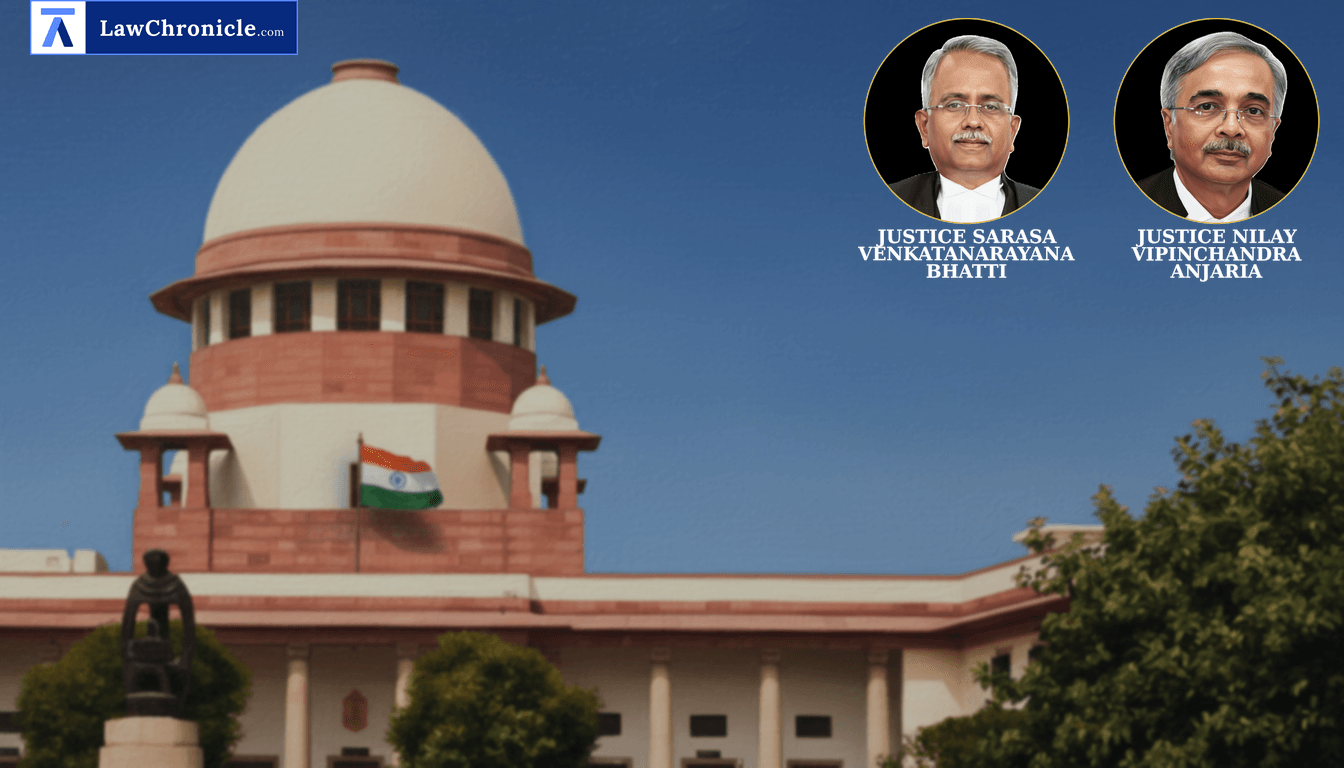
Setting a firm precedent against procedural hyper-technicalities in execution proceedings, the Supreme Court has ruled that a third-party objector's claim over property cannot be dismissed merely for citing an incorrect legal provision. Clarifying that execution courts are duty-bound to conduct a full-fledged inquiry into independent property rights, the Apex Court set aside lower court orders that erroneously shifted the burden of proof and prioritized procedural flaws over substantive determination.
A Division Bench of Justice S.V.N. Bhatti and Justice N.V. Anjaria set aside the judgments of the Telangana High Court and the Executing Court, remanding the execution proceedings for a fresh and comprehensive inquiry into the identity and title of the disputed property.
Key Takeaways
- Procedural Flexibility Victorious: Citing an incorrect section, such as Order XXI Rule 58 instead of Rule 97 of the Code of Civil Procedure, 1908, does not invalidate a third party's substantive objection to execution.
- Mandatory Inquiry into Independent Rights: Execution courts must resolve all disputes regarding right, title, or interest raised by strangers under Order XXI Rule 97 in accordance with Rule 101.
- Property Identity Trumps Unproven Claims: Decree Holders cannot automatically claim execution without establishing the precise correlation and identity of suit property schedules across anterior title deeds.
- Burden of Proof Rectification: Executing courts cannot dismiss third-party objections simply by improperly fastening the entire burden on the objector while ignoring sketchy evidence from the decree holder.
Court's Rationale and Rejection of Lower Courts' Approach
The Supreme Court observed that the lower courts erred in dismissing the Third Party Objector’s claim on technical grounds, such as quoting Order XXI Rule 58 of the Code of Civil Procedure, 1908 instead of Rule 97, and failing to properly determine the physical identity of the disputed premises. The Bench observed that "In a matter such as the present, the decisive factor is not the claim of the DHR or the Appellant, but the identity of the property in the old and contemporaneous Revenue or Municipal Records. The documents relied on by the DHR are sketchy and do not establish the title, let alone defeat the title in favour of the Appellant recognised in earlier rounds of litigation... The burden is wrongly fastened on the Third Party/Appellant."
The Supreme Court highlighted that the key legal principles governing third-party resistance during execution proceedings had been decisively settled by precedents. Referring to Periyammal (Dead) Through Legal Representatives and Others v. V. Rajamani and another, the Supreme Court highlighted the procedure under Order XXI of the Code of Civil Procedure, 1908:
A. Order XXI Rule 35 of the Code of Civil Procedure, 1908 confers jurisdiction on the Executing Court to remove any person bound by the Decree who refuses to vacate the property. Rules 97 to 101 of Order XXI deal with situations where execution is obstructed or resisted by "any person", including even a stranger to the Decree who is not bound by it or who claims an independent right, title or interest in the property.
B. Order XXI Rule 97 applies before a Decree for Possession is executed, allowing the Court to resolve an obstructionist's grievance before delivering the Decree to the DHR. Rule 99 applies later, when a stranger claiming rights in the property has been dispossessed and seeks restoration.
C. If a purported stranger to the Decree resists execution, the DHR's sole remedy lies under Order XXI Rule 97 of the Code of Civil Procedure, 1908. The Holder cannot bypass such obstruction and insist on the reissuance of the warrant for possession under Order XXI Rule 35.
D. Courts adjudicating an Application under Order XXI Rule 97 must do so in accordance with Rule 101 of the Code of Civil Procedure, 1908 and conduct a full-fledged inquiry into all questions, including those relating to the right, title, or interest in the property arising between the parties.
Ratio
An application resisting the execution of a decree for possession filed by a stranger claiming independent right, title, or interest cannot be rejected merely because it cites an incorrect provision of the Code of Civil Procedure, 1908. Under Order XXI Rules 97 to 101 of the Code of Civil Procedure, 1908, the Executing Court is required to conduct a full-fledged inquiry to determine all questions of title, right, interest, and exact property identity between the parties prior to enforcing the decree.
Background
The dispute stems from an ex-parte decree passed in O.S. No. 2204 of 2012 by the VII Senior Civil Judge, City Civil Court at Hyderabad. Respondent No. 1 had filed the suit seeking specific performance of an Agreement of Sale dated 23.02.2001 allegedly executed by Respondent No. 2. After the suit was decreed in 2015, Respondent No. 1 filed E.P. No. 4 of 2016 for physical possession of the suit schedule property admeasuring 373 sq. yards in Hyderabad.
The Appellant, Alladin Charities and Zakat Wakf, filed E.A. No. 94 of 2016 as a third-party objector to resist execution. The Appellant claimed independent ownership and possession over the property under a Farman Mubarak issued by the former Nizam of Hyderabad, subsequently recognized in the Muntakhab of 1949, a 1976 Trust Deed, and notified in the Gazette under the Waqf Act, 1995. The Appellant emphasized that past litigations up to the Supreme Court had confirmed their possession and entitlement over the Waqf property. However, the Executing Court dismissed the Appellant's claim petition in January 2019, holding that an application under Order XXI Rule 58 of the Code of Civil Procedure, 1908 was not maintainable in execution proceedings seeking delivery of possession, and that the Appellant failed to conclusively prove title. The High Court for the State of Telangana upheld this dismissal in CCCA No. 94 of 2019.
Aggrieved, the Appellant approached the Supreme Court. The Supreme Court set aside the decisions of both the High Court and the Executing Court, allowed the civil appeal, and remanded the matter back for full adjudication after allowing both parties to file additional evidence.
Case Details:
Case No.: Civil Appeal No. of 2026 (@ S.L.P. (Civil) No. 23573 of 2025)
Neutral Citation: 2026 INSC 1122
Case Title: Alladin Charities and Zakat Wakf v. Mohammed Saleem alias Mohd. Wajid Ali and Another
Source: 2026 CaseBase(SC) 8262
 Breaking News