Failed Consensual Relationships Cannot Be Retrospectively Branded As Rape: Supreme Court
 Copy Link
 Share
 Save
In a stern warning against the weaponization of criminal law in the aftermath of emotional discord, the Supreme Court has ruled that a breakdown of a long-standing consensual relationship cannot retrospectively transform prior instances of physical intimacy into offences of rape. The Apex Court discharged a man accused under various provisions of sexual assault and cheating, holding that criminal law cannot be deployed to settle personal scores or exact revenge when adult relationships sour.
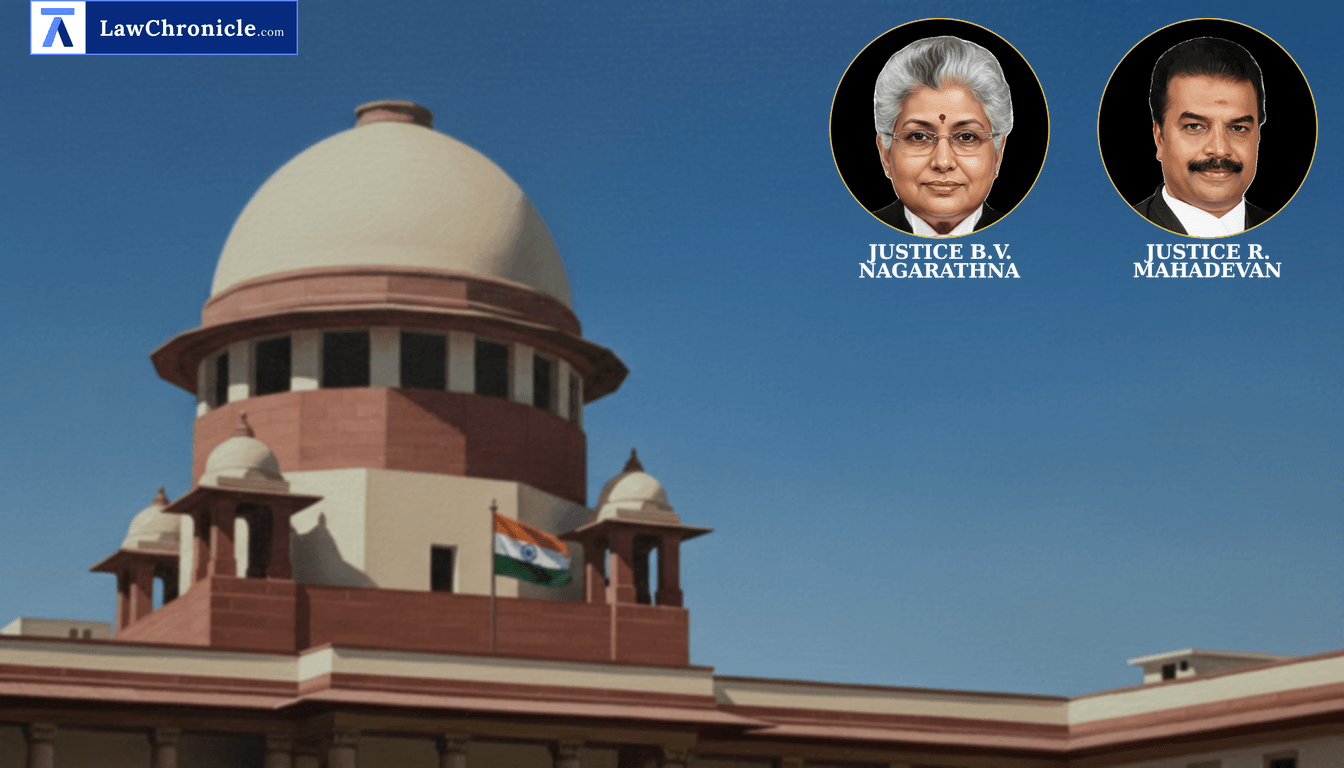
A bench of Justice B.V. Nagarathna and Justice R. Mahadevan set aside the Kerala High Court order that had upheld the trial court's rejection of the discharge application filed by the appellant.
Key Takeaways
- Consensual Relationship vs. Rape: Subsequent breakup or fallout in a consensual relationship between adults cannot convert past consensual sexual acts into rape.
- Limits of Section 376(2)(n): Section 376(2)(n) of the Indian Penal Code, 1860 requires distinct, repeated acts of sexual assault rather than continuous intimacy within a long-standing personal cohabitation.
- Deceit and Misconception of Fact: A woman who voluntarily continues cohabitation after acquiring knowledge of a partner's pre-existing marriage cannot claim that consent was continuously obtained through deception.
- Prevention of Process Abuse: Courts must prevent the abuse of the criminal justice system where failed adult relationships are converted into criminal prosecutions causing severe stigma and harassment.
Consensual Relationships and Discharge Standards
Examining the scope of judicial scrutiny at the stage of framing charges under Section 227 of the Code of Criminal Procedure, 1973, the Apex Court underscored that the court must evaluate the broad probabilities and sift evidence to determine if a prima facie case exists. Relying on Union of India vs. Prafulla Kumar Samal ( "(1979) 3 SCC 4": 1978 CaseBase(SC) 17) and Sajjan Kumar vs. Central Bureau of Investigation ( "(2010) 9 SCC 368": 2010 CaseBase(SC) 383), the Supreme Court reiterated that while a roving enquiry is impermissible, a judge cannot act merely as a mouthpiece of the prosecution. The Bench observed that the respondent had lived with the appellant from 1996 to 2003 and admitted to learning of his prior marriage shortly after cohabiting, yet continued the relationship. The Court held that physical intimacy during the currency of a functioning relationship cannot be artificially severed or recharacterized following a discord.
The Supreme Court expressed concern over the increasing instances of weaponizing criminal law after relationship discord. The Bench stated that “We wish to note a worrying trend in recent years wherein consensual relationships that have come to an end are retrospectively combed with a fine tooth so as to identify what can post-facto be construed as violence and sexual assault. There is thus a need to distinguish between an absence of consent in its entirety because of it having been built entirely on a mirage of deceit and falsehood at the outset on the one hand from the experiencing of regret over having consented to past sexual acts, owing to the later demise of the relationship. While the latter scenario is unfortunate, such hindsight on its own cannot constitute a consensual relationship as a crime and set the gears of the criminal justice system into motion in a manner that deprives the accused of his liberty and reputation.” Accordingly, the Apex Court discharged the accused.
Ratio
Consensual sexual intercourse between consenting adults during the currency of an ongoing personal relationship cannot be retrospectively criminalised as rape under Section 376 of the Indian Penal Code, 1860 upon the eventual failure or termination of the relationship. Where knowledge of a pre-existing marriage is acquired during cohabitation and the relationship continues voluntarily, allegations of consent vitiated by deceit or misconception of fact under Sections 376, 420, 493, 494, and 495 of the Indian Penal Code, 1860 are untenable.
Background
The dispute originated from a relationship between the appellant and respondent No. 2, who cohabited between 1996 and 2003 after performing marriage rituals at a temple in Mysuru. Five years after their separation in 2003, respondent No. 2 filed proceedings under Section 12(1) of the Protection of Women from Domestic Violence Act, 2005, which were dismissed. Subsequently, she initiated private criminal complaints alleging offences under Sections 376, 420, 493, 494, and 495 of the Indian Penal Code, 1860.
Following a police investigation pursuant to an order under Section 156(3) of the Code of Criminal Procedure, 1973, an FIR was registered. The appellant sought discharge before the trial court, which was dismissed. The Kerala High Court confirmed the trial court's order, holding that consent given under a misconception of fact attracted Section 376 of the Indian Penal Code, 1860. Reversing these findings, the Supreme Court allowed the appeal and discharged the appellant of all charges.
Case Details:
Case No.: Criminal Appeal Nos. of 2026 (Arising Out of SLP (Crl.) Nos.10173-10174 of 2025)
Neutral Citation: 2026 INSC 1179
Case Title: Santhosh Kumar N.P. v. State-Station House Officer, Kadirur Police, Tellicherry, Kannur District & Another
Appearances:
For the Petitioner(s): Sri R. Basant, Senior Advocate
For the Respondent(s): Sri K. Rajeev, Advocate-on-Record
Source: 2026 CaseBase(SC) 9513
 Breaking News