Fairness Not A One-Way Street: SC Restores 30-Year-Old Auction Sale
 Copy Link
 Share
Share Save
Save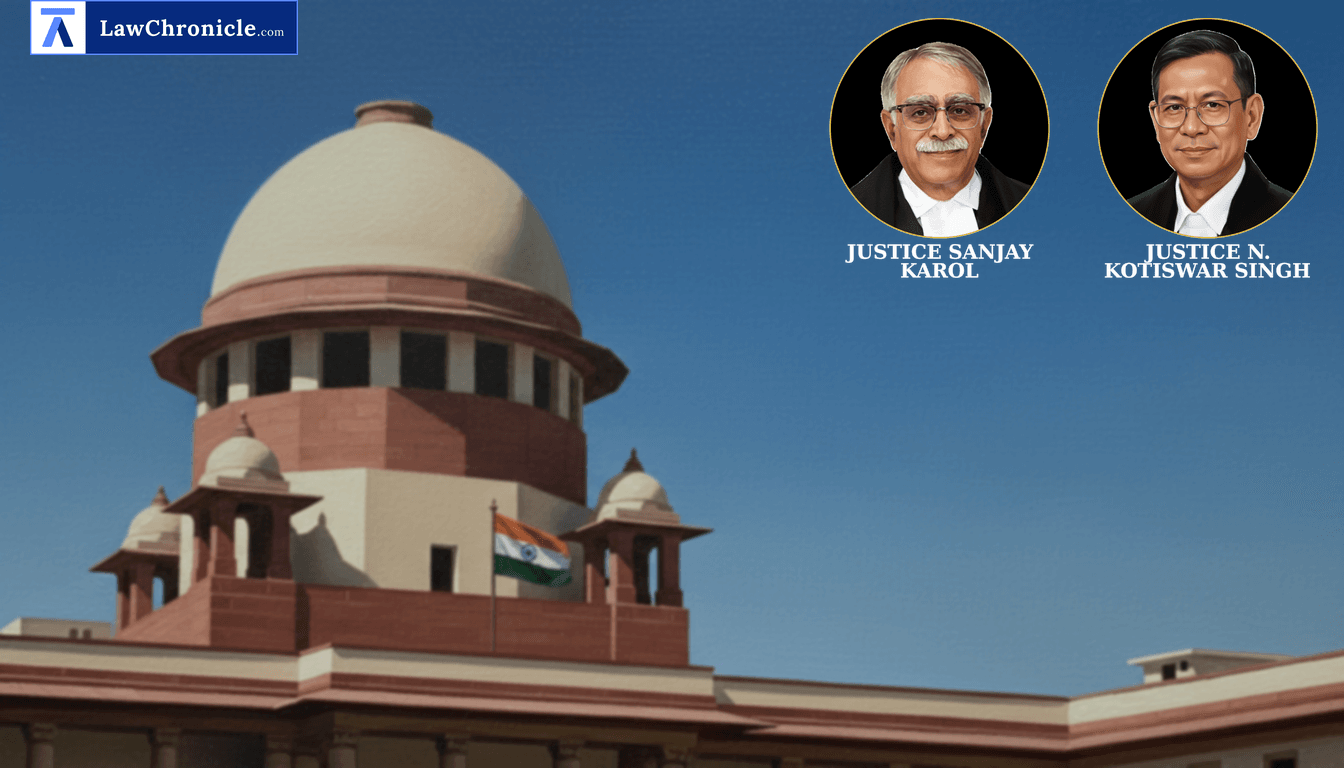
Recalcitrant borrowers who systematically exploit legal processes to stall recovery cannot demand equitable relief when a Financial Corporation exercises its statutory power of sale. The Supreme Court has ruled that a long-crystallized auction sale cannot be unsettled due to minor procedural omissions when the debtor’s conduct is defined by persistent default and bad faith.
A bench comprising Justice Sanjay Karol and Justice Nongmeikapam Kotiswar Singh adjudicated upon the appeals filed by the Bihar State Financial Corporation and the auction purchaser. The Court was tasked with determining whether a civil court could sustain the setting aside of an auction sale conducted under Section 29 of the State Financial Corporations Act, 1951 after the borrowers had failed to regularize their accounts despite multiple opportunities spanning nearly a decade.
The Doctrine of Fairness in Financial Recovery
The Court clarified that while an instrumentality of the State must act reasonably, this obligation does not extend to the point of disabling the recovery of public money. Relying on the principles established in Haryana Financial Corpn. v. Jagdamba Oil Mills and U.P. Financial Corpn. v. Gem Cap (India) (P) Ltd., the Bench observed that the relationship between the Corporation and the borrower is primarily that of a creditor and debtor. The Court noted that public money must be recycled, and dilatory tactics by borrowers defeat public policy.
In its reasoning, the Bench emphasized: "The fairness required of the Corporations cannot be carried to the extent of disabling them from recovering what is due to them... Unless its action is mala fide, even a wrong decision by it is not open to challenge. It is not for the courts or a third party to substitute its decision, however, more prudent, commercial or businesslike it may be, for the decision of the Corporation."
Absence of Valuation Report Not Fatal to Sale
Addressing the High Court's finding that the sale was void due to the absence of a formal valuation report, the Supreme Court held that such an omission does not vitiate the sale in isolation. The Court pointed out that the borrowers had been offered a chance to match the auction terms but failed to do so. Citing Celir LLP v. Sumati Prasad Bafna ( "2024 SCC OnLine SC 3727": 2024 CaseBase(SC) 697), the Court reiterated that once an auction is confirmed and rights have crystallized over decades, they should not be lightly disturbed.
Validity of the Sale and Conduct of Borrowers
The Bench rebuked the borrowers for initiating successive rounds of litigation to obstruct recovery. The Court found that the Financial Corporation had acted within its rights under Section 29 and Section 30 of the State Financial Corporations Act, 1951. While the Bench affirmed that the suit was not barred by Section 69(2) of the Partnership Act, 1932 or the principle of res judicata, it held that the merits of the case favored the appellants.
The Court has the following directions:
"The impugned judgment and order dated 18.03.2025 passed by the High Court of Judicature at Patna in First Appeal No.268 of 1999 and First Appeal No.272 of 1999, as well as the judgment and decree dated 19.05.1999 passed by the Trial Court in Title Suit No.39/1996, are set aside to the aforesaid extent."
Key Takeaways:
Priority of Debt Recovery
State Financial Corporations are not obliged to resurrect every sick unit at the cost of public funds; their primary duty includes the recovery of loans for recycling capital.
Limits of Judicial Review
Courts cannot sit as appellate authorities over commercial decisions of Financial Corporations unless there is a clear statutory violation or established mala fides.
Borrower Conduct as Decisive Factor
Equitable relief is reserved for honest and sincere litigants; borrowers who use litigation as a shield for persistent default lose their claim to fairness.
Stability of Auction Sales
Once an auction sale is confirmed and the purchaser remains in possession for a significant period, the sale cannot be set aside without concrete proof of fraud or collusion.
Ratio Decidendi:
Under the State Financial Corporations Act, 1951, the 'fairness' required of a Financial Corporation is not a one-way street. The power to transfer assets under Section 29 is a commercial right, and procedural irregularities like the absence of a valuation report do not render a sale void if the borrower was given ample opportunities to discharge the debt and match the auction price. Judicial interference is restricted to cases of statutory violation or unreasonableness that results in manifest injustice.
Case Details:
Case No.: CIVIL APPEAL NOS. OF 2026 (Arising out of SLP (C) Nos. 16552-53 of 2025)
NeutralCitation: 2026 INSC 673
Case Title: Bihar State Financial Corporation & Anr. Versus Bhushan Singh & Ors. With Civil Appeal No. Of 2026 (Arising Out Of Slp (C) No. 24073 Of 2025)
Source: 2026 CaseBase(SC) 629
 Breaking News