

Forum Shopping Deprecates Uberimma Fides Required For Bail: Supreme Court
 Copy Link
 Share
Share Save
Save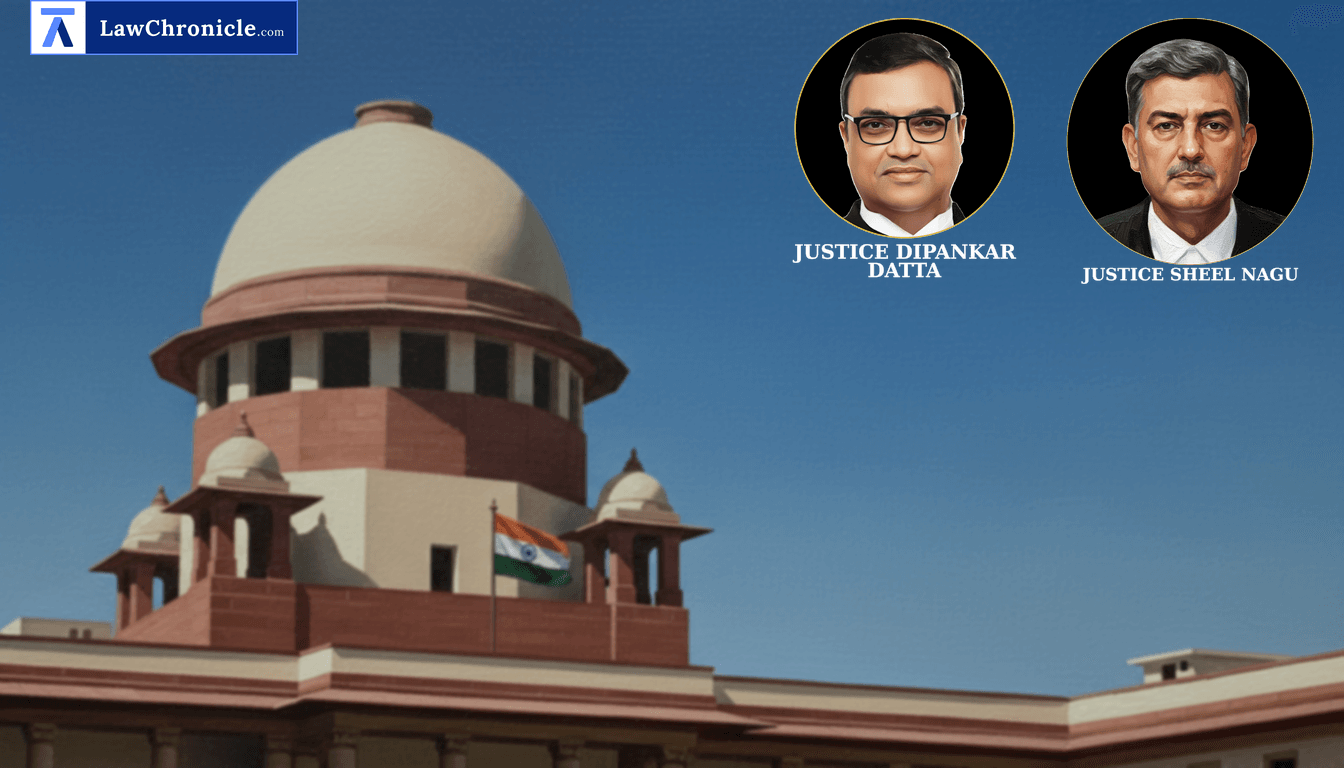
The Supreme Court has ruled that concealment of material facts and forum shopping strike at the very foundation of the equitable and discretionary jurisdiction exercised by courts while granting relief. The Bench emphasized that pursuing parallel remedies for bail across multiple forums without disclosing adverse interim orders severely degrades the integrity of judicial proceedings.
A bench comprising Justice Dipankar Datta and Justice Sheel Nagu heard an appeal filed by the Senior Intelligence Officer of the Directorate General of Service Tax Intelligence challenging a Central Goods and Services Tax Act, 2017 bail order granted to an accused by the High Court of Karnataka during its winter vacation.
Key Takeaways
- Prohibition of Parallel Remedies: Litigants cannot simultaneously pursue multiple bail or release applications across different judicial fora without transparent disclosures.
- Strict Duty of Disclosure: The principle of uberimma fides (utmost good faith) is paramount when invoking equitable jurisdictions like bail; suppression of adverse orders will lead to judicial scrutiny.
- Vacation Bench Listing Guidelines: High Court registries must compute time-bound listing directions by excluding vacation periods unless explicitly ordered otherwise by the Bench.
Forum Shopping in Bail Matters
The Supreme Court highlighted that “Respondent’s conduct in pursuing such parallel remedies, while keeping all judicial authorities in the dark, must be severely deprecated. It may be a right of the accused to challenge his arrest or to approach a court seeking bail; however, such conduct of pursuing remedies parallelly, particularly without adequate disclosure, clearly amounts to abuse of the process of law.” On the issue of listing matters during court vacations, the Supreme Court further observed: "In cases of the present nature, where a Bench of a high court directs listing of a petition 'two weeks hence' and the day following expiry of the period of 'two weeks', in terms of such direction, happens to fall in the midst of a vacation, the period of two weeks should ordinarily be computed by the registry of each such court excluding the period during which the court is on vacation."
The Supreme Court strongly censured the respondent's conduct of suppressing the dismissal of parallel prayers. The Court issued the following directions: "Thus, we set aside that part of the impugned order whereby the criminal petition stood disposed of with the result that the same shall revive on the file of the High Court; and we direct that instead of the bail granted by the Single Judge, the respondent shall continue to remain on interim bail on earlier terms and conditions. Appellant is granted liberty to place all materials on record by filing a counter affidavit within two weeks, peremptorily. Respondent will have a week’s time to file his rejoinder. The Single Judge shall, thereafter, decide the criminal petition on its own merits, preferably by the end of this year. Needless to observe, interim bail granted to the respondent shall be operative till such time further orders are passed by the Single Judge on the criminal petition."
Ratio
Simultaneous pursuit of parallel remedies for bail or release across different judicial forums without full disclosure of material proceedings and adverse orders constitutes an abuse of the court's process. The discretionary and equitable relief of bail requires utmost good faith (uberimma fides), failing which the order of relief is liable to be remitted for fresh consideration.
Background
The dispute arose from a private complaint filed against the respondent alleging offences under Section 16(2)(b) read with Sections 132(1)(b), 132(1)(c), and 132(1)(f) of the Central Goods and Services Tax Act, 2017, punishable under Section 135 thereof, for allegedly generating fake invoices and fraudulently availing input tax credit to the tune of over Rs. 43 Crore. Following his arrest on September 16, 2025, the respondent's bail pleas were successively rejected by the trial court and the Sessions Court.
While his criminal petition for bail was pending before the High Court of Karnataka, the respondent filed another bail application before the Sessions Court as well as a writ petition under Article 226 of the Constitution of India read with Section 483 of the Bharatiya Nagarik Suraksha Sanhita, 2023 challenging his arrest. Although the writ court refused ad-interim release on December 22, 2025, the respondent suppressed this refusal and moved an urgent memo to list his pending High Court bail petition during the winter vacation on December 26, 2025, where bail was granted.
Taking note of the non-disclosure, forum shopping, and expedited listing during vacation without proper notice to the tax authorities, the Supreme Court partially set aside the final disposal order, converted the bail to interim bail, and remitted the matter back to the High Court Single Judge for fresh consideration on merits.
Case Details:
Case No.: Criminal Appeal No. OF 2026 [Arising out of SLP (Crl) No. 7504 of 2026]
Neutral Citation: 2026 INSC 1140
Case Title: Senior Intelligence Officer v. Mohammed Kamran
Appearances:
For the Petitioner(s): Mr. N. Venkataraman, Additional Solicitor General
For the Respondent(s): Mr. S. Nagamuthu, Senior Counsel
Source: 2026 CaseBase(SC) 8278
 Breaking News