Governing Law Clause prevails over mention of Venue to determine Arbitration Seat: SC
 Copy Link
 Share
 Save
The Supreme Court has ruled that High Courts cannot entertain applications under Section 11(6) of the Arbitration and Conciliation Act, 1996 when exclusive jurisdiction over arbitral proceedings is contractually seated elsewhere. The Apex Court emphasized that where an arbitration clause refers to multiple locations, a governing law clause vesting exclusive jurisdiction in a specific court definitively establishes the juridical seat of arbitration.
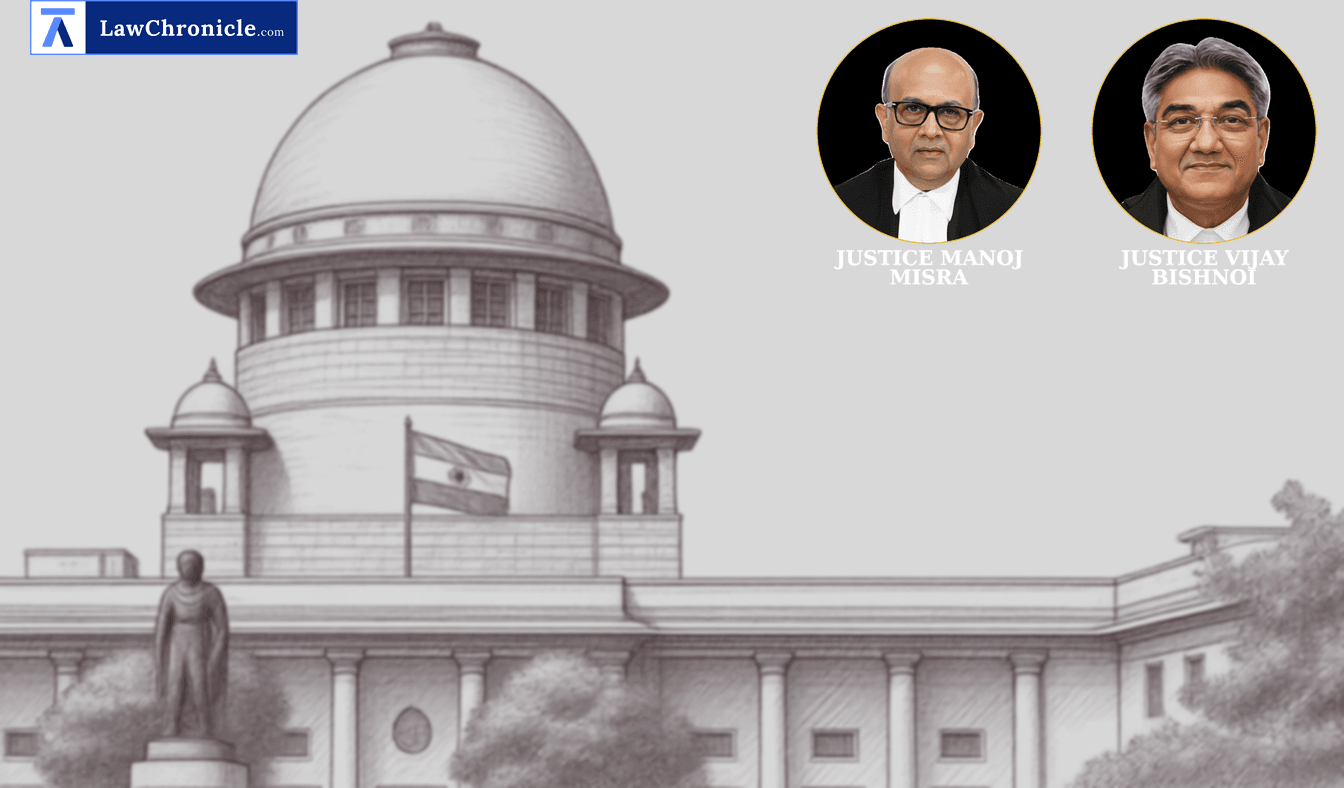
A Bench comprising Justice Manoj Misra and Justice Vijay Bishnoi set aside an order of the Delhi High Court that had appointed a sole arbitrator under Section 11(6) of the Arbitration and Conciliation Act, 1996. The apex court clarified the delicate distinction between a mere 'venue' and the 'juridical seat' when contract clauses display apparent internal conflict.
Key Takeaways
Exclusive Jurisdiction Clauses Control Seat: When an agreement lists conflicting locations for arbitral proceedings, the clause specifying governing law and exclusive court jurisdiction decisively determines the juridical seat.
Harmonious Construction of Contracts: Courts must read dispute resolution clauses in conjunction with general governing law clauses to give full effect to party intent rather than rendering provisions redundant.
Section 11(6) Jurisdiction Curtailed: High Courts lack territorial jurisdiction to appoint arbitrators under Section 11(6) of the Arbitration and Conciliation Act, 1996 if the contractually agreed juridical seat falls outside their territorial limits.
Court's Rationale on Venue Versus Juridical Seat
The Supreme Court analyzed the contractual provisions and applied the established legal framework to resolve the conflict between two locations mentioned within the same arbitration clause. The Court held that specifying a location for holding proceedings does not automatically elevate it to a juridical seat if another place is explicitly vested with exclusive jurisdiction. The Bench observed that “Upon reading the Agreement in its entirety, we find that the juridical seat of arbitration was at Goa, therefore, we are of the view that the Delhi High Court lacked jurisdiction to entertain the application under sub-section (6) of Section 11 of the 1996 Act.”
Ratio
When an arbitration agreement refers to multiple places for conducting arbitral proceedings, the juridical seat of arbitration must be determined by reading the contract in its entirety. If the governing law clause explicitly confers exclusive jurisdiction on the courts of a particular place, that place constitutes the juridical seat, rendering other mentioned locations as mere venues for convenience. Consequently, only the High Court having territorial jurisdiction over the designated juridical seat possesses the statutory authority to entertain applications under Section 11(6) of the Arbitration and Conciliation Act, 1996.
Background
The dispute arose out of a Franchise Agreement dated August 3, 2023. Clause 32.4 of the agreement provided that the location of the arbitration shall be within Delhi, while Clause 32.5 stated that the proceedings will be held in Goa. Additionally, Clause 38 explicitly stipulated that the agreement would be subject to the exclusive jurisdiction of competent courts in Goa.
Following a dispute, the respondent proposed a sole arbitrator, which was rejected by the appellant. The respondent then approached the Delhi High Court under Section 11(6) of the Arbitration and Conciliation Act, 1996. The Delhi High Court appointed an arbitrator and left the venue open to consultation. The appellant challenged this decision before the Supreme Court, arguing that Delhi was merely a venue and Goa was the juridical seat by virtue of Clauses 32.5 and 38.
The appellant placed reliance on precedents including Arif Azim Company Limited v. Micromax Informatics FZE, Indus Mobile Distribution Private Limited v. Datawind Innovations Private Limited and others ( "(2017) 7 SCC 678": 2017 CaseBase(SC) 917), Swastik Gases (P) Ltd. v. Indian Oil Corporation Ltd., BGS SGS SOMA JV v. NHPC LIMITED ( "(2020) 4 SCC 234": 2019 CaseBase(SC) 2108), and Activitas Management Advisor Private Limited v. Mind Plus Healthcare Private Limited to contend that exclusive jurisdiction clauses dictate the seat. Conversely, the respondent relied on Sasan Power Ltd. v. North American Coal Corporation (India) Pvt. Ltd. ( "(2016) 10 SCC 813": 2016 CaseBase(SC) 486), M/s. Cable Corporation of India Ltd. v. M/s. Jay Pee Sports International Ltd. and Another, Sunil Kumar Chandra v. Spire Techpark (P) Ltd., Ramkishorelal and Another v. Kamal Narayan, Shree Bhowani Cotton Mills v. Union Textile Traders, and M/s Lyrus Life Sciences Pvt. Ltd. v. M/s Acme Generics LLP, arguing that the arbitration clause is independent of the main contract and that Clause 32.4 should prevail as it appears first in sequence.
The Supreme Court rejected the respondent's arguments, holding that reading the agreement harmoniously demonstrates that the parties intended Goa to be the juridical seat, with Delhi serving merely as a venue. Finding that the Delhi High Court lacked jurisdiction, the Supreme Court allowed the appeal and set aside the impugned order, granting liberty to the parties to approach the appropriate jurisdictional High Court.
Case Details:
Case No.: Civil Appeal No. OF 2026 (Arising out of SLP Civil No. 35915 of 2025)
Neutral Citation: 2026 INSC 1109
Case Title: Arcis Clean Energy Pvt. Ltd. v. Parshva Innovation
Source: 2026 CaseBase(SC) 8258
 Breaking News