Grounds for Recusal of Judges: A Look at Justice Swarana Kanta Sharma Judgment
 Copy Link
 Share
Share Save
Save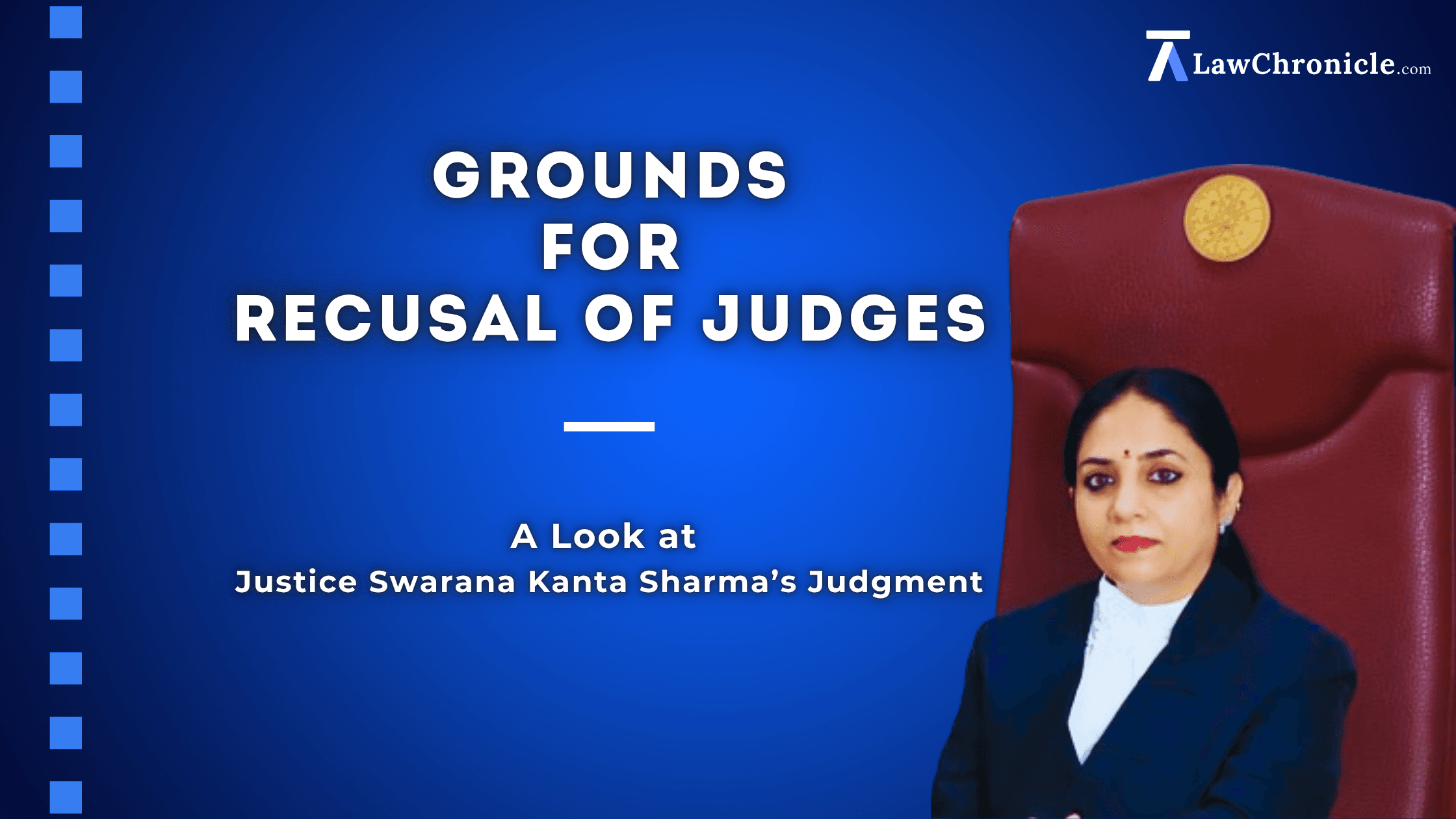
On 20th April, 2026, Justice Swarana Kanta Sharma refused to recuse from CBI Appeal against Arvind Kejriwal and others. She took more than an hour, orally stating why she decided not to step back. Justice Swarana Kanta Sharma’s recusal judgment (2026 CaseBase(DEL) 253) discussed in detail when should a judge recuse himself or herself from a case and the jurisprudence surrounding reasons for recusal of judge. The same has been highlighted in the article below for a better understanding with the help of landmark judgments on grounds for recusal of Judges.
Justice Swarna Kanta Sharma on Recusal of Judge
In her judgment deciding recusal application in CBI’s appeal in Excise Policy case, Justice Swarana Kanta Sharma discussed the questions raised against herself as the Judge, and the institution of Justice. In her words, “The robe that this Court wears is not so light that, on a mere whisper of accusation, it would seek refuge in recusal where no reason for such recusal exists.” She took up all the arguments raised by the recusal applicants, and threw light upon the possibilities based on recusal jurisprudence.
Prima Facie Observations
- While discussing prima facie view portrayed as another reason for apprehension of bias, Justice Swarana Kanta in recusal case opined that if an accused was allowed to “question and castigate the Judge” prima facie views expressed in an order, apprehending an adverse final order, it would mean ignorance of the basic principle that prima facie view is not final. It further expressed that “A litigant cannot seek recusal merely because he apprehends that a Court which had earlier expressed a prima facie view may not agree with the findings of the learned Trial Court.”
- Justice Swarana Kanta Sharma clarified that prima facie views cannot be the basis for recusal of a Judge. As she said, “...an order passed in a petition, on the very first date of hearing, cannot by itself become a ground for seeking recusal of the Court on the premise that such order, merely because it records certain prima facie observations, creates an apprehension of bias in the mind of the opposite party.”
Higher Court Factor
- Justice Swarana Kanta clarified that a party aggrieved by interim order has the option to challenge such orders in higher courts, not to seek recusal of the Judge. If entertained, Justice Sharma cautioned that the Courts would then be flooded with frivolous applications.
- “the fact that a judgment of a High Court is set aside or modified by the Hon‟ble Supreme Court, can never be a ground to seek recusal of the Judge. Judicial decisions are always subject to appellate scrutiny, and correction by a higher court is an integral part of the judicial process.”
Test for Apprehension of Bias
- “The real test of absence of bias is whether, despite personal experiences, professional associations, or past positions, the Judge is able to approach the case with an open mind and decide it fairly. Since there is a strong presumption of judicial impartiality attached to every Judge, it cannot be lightly displaced merely because an argument of apprehension of bias is raised.”
- “The test of apprehension of bias also cannot rest entirely upon the subjective perception of a litigant, who merely fears that the Judge may not grant him relief in view of adverse orders suffered by him in the past, and therefore seeks recusal.... Reasonable apprehension of bias, therefore, cannot be based on imagination or personal perceptions of a litigant who is guided by his own concerns or interests.”
- With reference to recusal case of Virbhadra Singh & Anr. vs Central Bureau of Investigation (2017), Justice Swarana Kanta made it clear that “A judge may know people, may hear allegations, may face doubts, but what matters is whether those doubts are real, reasonable, and grounded in fact. Not every apprehension can become a reason to step aside.”
- “A judicial practice which is accepted without objection when it operates in one’s favour, cannot suddenly become a ground of bias when the same course is adopted in another case by a court of law.”
When Recusal is Unwarranted
Justice Swarana Kanta in Arvind Kejriwal recusal application judgment discussed several facts and circumstances when recusal is baseless. Parts of the judgment have been pointed out below for better understanding:
- “Allegations and insinuations, though persistent and loud, can never take the place of the proof required in law for seeking recusal.”
- “mere unease is wholly insufficient for a Judge to recuse.”
- “Suspicion without substance, and apprehension without foundation, cannot become grounds to seek recusal of a Judge.”
- “If, merely because allegations are made, the judge steps aside, it may create an impression that such allegations have some basis..... The matter must be dealt with in accordance with law, so that there remains no room for any genuine doubt, and the integrity of the process is preserved.”
Legal Basis for Recusal of Judge: Landmark Judgments
Below mentioned are the landmark cases where Supreme Court and High Courts, while passing recusal judgments, illuminated the answer to when a Judge is justified in recusing from a case:
Supreme Court Advocates-on-Record Association v. Union of India (dated 16th October, 2015)
The 5-Judge Bench of Supreme Court laid three crucial pointers to suggest when should a Judge recuse himself/herself from a case. They were as:
- If a Judge has a financial interest in the outcome of a case, he is automatically disqualified from hearing the case;
- In cases where the interest of the Judge in the case is other than financial, then the disqualification is not automatic but an enquiry is required whether the existence of such an interest disqualifies the Judge tested in the light of either on the principle of “real danger” or “reasonable apprehension” of bias;
- The Pinochet case – The Judge is automatically disqualified from hearing a case where the Judge is interested in a cause which is being promoted by one of the parties to the case.
Chandra Kumar Chopra vs Union Of India And Others (2012 CaseBase(SC) 632)
The Supreme Court while discussing the grounds for recusal of Judges reiterated that an apprehension of bias cannot be based on imagination or mere suspicion but in accordance with the prudence of a reasonable person. The Court cautioned that wild, irrelevant, or imaginary allegations made to frustrate proceedings cannot be equated with a reasonable apprehension of bias, and that such a principle cannot be invoked in a vacuum without any substantive foundation.
Trishala v. M.V. Sundar Raj (2010)
In this case, the question pertained to recusal of a Judge who had earlier served as Standing Counsel for the Municipal Corporation. The Supreme Court observed that past professional association, by itself, does not create a ground for recusal unless there is a direct nexus with the lis in question.
Neelam Manmohan Attavar vs Manmohan Attavar (2021 CaseBase(SC) 1275)
In this case, the Supreme Court observed that a previous Court order against the applicant cannot be the ground for recusal application against a Judge. The Court clarified that a litigant cannot be allowed to browbeat the Court by seeking a chosen Bench.
All India Institute Of Medical Sciences vs Prof. Kaushal K. Verma And Ors (2015 CaseBase(DEL) 3966)
Terming it an “unusually prolix order”, the Delhi High Court observed that “requests for recusal are to be based on reasonable apprehensions; they cannot be speculative or fanciful suppositions”. In other words, an interim order cannot become a tool for seeking recusal, nor can a litigant be permitted to choose a Bench merely because a prima facie view expressed by the Court does not suit him, as simplified in Justice Swarana Kanta Sharma’s recusal judgment.
Indore Development Authority (Recusal Matter-5) vs Manohar Lal (2020)
In this case, the Supreme Court expressed stronger observations against question of bias or reasonable apprehension based on a previous judgment. The Court viewed that in such cases, accepting recusal application would “sound a death knell to the independent system of justice delivery”, refusing litigants to dictate participation of preferred judges. The Court firmly clarified that “Recusal is not to be forced by any litigant to choose a Bench. It is for the Judge to decide to recuse”.
Conclusive Reasons for Recusal of Judge
Based on the detailed discussion over recusal applications and law pertaining to when should a Judge recuse himself/herself from a case, the following reasons can be summed up:
- When a real conflict of interest exists or where recusal is genuinely warranted.
- When he/she has a financial interest in the outcome of the case.
- When non-financial interest is in question, "real danger" or "reasonable apprehension" of bias are to be assessed.
- When the Judge has an interest in a cause being promoted by one of the parties (following the Pinochet principle).
In all circumstances, it has been clarified that recusal without hearing the application is not automatically the right course. It has also been settled that the decision to recuse vests solely in the Judge.
 Breaking News