Gujarat HC: Court Rejects Lifting the Corporate Veil to Fasten Tax Liability on Director
 Copy Link
 Share
Share Save
Save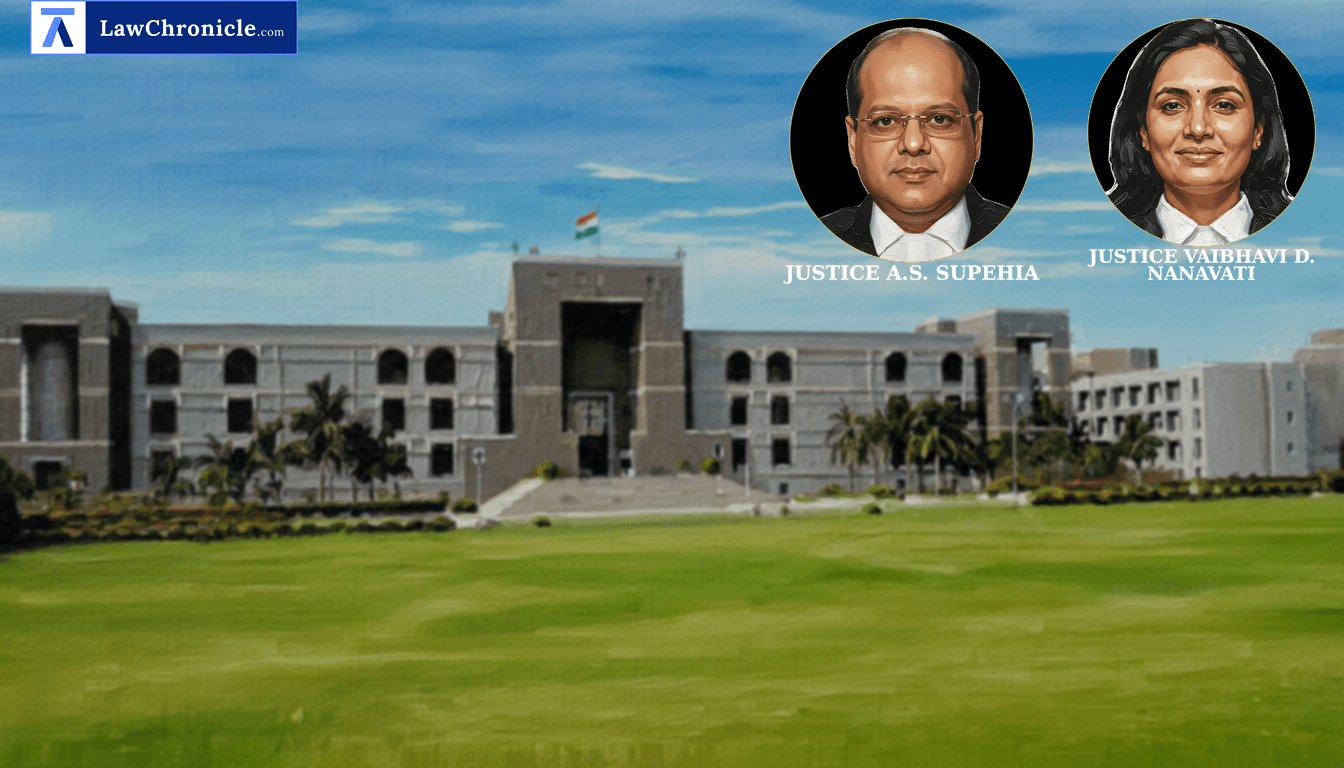
In a decisive check on the Revenue's power to pierce the corporate form, the Gujarat High Court has ruled that a director’s substantial shareholding in an unlisted public company does not automatically transform it into a private entity for fastening vicarious tax liability. The judgment reinforces that Section 179 of the Income Tax Act, 1961 cannot be invoked unless the Revenue proves a direct nexus between the non-recovery of dues and specific acts of gross negligence or misfeasance by the director.
Following a protracted legal battle that included a recall of a previous judgment and a clarification from the Supreme Court, a Division Bench comprising Justice A.S. Supehiya and Justice Vaibhavi D. Nanavati heard the challenge against an order seeking to recover over Rs. 2.40 crore in tax dues from a former director. The case centered on whether the corporate veil could be lifted to treat Hirak Biotech Limited, a registered public limited company, as a private company due to the petitioner holding nearly 98% of its shares for a brief period.
Key Takeaways
Shareholding Does Not Determine Status
Concentration of shares in one director's hands does not legally convert an unlisted public company into a private one under the Companies Act, 1956.
Stringent Burden on Revenue
To invoke Section 179, the Revenue must provide specific findings of gross neglect, misfeasance, or breach of duty directly linked to the non-recovery of tax.
Natural Justice is Sacrosanct
Reliance on third-party statements to allege fraud without allowing the affected director to rebut such evidence vitiates the recovery order.
Temporal Limitation of Liability
A director who resigned years before a tax demand was finalized cannot be held liable if they had no role in the company's subsequent financial management.
Court Rationale on Section 179 and Corporate Status
The Court rejected the Revenue's argument that the company was a "one-man show." The Bench emphasized that a company’s classification as public or private depends on its Memorandum of Association and Articles of Association, not the concentration of its shareholding. The Court observed that while the Revenue relied on Pravinbhai M. Kheni vs. Assistant Commissioner of Income Tax, Central Circle-2&2 ( "(2012) 28 taxmann.com 111 (Gujarat)": 2012 CaseBase(GUJ) 668) to lift the corporate veil, that precedent involved egregious cases where companies were used as conduits for family-owned unaccounted wealth, which was not established in the present case.
The Court has following directions:
"On an overall analysis of the facts, legal precedent and the provisions of Section 179 of the IT Act, we hereby quash and set aside the impugned order dated 31.03.2016 passed by the respondent authority under Section 179 of the IT Act. Accordingly, the writ petition stands allowed."
The Court, in its reasoning, observed: "In our considered opinion, the status of public limited company cannot be doubted and held to be a private limited company by mere holding of substantial numbers of equity shares by a director... A company's classification as public or private depends on its Memorandum of Association (MoA) and Articles of Association (AoA), not the concentration of its shareholding."
Ratio
The authority cannot examine the status of a company based on the definition of a private company under the Companies Act, 1956 by ignoring its registration as a public limited company. For the purpose of Section 179(1) of the Income Tax Act, 1961, the Revenue must establish that non-recovery of tax is attributable to the director's gross negligence, misfeasance, or breach of duty. The mere holding of a majority of shares or a directorship does not satisfy this statutory requirement if the director proves they were not involved in financial management or the siphoning of funds.
Background
The dispute arose after the Income Tax Department determined a liability of Rs. 240.08 lakh against Hirak Biotech Limited for A.Y. 2006-07. The petitioner was a director for a brief five-month period in 2005 and held 98.33% of shares through a firm. The Revenue attempted to recover the company's dues from the petitioner under Section 179 of the Income Tax Act, 1961, alleging that the public company was effectively a private concern and that the petitioner was responsible for its defaults.
The petitioner argued that he resigned in September 2005, long before the assessment was completed in 2008, and was never an authorized signatory or involved in the day-to-day management. He further contended that the Revenue relied on a statement from another director without giving him an opportunity to respond. Relying on Maganbhai Hansrajbhai Patel vs. Assistant Commissioner of Income-tax and Anr., the Court found that the Revenue failed to record any finding that the petitioner had siphoned off funds or that the non-recovery was due to his gross neglect. Consequently, the High Court quashed the recovery order.
Case Details:
Case No.: R/SPECIAL CIVIL APPLICATION NO.6580 of 2016
Neutral Citation: 2026:GUJHC:57301-DB
Case Title: Ajay Surendra Patel Versus Deputy Commissioner Of Income Tax
Appearances:
For the Petitioner(s): MR S N SOPARKAR, SENIOR ADVOCATE WITH MR. JAIMIN R DAVE & MS MANVI A DAMLE
For the Respondent(s): MR DEV D PATEL
Source: 2026 CaseBase(GUJ) 21510
 Breaking News