High Court Cannot Overturn Acquittal Without Finding Perversity: SC
 Copy Link
 Share
Share Save
Save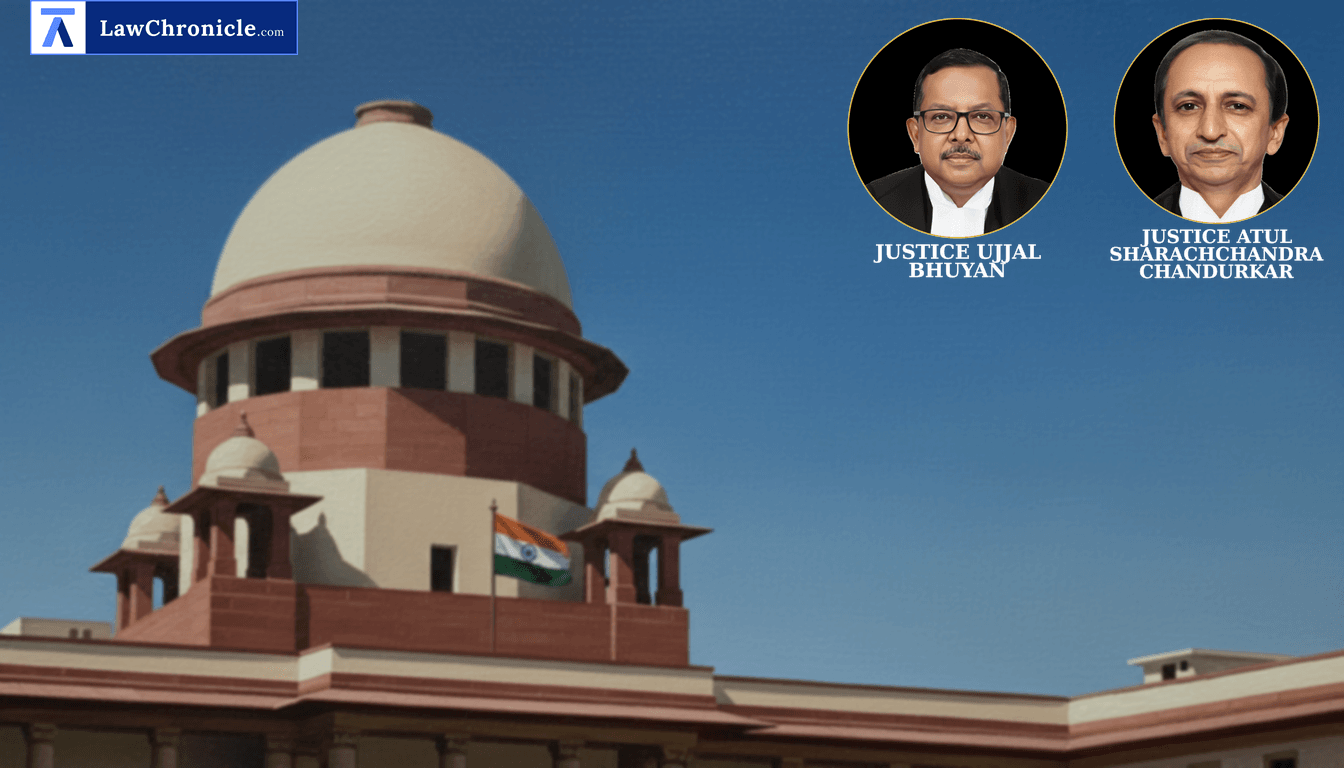
Reaffirming the sanctity of acquittals, the Supreme Court has set aside a High Court judgment that reversed an order of acquittal without recording a definitive finding of perversity or impossibility against the trial court's reasoning.
A bench comprising Justice Ujjal Bhuyan and Justice Atul S. Chandurkar heard the appeal against a judgment of the High Court of Himachal Pradesh, which had overturned the Sessions Court's acquittal of the husband and convicted him for offences under Section 498-A and Section 306 of the Indian Penal Code, 1860.
Key Takeaways
Trial Court Acquittal Holds Presumption of Innocence
An appellate court cannot disturb an acquittal merely because a second view is possible, reinforcing judicial restraint in reversing trial court decisions.
Specific Abetment Mandatory for Section 306 IPC
General allegations of matrimonial discord or harassment do not automatically amount to instigation under Section 107 of the Indian Penal Code, 1860 without intentional act aiding the suicide.
Appellate Court Must Address Trial Court's Reasoning
Reversal of an acquittal requires the High Court to systematically dismantle the trial court's findings and demonstrate perversity based on the record.
Court's Analysis on Acquittal Appeals and Abetment
The Supreme Court observed that the High Court failed to engage with the reasons assigned by the Sessions Court and proceeded on general allegations not supported by evidence on record.
The Court has the following directions:
"The impugned judgment of the High Court dated 17.08.2016 passed in Criminal Appeal No.566 of 2010 is quashed and set aside. The appellant is acquitted of the charges framed against him. He is presently enlarged on bail. His bail bonds stand cancelled."
The Court, in its reasoning, observed: "In our view, it was necessary for the High Court, as an appellate Court, while considering an appeal against acquittal, to record a finding that the Sessions Court had either misread the entire evidence to arrive at a perverse conclusion or that its conclusion could not be supported by the evidence on record. However, no such finding has been recorded in the impugned judgment."
Tracing the principles of appellate intervention, the Court highlighted the classic decision in Sheo Swarup and others and The King-Emperor, which was subsequently approved in Bhubneshwar Mandal and others Vs. The State of Bihar ( "Criminal Appeal No.257 of 1969 decided on 06.12.1972": 1972 CaseBase(SC) 66). It also noted the principles governing appeals against acquittals laid down in State of Uttar Pradesh Vs. Samman Dass ( "1972 INSC 11": 1972 CaseBase(SC) 138). To evaluate the offense of abetment of suicide, the Court relied on the ratio of Madan Mohan Singh Vs. State of Gujarat and another ( "2010 INSC 521": 2010 CaseBase(SC) 960) to hold that specific intention to instigate or aid suicide is mandatory under Section 306 read with Section 107 of the Indian Penal Code, 1860, a threshold not met by the prosecution evidence.
Ratio
An appellate court cannot reverse a trial court's judgment of acquittal without explicitly finding that the trial court's view was perverse, impossible, or unsupported by evidence on record. Furthermore, to sustain a conviction under Section 306 of the Indian Penal Code, 1860, the prosecution must prove specific abetment as defined under Section 107 of the Indian Penal Code, 1860 with the explicit intention of bringing about the suicide.
Background
The prosecution alleged that the appellant married the victim in January 2008. Following marriage, the victim was subjected to harassment and cruelty for dowry by the appellant and his family members. In July 2009, after giving birth to a daughter, the victim allegedly consumed poison at her matrimonial home and subsequently died during treatment. The police filed a charge-sheet against the appellant and his family members under Section 498-A and Section 306 of the Indian Penal Code, 1860.
The Sessions Court, by judgment dated 10.06.2010, acquitted all the accused, noting that allegations were vague, general, and mostly hearsay, with no prior complaints or physical injuries reported. It was also noted that the appellant took prompt steps to secure medical help for the victim. On appeal by the State, the High Court reversed the acquittal of the husband (appellant), convicting him under Sections 498-A and 306 of the Indian Penal Code, 1860, while affirming the acquittal of the co-accused.
Assailing the High Court judgment, the appellant relied on Chandrappa and others Vs. State of Karnataka ( "2007 INSC 142": 2007 CaseBase(SC) 278), Sheo Swarup and others and The King-Emperor, Bhubneshwar Mandal and others Vs. The State of Bihar ( "Criminal Appeal No.257 of 1969 decided on 06.12.1972": 1972 CaseBase(SC) 66), State of Uttar Pradesh Vs. Samman Dass ( "1972 INSC 11": 1972 CaseBase(SC) 138), and Madan Mohan Singh Vs. State of Gujarat and another ( "2010 INSC 521": 2010 CaseBase(SC) 960) to argue that the High Court exceeded its appellate jurisdiction. The Supreme Court agreed with the appellant, finding that the High Court reversed the acquittal in a brief two-paragraph analysis without recording any perversity in the Sessions Court's reasoning. The Supreme Court accordingly allowed the appeal and set aside the conviction.
Case Details:
Case No.: Criminal Appeal No.1108 of 2016
Neutral Citation: 2026 INSC 948
Case Title: Sanjay Kumar v. State of Himachal Pradesh
Appearances:
For the Petitioner(s): Mr. D.N. Goburdhun, Senior Advocate
For the Respondent(s): Mr. Vikrant Narayan Vasudeva, Advocate
Source: 2026 CaseBase(SC) 1810
 Breaking News