High Court's Quashing of Disproportionate-Assets Prosecution Set Aside; Trial Restored and Sanction Validity Left for Trial
 Copy Link
 Share
Share Save
Save
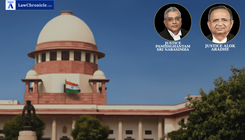
A bench of Justices Pamidighantam Sri Narasimha and Manoj Misra heard an appeal against the Madras High Court’s order quashing criminal proceedings under Section 13(2) read with Section 13(1)(e) of the Prevention of Corruption Act, 1988, arising from allegations of assets disproportionate to known sources of income for the period 01.01.2001 to 31.08.2008.
The Court allowed the State’s appeal, set aside the High Court judgment and restored C.C. No. 30/2013 to the trial court to continue from the stage it was interdicted, while requesting expeditious conclusion of the trial. The Court held that inherent powers under Section 482 Cr.P.C. must be exercised sparingly and that the High Court had impermissibly re-evaluated evidence and “jumped to the probable conclusion of trial.” The Court, in its reasoning, observed: "It is clear that the High Court jumped to the probable conclusion of trial by not appreciating the limited scope of Section 482 Cr.P.C. Instead of determining 'whether or not there is sufficient ground for proceeding against the accused' based on the material, it asked the wrong question as to, 'whether that would warrant a conviction'." The Court also endorsed the Special Court’s view that at the stage of framing charges “the court cannot conduct a mini trial at the stage of framing of charges.”
Background The respondent, a government surveyor who became Assistant Director with the Nagercoil Local Planning Authority, faced an FIR registered on 27.07.2009 and a chargesheet filed on 23.09.2013 alleging acquisition of disproportionate assets worth Rs. 26,88,057/-. The Special Court dismissed the respondent’s discharge application under Section 239 Cr.P.C. after noting that certain valuation adjustments and explanations required fuller inquiry; it held that prima facie materials existed for framing charges and cautioned against conducting a mini-trial at that stage. The respondent’s revision petition before the Madras High Court was dismissed, with liberty to advance contentions at trial.
Subsequently the respondent filed a Section 482 Cr.P.C. petition seeking quashing on largely identical grounds, including challenges to the validity and timing of government sanction for prosecution. The High Court quashed proceedings, expressing suspicion over the sanction’s antecedents and delay, and suggested the sanction might have been “passed without application of mind.” The State contended the perceived date anomaly arose from a typographical error and argued that validity and prejudice arising from sanction should be examined during trial.
The Supreme Court reviewed precedents including Krishnan v. Krishnaveni, Renu Kumari v. Sanjay Kumar, and State by Karnataka Lokayukta v. M.R. Hiremath, reiterated that inherent jurisdiction to quash was limited to rare cases (e.g., absence of legal evidence or a legal bar) and could not substitute trial appreciation of evidence. The Court found no material change in circumstances since dismissal of discharge and revision petitions, held that the High Court had exceeded the established limits of Section 482, and ruled that questions regarding sanction and merits were premature and to be addressed at trial. The appeal was allowed and the trial court was directed to proceed expeditiously.
Case Details: Case No.: CRIMINAL APPEAL NO. 1405/2019 (2025 INSC 397) Case Title: State rep. by the Deputy Superintendent of Police, Vigilance and Anti Corruption, Chennai City-I Department v. G. Easwaran Appearances: For the Petitioner(s): [State Counsel — names not specified in judgment] For the Respondent(s): [Counsel for respondent — names not specified in judgment]
 Breaking News