High Court Supervisory Power Cannot Substitute Statutory Rent Determination: SC
 Copy Link
 Share
Share Save
Save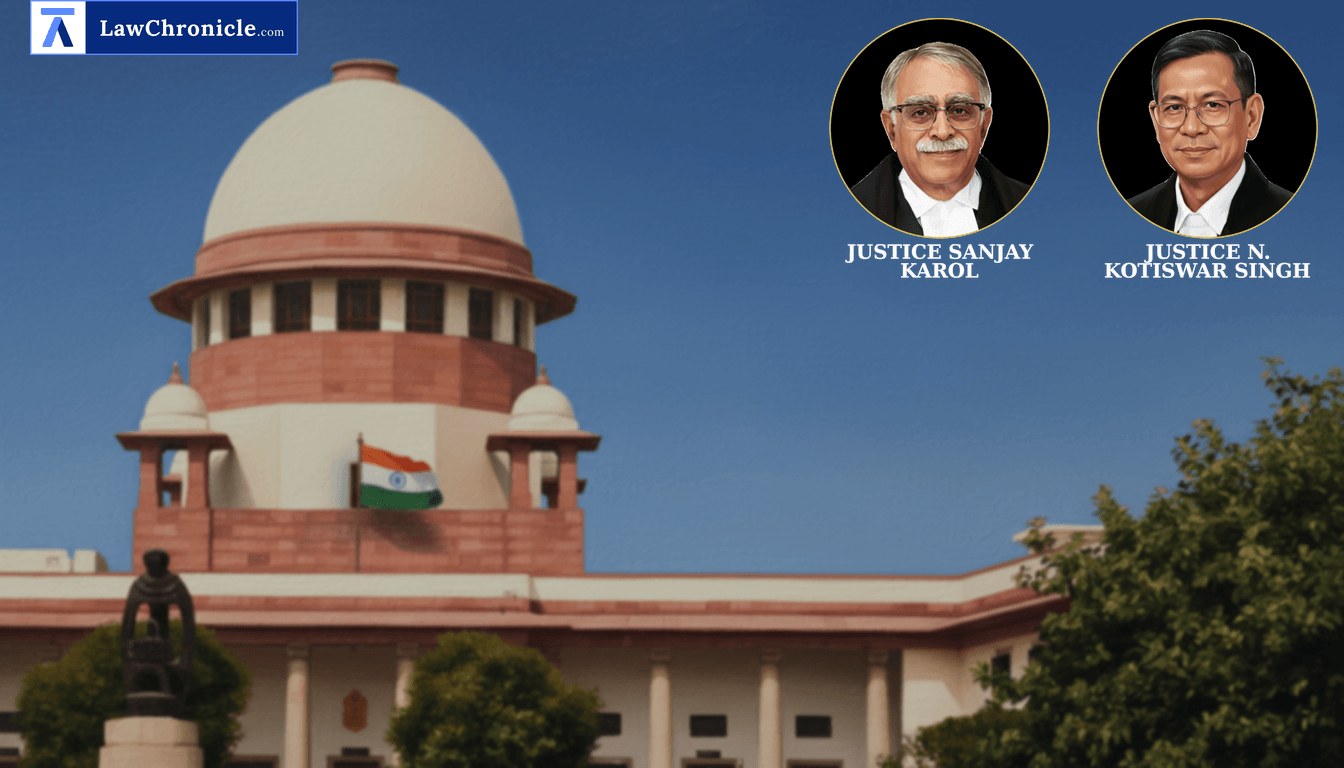
The Supreme Court has clarified that while the High Court possesses supervisory jurisdiction over rent control matters, it cannot unilaterally enhance rent based on mere statements without evidentiary support, especially when special statutes prescribe specific procedures for such determination.
In a significant verdict, a bench of Justice Sanjay Karol and Justice Nongmeikapam Kotiswar Singh deliberated on the scope of judicial interference in rent enhancement proceedings. The Court addressed whether the omission of certain clauses in the Uttar Pradesh Urban Buildings (Regulation of Letting, Rent and Eviction) Act, 1972 affected the operationality of the proviso governing rent enhancement for buildings occupied by government entities.
While upholding the maintainability of rent enhancement applications under the Act, the Supreme Court emphasized that the High Court's power under Article 227 of the Constitution of India must be exercised judiciously and sparingly. The Court observed that the High Court should not substitute its own decision for that of the specialized Rent Control Authority, particularly in the absence of conclusive material on record.
The Court, in its reasoning, observed: "...the deletion of clauses (ii) and (iv) does not impact the operationality of the proviso. We are of this firm view for the reason that if the contention of the appellant-State is accepted in so far as the interpretation of the clause is concerned it would amount to virtually making the tenant into the landlord. No bonafide requirement; no enhancement of rent: means no way for the landlord to reclaim his own property either physically or financially."
Directives Issued to Rent Control Authorities
The Court has the following directions:
"...while we do remand the matter to the above said Authority to decide the question of rent payable by the appellant-tenants afresh as also the particulars as pointed out by the Appellate Authority in its order dated 28th March 2016, we direct that the same shall be decided within four months from the date of this order. The order once made, shall be applicable from the date of the institution of the original application in the year 2008."
Background:
The dispute originated when the respondent-landlords let out a building in Bahraich to the Trade Tax Department of Uttar Pradesh in 1966. In 2008, the landlords sought an enhancement of rent under Section 21(8) of the Uttar Pradesh Urban Buildings (Regulation of Letting, Rent and Eviction) Act, 1972. The Rent Control Officer initially fixed the rent at Rs.14,400/- per month (at Rs.4 per sq.ft.). This was challenged before the Additional District Judge, who remanded the matter for fresh consideration regarding the intervals and commencement date of the enhancement.
The landlords then moved the High Court, which modified the order to enhance the rent to Rs.14 per sq.ft. based on the landlords' claim that an adjacent premise was rented at that rate. The State of U.P. challenged this, arguing that the High Court exceeded its jurisdiction under Article 227.
The Supreme Court analyzed several precedents including Ouseph Mathai v. M. Abdul Khadir ( "(2002) 1 SCC 319": 2001 CaseBase(SC) 1319), State v. Navjot Sandhu, Surya Dev Rai v. Ram Chander Rai ( "(2003) 6 SCC 675": 2003 CaseBase(SC) 1214), Waryam Singh v. Amarnath ( "AIR 1954 SC 215": 1954 CaseBase(SC) 145), L. Chandra Kumar v. Union of India, Laxmikant Revchand Bhojwani v. Pratapsing Mohansingh Pardeshi, Koyilerian Janaki v. Rent Controller (Munsiff), and Shalini Shyam Shetty to define the limits of supervisory power. It noted that while Article 227 is part of the basic structure as held in L. Chandra Kumar v. Union of India, it is not an appellate power. The Court found that the High Court had modified the rent without sufficient material on record. Consequently, the Apex Court set aside the High Court's order and remanded the matter to the Rent Control Officer, Bahraich, for a time-bound fresh determination.
Case Details:
Case No.: Civil Appeal Nos. of 2026 (@ SLP (Civil) Nos. 38495-38496 of 2025)
NeutralCitation: 2026 INSC 601
Case Title: State of U.P. & Ors. v. Raghvendra Nath Srivastava & Ors.
Source: 2026 CaseBase(SC) 514
 Breaking News