


High Court's Section 482 CrPC Inherent Powers Extend to Recalling Orders to Protect Juveniles: SC
 Copy Link
 Share
 Save
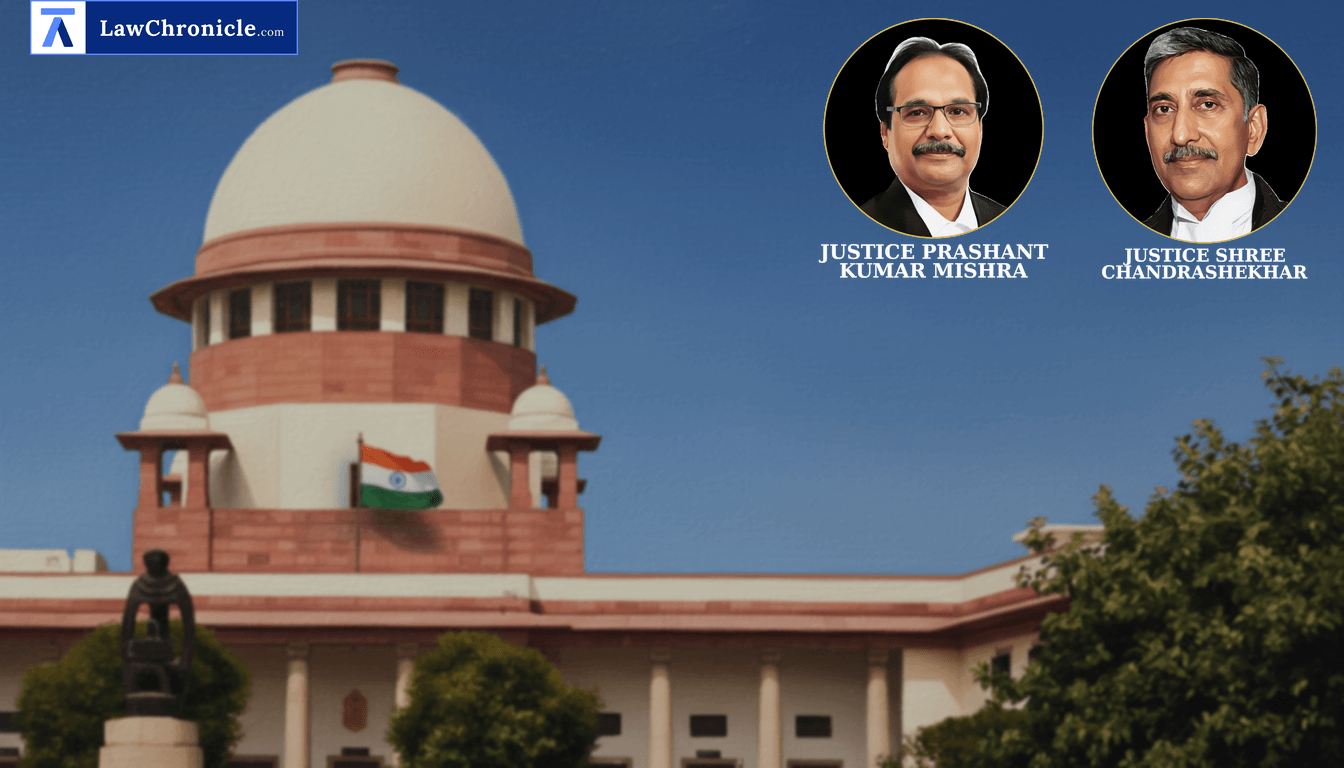
The Supreme Court has held that procedural restrictions and the principle of finality cannot override statutory child protection benefits, ruling that High Courts possess inherent jurisdiction under Section 482 of Code of Criminal Procedure, 1973 to recall orders and rectify jurisdictional errors to prevent miscarriages of justice. The decision mandates that technical procedural lapses cannot be used by the State machinery to deprive an individual of the protective umbrella guaranteed to juveniles under statutory law.
A Bench comprising Justice Prashant Kumar Mishra and Justice Shree Chandrashekhar delivered the verdict while setting aside the conviction and sentence of an individual who was a juvenile at the time of the alleged offense. The Court addressed the core issue of whether a High Court can exercise its inherent powers to re-examine a plea of juvenility after a Special Leave Petition challenging the conviction has been dismissed as withdrawn by the Apex Court.
Key Takeaways
- Inherent Jurisdiction Trumps Finality: High Courts retain inherent powers under Section 482 of Code of Criminal Procedure, 1973 to procedural review and recall orders to remedy grave prejudice and jurisdictional errors.
- Non-Waiver of Juvenility Rights: A claim of juvenility can be raised at any stage of proceedings, even after the final disposal of the case, and cannot be barred by procedural delays or technicalities.
- Strict Proof for Section 201 IPC: Conviction for causing disappearance of evidence under Section 201 Part II of Indian Penal Code, 1860 cannot stand in the absence of proof of the underlying primary offense.
- State's Parens Patriae Duty: Judicial and investigative authorities are obligated to give full, retrospective effect to child welfare statutes to prevent the stigmatization of minors.
Courts Rationale and Legal Reasoning
The Apex Court critically evaluated the scope of judicial review under Section 482 alongside the bar created by Section 362 of Code of Criminal Procedure, 1973. The Court observed that the bar under Section 362 does not impede the inherent power of a High Court to recall an order passed without jurisdiction or under a misconception of law.
The Court, in its reasoning, observed: "The provisions under section 362 cannot be considered in a rigid or overtechnical manner to defeat the ends of justice. The bar of section 362 of the Code of Criminal Procedure shall not operate in cases where the order or judgment under consideration was without jurisdiction and inherent power of the High Court can be exercised to recall such orders... The power of procedural review which is inherent in the High Court is not affected by section 362 of the Code of Criminal Procedure, and the High Court can set aside a palpably erroneous order which was passed under some misconception of law."
On the substantive conviction under Section 201 Part II of Indian Penal Code, 1860 following an acquittal from charges of murder and dowry death, the Court noted: "His conviction under section 201 Part II can be recorded only upon a finding that a crime was committed and he was knowing or having reason to believe that such an offence was committed, and with the intent to screen the offender from legal punishment, caused the evidence thereof to disappear... Therefore, the conviction of the appellant under section 201 Part II of the Indian Penal Code must be held illegal."
The Court has the following directions:
"The conviction of the appellant under section 201 Part II of the Indian Penal Code having been found illegal, cannot be sustained and is, accordingly, set aside. Consequently, the judgment of conviction and of sentence both dated 21st December 2005 in Sessions Case No. 129 of 2005 passed against the appellant by 2nd Additional Sessions Judge, Morena are set aside. The appellant, who is on bail, stands discharged from the liability of bail bonds furnished by him."
Ratio
The inherent power of the High Court under Section 482 of Code of Criminal Procedure, 1973 is not constrained by Section 362 when invoked to perform a procedural review or recall a judgment resulting from a fundamental jurisdictional error. Furthermore, beneficial statutory protection under juvenile justice legislations takes precedence over procedural finality, allowing juvenility claims to be entertained at any stage to secure the ends of justice.
Background
The dispute stemmed from an incident in September 2004 involving allegations of dowry death, murder, and destruction of evidence under Sections 302, 304B, and 201 read with Section 34 of Indian Penal Code, 1860. While the trial court acquitted the accused of the charges of murder and dowry death due to hostile prosecution witnesses, it convicted the appellant under Section 201 Part II of Indian Penal Code, 1860 and sentenced him to three years of rigorous imprisonment.
The High Court affirmed the conviction, and the subsequent Special Leave Petition filed before the Supreme Court was dismissed as withdrawn. Thereafter, the appellant filed a petition under Section 482 of Code of Criminal Procedure, 1973 before the High Court seeking recall of the appellate order, raising the plea of juvenility. Pursuant to an inquiry ordered by the High Court, the Juvenile Justice Board determined that the appellant was aged 17 years, 2 months, and 12 days at the time of the incident.
Despite the JJ Board's conclusive report, the High Court dismissed the Section 482 application on the premise that the judgment of conviction had attained finality up to the Supreme Court and could not be reopened under inherent powers. Reversing this approach, the Supreme Court highlighted a series of precedents including Abuzar Hossain Alias Gulam Hossain Vs. State of West Bengal ( "(2012) 10 SCC 489": 2012 CaseBase(SC) 400), State of Madhya Pradesh Vs. Ramji Lal and Anr., Mahant Ram Saroop Dasji v. S.P. Sahi & Ors., Sheela Barse (II) & Ors. v. Union of India & Ors., Umesh Chandra v. State of Rajasthan ( "(1982) 2 SCC 202": 1982 CaseBase(SC) 19), Gopinath Ghosh v. State of West Bengal, Bhoop Ram v. State of U.P., Pradeep Kumar v. State of UP, Bhola Bhagat v. State of Bihar, Vaneet Kumar Gupta v. State of Punjab, Hari Ram v. State of Rajasthan & Anr. ( "(2009) 13 SCC 211": 2009 CaseBase(SC) 301), Ashwani Kumar Saxena v. State of Madhya Pradesh ( "(2012) 9 SCC 750": 2012 CaseBase(SC) 834), and Karan alias Fatiya v. State of Madhya Pradesh to emphasize that age determination relates to the date of commission of the offense and that delay in raising the claim is not fatal.
The Apex Court also examined principles laid down in Sankatha Singh & Ors. v. State of U.P. ( "AIR 1962 SC 1208": 1962 CaseBase(SC) 218), Hari Singh Mann v. Harbhajan Singh Bajwa & Ors. ( "(2001) 1 SCC 169": 2000 CaseBase(SC) 478), State of Karnataka v. M. Devendrappa & Anr. ( "(2002) 3 SCC 89": 2002 CaseBase(SC) 1149), P. Ramachandra Rao v. State of Karnataka ( "(2002) 4 SCC 578": 2002 CaseBase(SC) 116), Talab Haji Hussain v. Madhukar Purshottam Mondkar & Other ( "AIR 1958 SC 376": 1958 CaseBase(SC) 81), Superintendent and Remembrancer of Legal Affairs, West Bengal v. Mohan Singh & Ors. ( "(1975) 3 SCC 706": 1974 CaseBase(SC) 249), Asit Kumar Kar v. State of West Bengal & Ors. ( "(2009) 2 SCC 703": 2009 CaseBase(SC) 684), State of Punjab v. Davinder Pal Singh Bhullar & Ors., Ganesh Patel v. Umakant Rajoria, and A.R. Antulay v. R.S. Nayak & Anr. ( "(1988) 2 SCC 602": 1986 CaseBase(SC) 455) regarding procedural limitations under Section 362 of Code of Criminal Procedure, 1973, affirming that recalling an order passed under a misconception of law does not amount to a substantive review. Relying on Suleman Rehiman Mulani & Anr. v. State of Maharashtra ( "(1967) SCC OnLine SC 337": 1967 CaseBase(SC) 62) and Kedar Nath & Ors. v. State of M.P., the Court reiterated that Section 201 of Indian Penal Code, 1860 cannot be sustained without established proof of an underlying crime. Applying constitutional protections under the Constitution of India, 1950, the Court allowed the appeal and set aside the conviction.
Case Details:
Case No.: Criminal Appeal No. OF 2026 (Arising out of Special Leave Petition (Criminal) No. 5654 of 2026)
Neutral Citation: 2026 INSC 942
Case Title: Mahavir @ Avnish v. The State of Madhya Pradesh
Source: 2026 CaseBase(SC) 915
Similar Articles



 Breaking News


